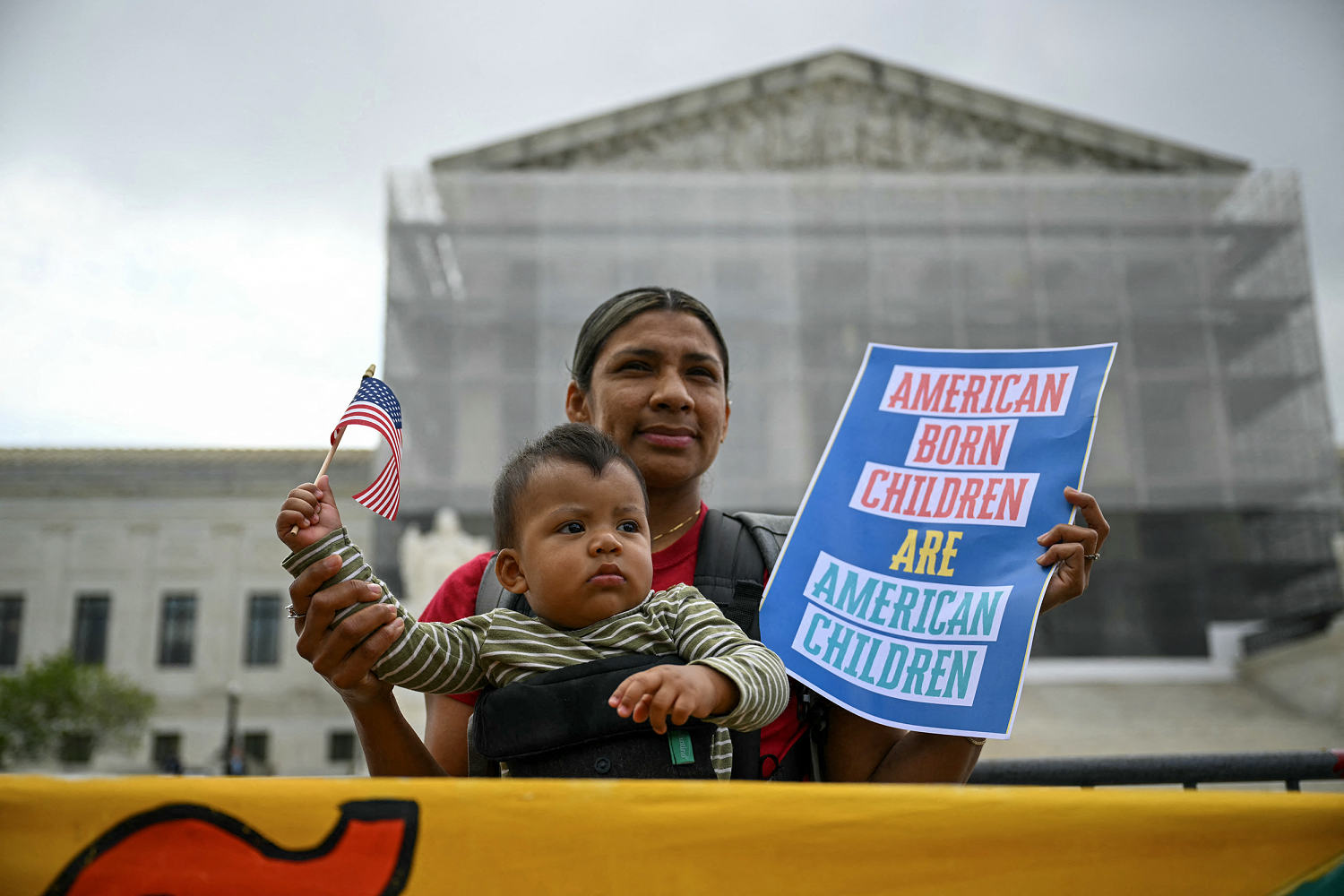
Today, the United States finds itself stretched between two radically different visions of the future. At the Supreme Court, the Department of Justice is arguing for a fundamental reinterpretation of the 14th Amendment that could effectively end birthright citizenship as we have known it since 1898. At the same time, 900 miles south in Florida, four astronauts are strapped into a capsule atop the most powerful rocket ever built, waiting to break a fifty-year terrestrial tether.
One event seeks to narrow the definition of who belongs to this country; the other aims to expand the reach of the entire species. The juxtaposition is jarring, but it is the reality of an April day in 2026 where the stakes for American identity and American capability have never been higher. You might also find this connected coverage useful: The $2 Billion Pause and the High Stakes of Silence.
The Assault on the 14th Amendment
The oral arguments in Barbara v. Trump began this morning with a level of tension rarely seen even in the highest court. The case centers on an executive order signed in early 2025 that directed federal agencies to deny Social Security numbers and passports to children born on U.S. soil if neither parent is a citizen or a lawful permanent resident.
For over a century, the legal bedrock has been United States v. Wong Kim Ark. That 1898 ruling established that the "jurisdiction" mentioned in the 14th Amendment refers to being physically present and subject to U.S. laws, not to the political status of one’s parents. The administration’s legal team is now attempting to flip that logic. They argue that "subject to the jurisdiction thereof" requires a "full and complete allegiance" that undocumented immigrants or temporary visitors cannot legally provide. As extensively documented in latest articles by The Washington Post, the results are significant.
If the Court sides with the administration, the impact will be immediate and seismic. We are not just talking about future births. The logistical nightmare of suddenly having a tiered class of residents—people born here but legally stateless—would overwhelm state and local systems. It would create a permanent underclass, a concept the 14th Amendment was specifically designed to dismantle after the Civil War.
The conservative majority on the bench appeared divided during the first hour of questioning. Chief Justice Roberts focused heavily on stare decisis, questioning why a century of settled law should be upended by executive fiat. On the other hand, several associate justices seemed interested in the administration’s argument that the 1898 Court misread the "jurisdiction" clause.
The case will not be decided today, but the questions asked this morning suggest a 6-3 or 5-4 split. This would be one of the most consequential decisions in American history, affecting millions of people and the core identity of the nation. It is a legal siege, plain and simple.
The Long Shot at the Moon
While the legal battle in Washington feels like a collision with the past, the scene at Kennedy Space Center in Florida is entirely about the future. After years of delays and budget overruns, NASA is finally on the clock to launch Artemis II, the first crewed mission to the Moon since 1972.
The four astronauts—Reid Wiseman, Victor Glover, Christina Koch, and Jeremy Hansen—are already in the Orion capsule. At the top of the Space Launch System (SLS) rocket, they are waiting for a window that opens at 6:24 p.m. EDT. This is not a landing mission. It is a ten-day loop around the Moon to test life-support systems and navigation before Artemis III attempts a lunar landing in late 2028.
The stakes for NASA are immense. If this mission fails, or if a significant anomaly occurs during the lunar flyby, the entire Artemis program—and the dream of a permanent lunar gateway—is effectively dead. The political will to fund a multibillion-dollar space program is already thin, especially with the current administration's focus on terrestrial border enforcement and national identity.
The SLS is a massive machine. It burns six million pounds of propellant in less than ten minutes. It is also an expensive and aging architecture that many critics argue is already obsolete in the age of SpaceX’s Starship. But for today, it is the only vehicle capable of sending humans beyond low Earth orbit.
The weather forecast currently sits at an 80% chance of favorable conditions. The primary concern is cloud cover and high winds at altitude. If the launch is scrubbed today, the next window opens tomorrow, but the propellant loading sequence is so complex and stressful on the hardware that a second attempt would be far more risky.
The Contrast of American Ambition
We are witnessing a strange duality in the American experiment. On one hand, there is a legal effort to restrict the definition of who belongs to the nation, based on a narrow and historically questionable reading of the Constitution. On the other, there is a technological push to send a diverse crew—including the first woman and the first person of color—beyond the cradle of Earth.
The crew of Artemis II represents a vision of America that is expansive and inclusive. The legal battle in the Supreme Court represents a vision that is restrictive and rooted in a specific, nationalist interpretation of the law. It is a collision of two very different ideas about what it means to be an American in 2026.
The Real Reason Artemis II Matters
This mission is not just about a lunar flyby. It is about whether NASA can still do the "hard things" that John F. Kennedy once challenged the nation to achieve. The agency has spent billions of dollars and decades of development on a rocket that some call a "Senate Launch System" because it was designed more for job creation in key states than for efficient space travel.
Yet, despite the politics, the technical achievement is undeniable. The Orion spacecraft is designed to survive a 25,000-mile-per-hour reentry into Earth's atmosphere, enduring temperatures that would melt almost any other material. It is a feat of engineering that requires a level of precision and risk-taking that is increasingly rare in American public life.
The success of Artemis II would provide a much-needed win for a nation currently mired in a bitter and divisive legal battle. It would be a reminder of what Americans can achieve when they look outward rather than inward. But it is a thin hope, and it is currently sitting on a tower of explosive chemicals in the Florida heat.
The Jurisdictional Fault Line
Back in Washington, the Supreme Court arguments are wrapping up. The legal director for the ACLU, Cecillia Wang, made a powerful closing argument, reminding the justices that the 14th Amendment was a direct response to the Dred Scott decision. It was meant to ensure that the circumstances of one's birth would never again be used to create a second-class citizenship in America.
The administration's rebuttal was cold and clinical. They argued that the "jurisdiction" clause is a matter of sovereignty and that no nation can be forced to grant citizenship to those who are not legally present within its borders. This is the central conflict: Is birthright citizenship an unalienable right, or is it a privilege that can be rescinded by a change in executive policy?
The decision, when it comes later this summer, will define the legal landscape for generations. If the Court rules in favor of the executive order, it will trigger a series of legal and social tremors that will be felt in every city and town in America. It will be the end of an era of American exceptionalism that was built on the idea that anyone born here is, by definition, one of us.
The countdown in Florida is entering its final hours. The astronauts are quiet, focusing on the thousands of tasks they need to perform in the coming days. The rocket is venting oxygen, a white plume of vapor against the blue Atlantic sky. It is a magnificent sight, but it is also a fragile one.
As the sun sets over the Kennedy Space Center and the Supreme Court justices return to their chambers to begin their deliberations, the country remains at a crossroads. We are a nation that can touch the Moon, yet we are still struggling to decide who among us is legally a person.
The rocket will either launch or it won't. The Court will either uphold the 14th Amendment or it won't. But the fact that we are even asking these questions at the same time is a testament to the strange, fractured moment in which we live.
There is no middle ground here. Either we are a nation of laws that protect everyone born within our borders, or we are a nation that uses the law to exclude. Either we are a nation that looks to the stars, or we are a nation that is increasingly focused on the ground beneath our feet.
The next few hours will tell us a lot about the future of American technology. The next few months will tell us even more about the future of the American soul.