The United States is currently staring down the barrel of a logistical nightmare in the Strait of Hormuz that no amount of carrier strike groups can fully resolve. While conventional wisdom suggests that a massive naval presence ensures the free flow of oil, the reality on the water has shifted toward a high-frequency, low-cost model of disruption that the Pentagon is ill-equipped to fight. We are witnessing the end of the era where raw tonnage equals control. If the Strait closes, or even if insurance premiums make transit functionally impossible, the American strategic pivot to the Pacific will be dead on arrival as the global economy suffers a massive cardiac arrest.
The math of modern naval warfare has turned toxic for the defender. Learn more on a similar subject: this related article.
The Asymmetric Math of Modern Blockades
For decades, the deterrent in the Persian Gulf was the sheer weight of the U.S. Fifth Fleet. If you harassed a tanker, you faced a billion-dollar destroyer. But in the current environment, the cost-to-kill ratio has flipped entirely. A drone that costs less than a used sedan can now disable a vessel carrying $100 million in crude oil.
This isn't just about explosive payloads. It is about the psychology of the shipping industry. The Strait of Hormuz is roughly 21 miles wide at its narrowest point, but the shipping lanes themselves are only two miles wide in each direction. This tight geography creates a "kill zone" where high-speed swarm boats and shore-based missiles can saturate defenses. When a single drone strike can spike global Brent Crude prices by 5% in a morning, the aggressor doesn't need to sink a ship to win. They only need to make the risk too high for Lloyd’s of London to underwrite the voyage. Further analysis by The Guardian explores similar views on this issue.
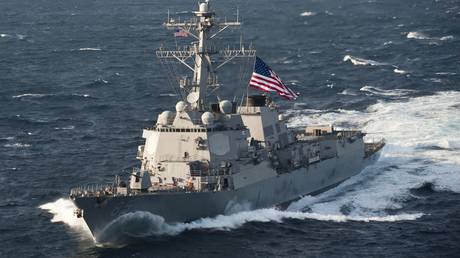
Washington’s reliance on the $13 billion Ford-class carrier as a solution to this problem is a classic case of bringing a broadsword to a knife fight. These massive platforms are engineering marvels, but they are increasingly vulnerable to the very "area denial" tactics that Iran and its proxies have spent forty years perfecting. If a carrier stays outside the Gulf to remain safe, its strike range is diminished. If it enters the Gulf, it operates in a bathtub where the enemy knows every coordinate.
The Illusion of Energy Independence
A common retort among domestic policy hawks is that the United States is now a net exporter of oil, rendering the Hormuz chokepoint a "European or Chinese problem." This is a dangerous misunderstanding of how global commodity markets function.
Oil is a fungible global commodity. Even if not a single drop of Middle Eastern crude reached American shores, a total blockage of the Strait—which handles about 20% of the world's daily oil consumption—would trigger an immediate, violent price surge at every gas station in the Midwest. The domestic political fallout would be instantaneous.
Furthermore, the "independence" argument ignores the flow of Liquefied Natural Gas (LNG). Qatar, which shares the world’s largest gas field with Iran, moves nearly all its exports through that 21-mile gap. In a world trying to transition away from coal, a permanent disruption of Gulf LNG would send the global manufacturing sector into a depression. We are not just talking about higher prices; we are talking about the physical absence of the energy required to run industrial grids in Japan, South Korea, and Western Europe.
The Electronic Warfare Blind Spot
The next conflict in the Strait won't just be fought with kinetic missiles. It will be fought in the electromagnetic spectrum. We have already seen "spoofing" incidents where tankers find their GPS coordinates showing them in Iranian territorial waters when they are actually in international lanes.
The U.S. Navy’s heavy reliance on networked systems is its greatest strength, but in a confined space like the Gulf, it becomes a massive surface area for electronic attack. If an adversary can successfully jam or spoof the sensors of an automated tanker or a guided-missile destroyer, the risk of a "gray zone" accident—one that provides a pretext for full-scale escalation—skyrockets.
The Pentagon has spent years focusing on "over-the-horizon" capabilities, but the Strait of Hormuz is an "in-your-face" problem. The density of commercial traffic makes it nearly impossible to distinguish between a legitimate fishing vessel and a scout boat for a missile battery until it is too late.
The Fragility of the Tanker Fleet
The global tanker fleet is not a government entity; it is a collection of private corporations motivated by profit and risk mitigation. These ships are not armored. They are essentially giant, floating gas cans with minimal crews.
During the "Tanker War" of the 1980s, the U.S. began re-flagging Kuwaiti tankers to provide them with military escorts. This "Operation Earnest Will" is often cited as a success. However, the weaponry available today—specifically sub-surface unmanned vehicles and precision-guided anti-ship cruise missiles—makes the 1980s look like the age of the musket.
- Sub-Surface Threats: Stealthy, autonomous mines can be deployed by small, non-military boats, making detection a needle-in-a-haystack scenario.
- Swarm Tactics: Using dozens of small, fast boats to overwhelm the targeting computers of a modern warship.
- Land-Based Batteries: Mobile missile launchers hidden in the rugged coastline of the Zagros Mountains, capable of "shoot and scoot" tactics that negate air superiority.
The Geopolitical Pivot Point
While the U.S. remains the primary guarantor of security in the region, its influence is fraying. China, the largest buyer of Gulf oil, has managed to maintain a neutral, brokering position. This creates a scenario where the U.S. bears all the financial and military costs of keeping the Strait open, while China reaps the economic benefits without the political baggage.
If the U.S. is forced into a kinetic conflict to clear the Strait, it would require a massive redirection of assets currently earmarked for the Indo-Pacific. This is the "strategic disaster" mentioned in hushed tones at the War College. A prolonged conflict in the Middle East is the best-case scenario for any power looking to alter the status quo in the South China Sea.
We are currently operating on the assumption that "freedom of navigation" is a self-evident truth that the world will always support. But as the U.S. domestic appetite for "forever wars" vanishes, the willingness to spend blood and treasure to protect shipping lanes for competitors like China is at an all-time low.
Infrastructure as a Weapon
The alternative routes—pipelines across Saudi Arabia or the UAE—are nowhere near capable of handling the volume that passes through the Strait. They are also static targets. In a real-world escalation, these pipelines would be the first things to go.
The reality is that there is no "Plan B" for the Strait of Hormuz. We have built a global civilization that relies on a single, narrow gate. The U.S. military is currently configured to win a war that involves clearing that gate, but it is not configured to provide the perpetual, low-cost security required to keep shipping rates stable in the face of constant, low-level harassment.
The U.S. needs to move away from the "Carrier-First" mentality and invest heavily in autonomous patrol fleets and advanced mine-countermeasures that don't require risking a 5,000-person crew for every minor provocation. Until the cost of defense is lower than the cost of offense, the U.S. is simply subsidizing its own eventual exhaustion.
The next time a drone hits a tanker in the Gulf, don't look at the fire on the deck. Look at the price of insurance in London and the deployment schedules in the Pacific. That is where the real war is being lost.
Stop treating the Strait of Hormuz as a localized naval problem and start treating it as a systemic vulnerability in the American ledger.