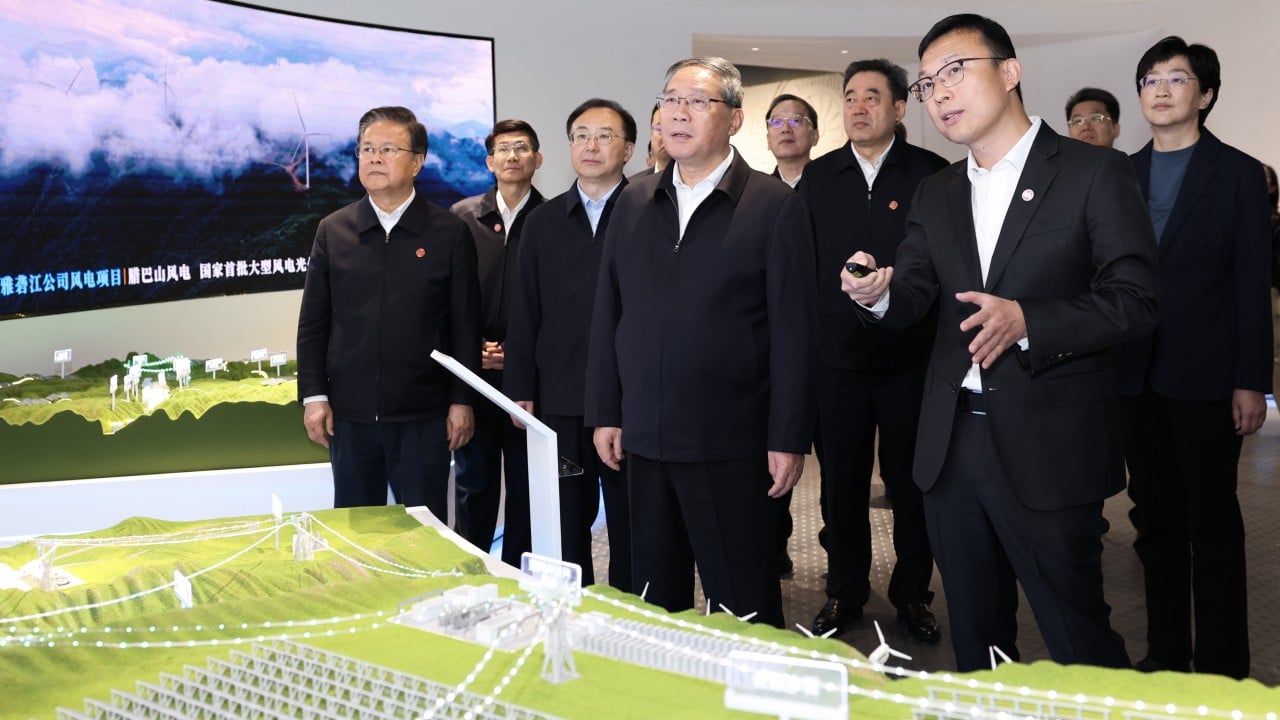
Beijing is currently re-engineering the very DNA of its electrical grid to ensure that a geopolitical flare-up in the Middle East or a sudden trade embargo cannot pull the plug on its industrial heartland. This isn't a simple hardware upgrade; it is the "AI Plus" initiative in its most aggressive form. Premier Li Qiang’s recent tours through the high-tech corridors of Sichuan and the futuristic substations of Xiong’an confirm a strategic pivot. China is no longer just building the world's largest power network—it is handing the keys of that network over to autonomous algorithms to solve the volatility that human operators can no longer manage.
The fundamental problem is one of physics and timing. As China aggressively scales its wind and solar capacity—now exceeding 1.8 billion kilowatts—it faces the "intermittency trap." The sun doesn't always shine in the industrial east, and the wind doesn't always blow in the resource-rich west. In the old world, you simply burned more coal to bridge the gap. In the new world, Li Qiang is betting that artificial intelligence can balance a hyper-complex, hybrid AC/DC grid with zero margin for error. For an alternative look, check out: this related article.
The End of Human Scale Dispatching
For decades, grid management was a reactive discipline. When demand spiked, a central command center ordered a power plant to spin up. But as millions of electric vehicles, rooftop solar panels, and massive data centers plug into the system, the number of variables has exploded beyond human cognition.
In the Xiong’an New Area, the government has already moved past the pilot phase. They have deployed an AI-based smart grid dispatching system that treats the entire city like a single, breathing organism. This system doesn't wait for a technician to spot a voltage drop. It uses predictive modeling to anticipate clouds moving over solar farms or a surge in EV charging at a specific office block, rerouting power through "smart capillaries" before the physical system even feels the strain. Similar insight on the subject has been published by TechCrunch.
This is the "microcirculation" strategy Li Qiang discussed during his 2026 field surveys. By breaking the national grid into a hierarchy of "aortas" (ultra-high voltage lines), "capillaries" (local distribution), and "microgrids," Beijing is creating a self-healing architecture. If a global shock—such as the ongoing energy volatility from the Iran conflict—cuts off liquefied natural gas (LNG) imports, the AI can instantly prioritize critical manufacturing and defense infrastructure while throttling non-essential consumption in real-time.
The Computing Power and Electricity Nexus
A glaring irony haunts the tech industry: the very AI needed to save the energy system is itself an energy glutton. Training a single large language model can consume as much electricity as thousands of homes use in a year. Li Qiang’s State Council sessions have recently focused on a concept called the "deeply integrated mechanism for coordinating computing power and electricity."
This is a direct response to the "triple transition" challenge where AI growth, energy transition, and geopolitical realignment happen simultaneously. China is now positioning its massive data centers not just as consumers, but as flexible assets. When the grid has a surplus of wind power at 3:00 AM, the AI shifts heavy computational workloads to that window. When the grid is stressed at 6:00 PM, the data centers dial back.
This synchronization is the real reason China is leading the AI race. It isn't just about having the best algorithms; it is about having the most resilient "compute-energy" stack. While Western nations struggle with localized grid saturation and NIMBY-ism preventing new transmission lines, China has built 45 ultra-high voltage "power highways." These lines function as the physical rails for the AI-driven economy.
Resilience as the Only Metric
The standard for success has shifted from "efficiency" to "resilience." In the 2025 Action Plan for Global AI Governance, Premier Li emphasized that digital infrastructure must be "safe, reliable, and strong." Behind the diplomatic language lies a hard-nosed realization: a nation’s sovereignty in 2026 is measured by its ability to maintain "zero large-scale outages" during a crisis.
China's renewable energy utilization has reached 97.6%, a figure that would be impossible without automated load balancing. However, this transition is not without its casualties. The "brutal truth" is that the AI-driven grid requires a level of data centralized control that effectively eliminates the independent power producer model. In this new system, every battery, every turbine, and every smart meter is a node in a state-controlled neural network.
The strategy also includes a massive fast-tracking of nuclear projects—23 new reactors are currently under construction. These provide the "baseload" that the AI uses as a foundation. While the world watches the "AI Plus" initiative for its impact on consumer electronics or healthcare, the real victory or defeat for the Chinese model will happen in the substations.
The goal is to reach a world-leading level of AI-energy integration by 2030. If the current trajectory holds, the "next-gen energy system" will be less of a utility and more of an autonomous defense shield. For global competitors, the message from Beijing is clear: you cannot lead in intelligence if you cannot master the electrons that feed it. The race for the future is no longer about who has the fastest chip, but who can keep those chips running when the rest of the world goes dark.
Invest in the grid or prepare for the blackout. There is no middle ground.