In the first quarter of 2026, the Ministry of Natural Resources in Beijing released a series of data points that should have ended any remaining illusions of Western resource parity. While Washington debates permitting reform and "Metals NATO" frameworks, China has spent the last five years quietly executing a geological blitzkrieg. The results are now public: a massive expansion of domestic reserves including a 100-million-ton copper deposit in Tibet, Asia’s largest single lithium deposit in Sichuan’s Yajiang, and a "super-large" gold mine in Shandong.
This is not a sudden stroke of luck. It is the tactical culmination of the 14th Five-Year Plan, which saw cumulative exploration investment hit 450 billion yuan ($62 billion). More importantly, the discovery of Huanghoite-(Nd) in Inner Mongolia—a new carbonate mineral dominated by neodymium—signals that China is moving beyond mere volume. They are now optimizing for the specific magnetic properties required by next-generation electric vehicle (EV) motors and offshore wind turbines. The "stunning" nature of these finds lies less in the dirt itself and more in how they bridge the final gap in China’s total vertical integration.
The Processing Trap
Western analysts often obsess over extraction, but mining is the easy part. The real leverage is held in the midstream. As of March 2026, China controls roughly 91% of global rare-earth separation and refining production. Even more dominant is their grip on the downstream: 94% of sintered permanent magnets are manufactured within Chinese borders.
The "discovery" of new domestic ores serves a specific geopolitical purpose. It allows Beijing to tighten export controls on "parts, components, and assemblies" without starving its own massive industrial base. In January and February 2026 alone, Chinese rare-earth magnet exports rose by 8.2%, reaching 10,763 metric tons. While the world worries about a supply shortage, China is actually increasing its exports of finished high-value products while simultaneously restricting the raw ores and the technology needed to process them. This is a classic "scissors effect": they are making the world more dependent on their manufactured goods while cutting off the ability for others to build their own.
Weaponizing the Price Floor
The second Trump administration has responded with the Dominance Act and the "Forge" initiative—a successor to the Minerals Security Partnership. The goal is to create a "protected zone" for Western miners by using price floors. This is a direct response to the predatory pricing seen in 2024 and 2025.
During that period, Chinese lithium exports surged even as global prices crashed by 80%. This effectively bankrupted projects in Canada and Australia that were deemed "uneconomic" at those levels. Beijing proved it can tolerate years of losses to clear the board of competitors. The current 2026 market for lithium carbonate remains a battlefield; prices jumped 78.3% in early January due to front-loading before a VAT rebate change, only to be pulled back by futures manipulation on the Guangzhou Futures Exchange (GFEX).
- China’s Reserve Strategy: Mandated strategic reserves are now part of Chinese law as of 2026.
- The Recycling Pivot: While the US looks to "leapfrog" China through recycling, China already processes the vast majority of "black mass" (battery scrap) globally.
- The Standards War: Washington is trying to win by raising Environmental, Social, and Governance (ESG) standards, betting that producing countries will prefer "clean" Western investment over "exploitative" Chinese deals.
The Global South Lock In
The battle has moved from the laboratory to the jungle. China’s Belt and Road Initiative (BRI) has evolved from building roads to securing "trade relationship lock-ins." In the Democratic Republic of the Congo (DRC), Chinese investment led to a 300% increase in cobalt flows to China, which now consumes 90% of the DRC's output.
Western strategy relies on the hope that countries like Zimbabwe or Indonesia will grow tired of Chinese dominance. Indonesia’s recent move to tighten nickel supply and Zimbabwe’s lithium export ban suggest a rising "resource nationalism." However, China has anticipated this. They aren't just buying the mines; they are building the refineries inside those countries. When a nation bans the export of raw ore, Chinese firms already have the only processing plant in the region ready to turn that ore into high-value chemicals.
The Innovation Illusion
The Council on Foreign Relations and other Western think tanks argue that the US can "leapfrog" China by scaling disruptive innovation, such as rare-earth-free magnets. This is a high-stakes gamble. Materials science moves at a glacial pace compared to the speed of industrial deployment.
While the West experiments with substitutes, China is doubling down on the minerals we already know work. They have filed over 22,000 patent families in rare-earth technologies between 2014 and 2024, accounting for 81% of global filings. They aren't just winning on volume; they are winning on the intellectual property required to make the minerals useful.
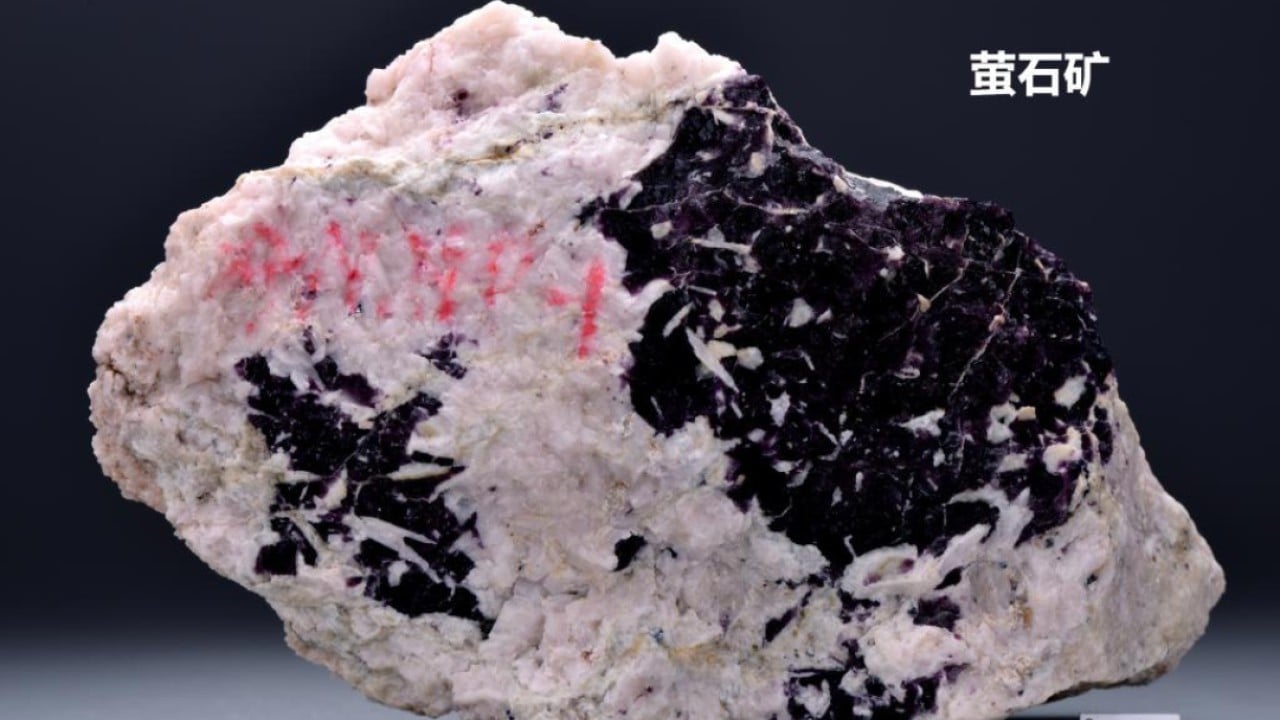
The 2026 mineral finds in Sichuan and Gansu include antimony, fluorite, and barite. These aren't just "hi-tech" minerals; they are essential for defense applications, flame retardants, and semiconductors. By securing these "boring" industrial minerals alongside the "sexy" rare earths, China is ensuring that no part of the modern industrial stack can function without their permission.
A New Economic Reality
The U.S. Geological Survey’s February 2026 report confirmed that China holds 44 million metric tons of rare-earth-oxide equivalent reserves. In contrast, the United States accounted for only 1% of global critical mineral production in 2024. The gap is not closing; it is widening.
The reality of 2026 is that "de-risking" is a fantasy if it doesn't include a massive, state-funded surge in domestic processing. Mining a mineral in Nevada or Wyoming is strategically irrelevant if that ore must be shipped to a Chinese-owned facility in Asia for separation. Washington’s current flurry of legislative initiatives—including $30 billion in equity stakes for domestic firms—is a drop in the bucket compared to the 450 billion yuan Beijing has already spent.
The hollowing out of Western mining expertise started in 1996 with the closure of the US Bureau of Mines. Thirty years later, the bill has come due. China didn't just find more minerals; they built the only world capable of using them.
Would you like me to analyze the specific impact of the 2026 lithium VAT rebate changes on US-based battery manufacturers?