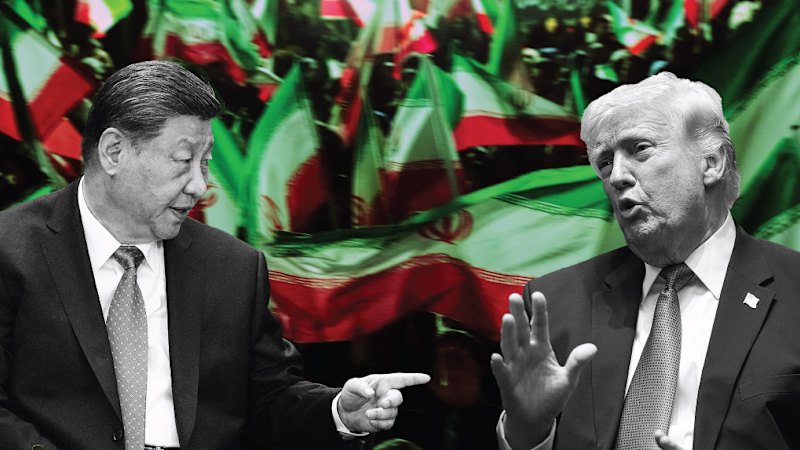
The consensus among the chattering classes in London and DC is as lazy as it is dangerous. They look at the "erratic" nature of American foreign policy and conclude that Beijing is privately popping champagne. They see a fractured West and assume the Chinese Communist Party (CCP) is effortlessly waltzing into the vacuum.
They are dead wrong.
Stability is the only currency that matters in Zhongnanhai. The "predictable" decline of a steady adversary is a manageable variable. A wild card that refuses to follow the neoliberal script is a systemic nightmare for a regime that prizes five-year plans and social harmony above all else. Beijing doesn’t want a "weak" America that might spontaneously combust; they want a legible America they can out-calculate over a fifty-year horizon.
The Myth of the Strategic Vacuum
Common wisdom suggests that when the U.S. retreats from global stagecraft, China wins by default. This assumes power is a simple zero-sum game of territory. It isn’t. Power is about the maintenance of the systems that allow you to eat.
China’s "Economic Miracle" wasn't built in a vacuum of "Eastern Wisdom." It was built on the back of the most predictable, stable, and subsidized maritime security environment in human history—provided entirely by the U.S. Navy. When American leadership becomes "erratic," the insurance policy on China’s entire export-led model goes up in smoke.
If the U.S. decides to stop playing global policeman, China doesn't just "take over." It inherits the bill. It inherits the regional brushfires in the Middle East that threaten its energy security. It inherits the headache of a nuclearized Japan or South Korea—outcomes that become much more likely when the U.S. security umbrella starts to leak.
Why "Erratic" is a Tactical Superpower
Game theory 101: if your opponent knows exactly how you will react to a provocation, they have already defeated you.
For decades, U.S. policy toward China was a series of known variables. We wanted "engagement." We wanted "responsible stakeholders." We followed the rules of the WTO while Beijing treated those rules like a suggestion box. The CCP became masters at "salami slicing"—taking tiny, incremental steps in the South China Sea that were never quite enough to trigger a predictable American response, but which eventually changed the map.
When an American president becomes unpredictable, the "salami slicing" stops working. You can't calibrate a provocation against a leader who might respond with a shrug one day and a total decoupling of the semiconductor supply chain the next.
This creates "Strategic Dissonance."
Beijing hates dissonance. Their entire model of governance is based on the elimination of surprise. I have sat in rooms with trade negotiators who were visibly vibrating with anxiety because they couldn't find the "logic" in the latest tariff threat. They were looking for a chess move. They were being met with a sledgehammer.
The Decoupling Delusion
The competitor piece argues that American volatility pushes allies toward China. Look at the data, not the op-eds.
Despite the rhetoric, foreign direct investment (FDI) into China has hit record lows recently. Why? Because capital hates a coin flip. If the U.S. might suddenly ban investment in Chinese tech sectors, or if Beijing might retaliate by disappearing a CEO, the "China Opportunity" starts to look like a "China Trap."
The "erratic" nature of modern U.S. policy has done what decades of polite diplomacy failed to do: it forced a realization that the global supply chain is a massive security vulnerability.
- The Old Paradigm: Efficiency at all costs. Just-in-time manufacturing.
- The New Reality: Resilience at any cost. "Friend-shoring."
China’s economy is $18 trillion of "just-in-time." It cannot survive a world where every Western board of directors is terrified of the next morning’s headlines. Beijing doesn’t benefit from this friction; they are the primary victims of it.
The Debt Trap is Multi-Directional
People ask: "Isn't China winning the Global South while the U.S. is distracted?"
This is the "Belt and Road" fallacy. Beijing spent nearly a trillion dollars buying friends, only to realize they’ve become the world’s largest repo man. Many of these projects are now underwater. When the U.S. is "erratic," it creates global currency fluctuations. When the Dollar strengthens because of American domestic policy shifts, the debt burden on Belt and Road nations—denominated in Dollars—skyrockets.
China then faces a brutal choice:
- Bail out failing states with money they need for their own aging population.
- Let these states collapse and lose their "strategic" investments.
An unpredictable America makes the global financial environment a minefield for a country that has $3 trillion in foreign exchange reserves mostly tied to the very system they are supposed to be "replacing."
The "Madman" Advantage in Deterrence
Consider the Taiwan Strait. For years, the policy was "Strategic Ambiguity." It was a polite, predictable dance.
But what happens when the U.S. stance moves toward "Unpredictable Resolve"?
If Beijing believes the U.S. might NOT intervene, they might be tempted to move. But if they believe the U.S. might react disproportionately—say, by freezing all Chinese sovereign debt or instituting a total naval blockade of the Malacca Strait—the risk/reward calculation shifts toward "Not Today."
Predictability is an invitation to a bully. Chaos is a deterrent.
The Real Miscalculation
The fatal flaw in the "China is winning" narrative is the belief that the CCP has a superior alternative to the liberal international order. They don't. They have a mercantilist survival strategy.
The U.S. can afford a decade of internal chaos and "erratic" leadership because it is energy independent, food independent, and protected by two oceans. China is none of those things. It is a giant factory that needs to import its fuel, import its food, and export its gadgets.
Every time a "volatile" American leader questions the status quo, they are pulling a thread on the sweater that keeps China warm.
What You Should Actually Do
If you are an investor or a policy lead, stop waiting for a "return to normalcy." The era of the "predictable" American hegemon was an anomaly, not the baseline.
- Assume Friction is Permanent: Stop betting on a "grand bargain" between DC and Beijing. It’s not coming.
- Value Resilience Over Margin: If your supply chain relies on a "stable" relationship with the CCP, you are effectively shorting American volatility. That is a losing trade.
- Watch the Energy, Not the Rhetoric: China’s real vulnerability isn't what a politician says on social media; it’s their ability to secure the Persian Gulf without American help.
The world isn't tilting toward China because America is "erratic." The world is fragmenting because the old rules no longer serve the person who wrote them. Beijing isn't the master of this new chaos; they are its most terrified observers.
Stop reading the tea leaves of diplomatic "snubs" and start looking at the structural fragility of a regime that requires total global predictability to survive.
The U.S. is the only player on the board that can afford to be crazy. In a high-stakes game, that doesn't make you the loser. It makes you the house. And the house always wins, eventually.