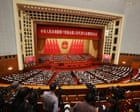
The era of the "Chinese Miracle" has officially transitioned into a period of managed decline. Beijing has finally signaled what global economists have whispered for years: the old engine is out of steam. By setting a national growth target below the 5% threshold for the first time in modern history, the Chinese Communist Party (CCP) is not just acknowledging a temporary slowdown. It is surrendering to a structural reality that no amount of state-directed lending can fix.
The shift is seismic. For decades, the 5% marker was a psychological and political floor, a baseline considered necessary to maintain social stability and provide jobs for the millions of graduates entering the workforce annually. Dropping below this line suggests that the leadership in Zhongnanhai has calculated that the cost of forcing growth—through deeper debt and unproductive infrastructure—is now higher than the risk of public discontent.
The Ghost of Overcapacity
To understand why the target has fallen, one must look at the skeleton of the Chinese economy: real estate and heavy industry. For twenty years, property development accounted for roughly 25% of China's GDP. It was a reliable, if hollow, way to pump up the numbers. Local governments sold land to developers, who built high-rises using borrowed money, which were then sold to a middle class with few other investment options.
That cycle is broken. The "Three Red Lines" policy, introduced to deleverage the sector, effectively strangled the cash flow of giants like Evergrande and Country Garden. Now, China is littered with "ghost cities" and unfinished apartments. The wealth of the average Chinese citizen, 70% of which is tied up in property, is evaporating. You cannot hit a 5% growth target when your primary engine of wealth creation is undergoing a controlled demolition.
Manufacturing was supposed to be the savior. The "New Three" industries—electric vehicles (EVs), lithium-ion batteries, and solar products—were intended to replace the property sector. However, the world is pushing back. High-speed growth in these sectors has led to massive overcapacity. China is producing more than its internal market can consume, leading to a flood of cheap exports that have triggered protectionist tariffs from the European Union, the United States, and even emerging markets like Brazil and Turkey.
The Demographic Trap
The math of 5% growth requires a steady supply of labor. China no longer has it. The working-age population peaked in 2014 and has been shrinking ever since. This is not a problem for the future; it is a problem for today.
A shrinking workforce means rising labor costs, which erodes the "factory of the world" advantage. While automation and high-tech manufacturing are being touted as solutions, they cannot move fast enough to offset the sheer volume of retirees. The dependency ratio is tilting. Every year, more resources must be diverted from innovation and infrastructure to healthcare and pensions for the elderly.
The Youth Unemployment Paradox
While the population shrinks, a bizarre crisis has emerged at the other end of the age spectrum. Youth unemployment reached such alarming levels recently that the government briefly stopped publishing the data. There is a profound mismatch between the jobs the CCP wants to create—factory-floor tech roles—and the jobs the educated youth want.
Graduates who spent their lives studying for the "Gaokao" are unwilling to work in manufacturing, even if it is "high-tech." They are "lying flat" (tang ping) or "letting it rot" (bai lan), rejecting the grueling 9-9-6 work culture. This cultural shift represents a loss of human capital that no government stimulus package can rectify.
Fiscal Constraints and Local Government Debt
For years, the "how" of Chinese growth was simple: debt. When the central government set a target, local officials made it happen by borrowing through Local Government Financing Vehicles (LGFVs). These "hidden debts" are estimated to be in the trillions of dollars.
The tap is running dry. Local governments are so burdened by debt service that they are struggling to pay basic salaries for teachers and civil servants, let alone fund new "growth-positive" projects. Beijing is wary of a massive bailout because it creates moral hazard, but allowing widespread defaults would shatter the banking system. The lower growth target is a signal that the central government is prioritizing financial survival over statistical vanity.
The Geopolitical Friction
Growth does not happen in a vacuum. China's rise was facilitated by a relatively peaceful integration into the global trade system. That era of "Chimerica" is dead. The "de-risking" strategies adopted by Washington and Brussels are not merely rhetorical; they are manifesting in redirected supply chains and restricted access to advanced semiconductors.
Without access to the highest-end chips and the machines that make them, China’s push for "Total Factor Productivity" hits a ceiling. If you cannot innovate your way out of a labor shortage because you are locked out of the latest AI and silicon hardware, your growth will naturally stagnate. The sub-5% target is a reflection of a nation that is turning inward, prioritizing "security" and "self-reliance" over the raw expansion of the GDP.
The Myth of Consumer-Led Recovery
The great hope for the Chinese economy was a transition to a consumer-driven model, similar to that of the United States. If 1.4 billion people start spending like Americans, the theory goes, the internal market will sustain growth.
But consumers are terrified. Without a robust social safety net—pensions are meager and healthcare is expensive—Chinese households save at some of the highest rates in the world. The property crash has only deepened this cautious streak. When your primary asset is losing value, you don't go out and buy a new car or dine at expensive restaurants. Beijing has tried "consumption vouchers" and subsidies, but these are band-aids on a gaping wound of consumer mistrust.
Capital Flight and the Private Sector
Confidence is a hard currency. The crackdowns on the tech sector, private education, and "celebrity culture" over the past few years have sent a chilling message to entrepreneurs. When Jack Ma vanished from public view, every aspiring founder in China took note.
Wealthy individuals are looking for exits. Despite strict capital controls, money is finding its way out of the country through various gray channels. This "silent exit" of capital and talent is a structural drain. The private sector, which provides 80% of urban employment, is in a defensive crouch. They are not investing in the future; they are trying to survive the present.
The Strategic Shift to Quality Over Quantity
The CCP is attempting to reframe this slowdown as a deliberate move toward "high-quality growth." This is a pivot that every aging tiger economy must eventually make. South Korea and Japan went through it. However, they did so while having much higher per capita incomes than China currently does. China is in danger of "getting old before it gets rich."
The lower target is a moment of cold, hard honesty. It suggests that the leadership has finally accepted that the "bazooka" stimulus of 2008 cannot be repeated without causing a systemic collapse. They are choosing a slow, painful diet over a fatal heart attack.
The Global Ripple Effect
What happens when the world’s primary growth engine throttles down? Commodity exporters in Australia, Brazil, and Africa will feel the pinch first. German carmakers and luxury brands in Paris are already seeing the slowdown in their balance sheets. The global economy has spent thirty years addicted to China's 8%, then 7%, then 6% growth. Adapting to a world where China grows at 3% or 4%—and perhaps even less in real terms—will be the defining economic challenge of the late 2020s.
The lower growth target is not a failure of policy as much as it is an admission of gravity. Beijing is no longer trying to outrun the laws of economics; it is merely trying to land the plane without it breaking apart on the tarmac. You should watch the unemployment figures and the yuan's exchange rate more closely than the GDP headlines. Those are the metrics that will determine if the CCP can maintain its grip as the "miracle" fades into memory.
Audit your portfolio for companies that rely on Chinese expansion as their sole growth thesis. The floor has moved, and it is much lower than many are willing to admit.