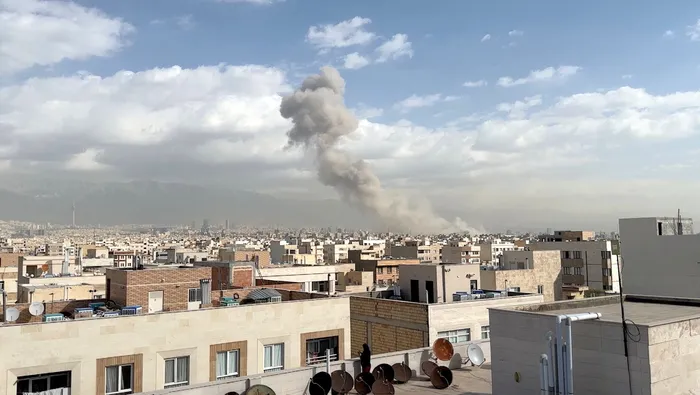
The joint military strikes by the United States and Israel against Iranian targets represent more than a localized retaliation. This coordinated offensive marks a fundamental shift in Western engagement strategies, moving away from the containment of the last decade toward a doctrine of active degradation. By targeting specific military infrastructure and command centers, the alliance is attempting to dismantle the logistical spine of Iranian regional influence. This is not a warning shot. It is a systematic attempt to reset the balance of power in the Middle East through kinetic force.
While the immediate headlines focus on the smoke rising from Tehran and Isfahan, the real story lies in the breakdown of back-channel diplomacy. For months, intelligence officials in Washington and Jerusalem watched as red lines were crossed with perceived impunity. The decision to strike suggests that the West has concluded that the cost of inaction now outweighs the risks of a broader regional conflict.
The Strategy of Disruption
Warfare in this region has long been defined by "the shadow war," a series of deniable attacks, cyber disruptions, and proxy skirmishes. Those days are over. The current campaign utilizes a high-visibility approach designed to signal a lack of fear regarding escalation.
Israel’s involvement brings a specific surgical precision to these operations. Their intelligence network within Iran has proven capable of identifying high-value targets that remain hidden from satellite surveillance. Meanwhile, the United States provides the heavy lift—the long-range capabilities and the integrated air defense suppression that allows these missions to succeed without significant losses.
The targets chosen reflect a deep understanding of the Iranian Revolutionary Guard Corps (IRGC) supply chain. They are hitting the factories that produce the drones seen on global battlefields and the storage facilities for medium-range missiles. By stripping away these assets, the alliance forces Tehran to choose between domestic stability and its expensive foreign adventures.
The Myth of De-escalation
For years, the prevailing wisdom in foreign policy circles was that economic pressure would eventually force a change in behavior. This has proven to be a fallacy. The Iranian leadership has shown an incredible capacity for absorbing economic pain while continuing to fund its external interests.
This military action is a confession that the diplomatic tools have failed. When you look at the map of the strikes, you see a clear pattern. The alliance is not hitting civilian infrastructure or the broader economy. They are hitting the specific tools of projection.
The Intelligence Failure in Tehran
One of the most striking aspects of this campaign is the apparent lack of Iranian preparedness. Despite the bellicose rhetoric emanating from the capital, the air defenses in several key sectors failed to engage effectively. This suggests a significant gap between Iran’s claimed capabilities and the reality on the ground.
- Electronic Warfare: Sources indicate that significant jamming operations preceded the physical strikes, rendering local radar systems useless.
- Internal Security: The ability of the alliance to hit moving targets suggests a level of human intelligence on the ground that should terrify the IRGC leadership.
- Command Breakdown: In the initial hours of the strikes, the Iranian response was fragmented, indicating that the command-and-control nodes were neutralized early in the sequence.
The Proxy Problem
A major concern for any analyst is how Iran’s regional partners will react. From the Levant to the Gulf of Aden, the "Axis of Resistance" has the capability to make life difficult for Western interests. However, the scale of the current strikes seems designed to paralyze these groups by showing them exactly what the alternative to restraint looks like.
If the IRGC is struggling to protect its own headquarters, the message to its proxies is clear: do not expect a rescue. This creates a vacuum of leadership that could lead to unpredictable actions by smaller, less disciplined factions. It is a high-stakes gamble that hinges on the idea that these groups are more rational than they are ideological.
The Economic Aftershocks
You cannot drop bombs in the Middle East without the global markets feeling the heat. Oil prices reacted instantly, but the long-term impact is more nuanced. The world is no longer as dependent on a single point of failure in the Persian Gulf as it was thirty years ago, but the psychological impact remains.
Investors are now pricing in a period of sustained instability. This isn't just about the price per barrel; it’s about the cost of shipping insurance, the security of maritime routes, and the stability of regional trade hubs. The strikes have effectively ended the period of relative predictability that allowed for post-pandemic recovery in regional markets.
A New Doctrine of Necessity
We are witnessing the birth of a doctrine that prioritizes immediate security outcomes over long-term political settlements. The "forever wars" of the early 2000s taught the West that nation-building is a losing game. The current strategy is far colder. It is about "mowing the grass"—periodically destroying the military capabilities of an adversary to prevent them from reaching a critical threshold of power.
This approach acknowledges that a total victory is impossible and perhaps even undesirable, as it would create a power vacuum that could be filled by something worse. Instead, the goal is a state of permanent managed weakness.
Tactical Diversification
The use of autonomous systems in these strikes cannot be ignored. The swarm tactics utilized to overwhelm Iranian defenses show a maturation of technology that was only theoretical a few years ago. These systems allow for high-risk missions without the political cost of losing pilots, which in turn lowers the threshold for a commander-in-chief to authorize an attack.
The Nuclear Question
The elephant in the room remains the Iranian nuclear program. While the current strikes focused on conventional military assets, the subtext is the protection of the nuclear status quo. By demonstrating that they can penetrate the most defended airspace in the country, the US and Israel have sent a clear message regarding the fate of the enrichment facilities if certain thresholds are crossed.
Tehran now faces a brutal dilemma. Do they accelerate their program as a deterrent, risking an even more devastating "decapitation" strike? Or do they retreat and lose face both at home and among their regional allies? There are no good options left for the Supreme Leader.
Regional Realignment
The silence from other regional powers is deafening. In the past, such strikes would have triggered immediate and vocal condemnation from across the Arab world. Today, the reaction is largely one of quiet observation. Many of Iran's neighbors view the IRGC's influence as a greater threat to their stability than Western military intervention.
This shift in sentiment provides the political cover necessary for the United States to operate. It suggests a realignment where the old divides are being replaced by a simple binary: those who want to maintain the current international order and those who wish to disrupt it.
The Burden of Proof
The success of this operation will not be measured by the number of targets destroyed today, but by the level of Iranian activity six months from now. If the proxies continue to fire and the drones continue to ship, then the strikes will be viewed as an expensive failure.
Historical precedent suggests that military force alone rarely changes the fundamental ideology of a regime. It can, however, break its will to act. The alliance is betting that the Iranian leadership values its survival more than its regional ambitions.
The immediate fallout will be a period of heightened alert and likely "asymmetric" responses—cyberattacks on Western infrastructure or harassment of shipping. These are the tools of a power that cannot win a conventional fight. The question is no longer whether there will be a conflict, but how the West manages the messy, violent reality of a regional power in decline.
Monitor the movement of carrier strike groups in the Mediterranean and the deployment of additional missile defense batteries to the Gulf. These are the indicators of whether the alliance expects a singular event or a sustained campaign.