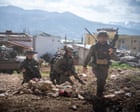
Military planners are currently obsessed with a nineteenth-century solution to a twenty-first-century nightmare. The headlines scream about Israel’s intent to occupy southern Lebanon to "expand the buffer zone." They treat the border like a sliding scale of safety—as if adding five kilometers of dirt between a civilian and a rocket launcher creates a mathematical shield. It is a lie. It is a strategic fossil.
Geography is no longer the primary currency of security. If you think seizing the Litani River protects northern Galilee, you are still fighting the 1982 Lebanon War. You are ignoring the reality of asymmetric saturation and the complete collapse of distance as a defensive barrier. The "buffer zone" isn't a shield; it's a target-rich environment for a ghost insurgency.
The Geography Trap
The mainstream media paints a picture of a "security belt." They argue that by pushing Hezbollah back, Israel creates a vacuum. This assumes that Hezbollah is a conventional army that needs to stand on a specific patch of grass to hurt you.
I have spent decades watching these "zones" crumble. A buffer zone only works if the enemy cares about holding territory. Hezbollah doesn't. They operate in a subterranean, decentralized web. When you move the line, they simply recalibrate their optics.
A static line is a gift to an insurgent force. It gives them a fixed target. It gives them a defined perimeter to probe. By occupying southern Lebanon, Israel isn't creating safety; it is voluntarily entering a meat grinder. The logic of "strategic depth" is dead when your opponent uses $500 first-person view (FPV) drones and short-range ballistic missiles that don't care about a 10-mile strip of scorched earth.
The Drone Math That Nobody Wants to Admit
Let’s talk about the physics of the modern skirmish. The "lazy consensus" says that distance equals time, and time equals interception. In the era of the Iron Dome, this seemed true. But the math has shifted.
The saturation of low-altitude, slow-moving suicide drones has turned the buffer zone into a liability. If you occupy a village in southern Lebanon to stop rockets, you now have thousands of soldiers sitting in static outposts. These soldiers are now within the "dead zone" of thermal-seeking loitering munitions.
You aren't protecting the kibbutz in the Galilee; you are just moving the casualties five miles north and putting them in uniform. It is a shell game where the only loser is the standing army.
The Kinetic Reality vs. The Political Map
- Political Map: A clean blue line pushed north, suggesting "control."
- Kinetic Reality: A porous, 3D battlespace where threats move through tunnels, under foliage, and via civilian frequencies.
An occupation force in 2026 is a logistics nightmare. Every supply truck bringing water to a forward operating base is a target. Every radio tower is a beacon for electronic warfare. The cost of maintaining a "buffer" is exponentially higher than the cost of disrupting it. We are seeing a massive asymmetry in "cost-per-kill" that favors the defender of the rubble, not the occupier of the ridge.
The Litani Myth
The Litani River is the "holy grail" of Israeli hawks. They believe that if no armed operative crosses that water, the north is safe. This is a fundamental misunderstanding of modern ballistics.
Hezbollah’s arsenal isn't built for "cross-border raids" anymore. They are built for stand-off capability. Pushing them behind the Litani does nothing to stop the heavy-payload Burkan rockets or the precision-guided Fateh-110s. It is like moving a beehive from your front porch to your back porch and claiming you solved the stinging problem.
I’ve watched military budgets disappear into the black hole of "territorial integrity." The hard truth? Security is now about persistence of vision, not persistence of presence. If you can't see the launcher, the dirt you stand on is irrelevant.
Why "Stability" is a Failed Metric
Western analysts love the word "stability." They think a buffer zone creates a "frozen conflict."
Frozen conflicts only exist in textbooks. On the ground, they are slow-motion wars of attrition. An occupation force in southern Lebanon becomes a "static state." It stops evolving because its primary mission is holding a line. Meanwhile, the adversary—unburdened by the need to govern or provide logistics for a standing army—iterates its technology every three months.
By the time the "buffer zone" is established, the technology that necessitated it is already obsolete.
The Irony of the Buffer
The more territory you take to protect your civilians, the more "surface area" you provide for the enemy to attack. It is a paradox of security:
- Increase territory to create a gap.
- Gaps require patrol and fortification.
- Fortifications become the new front line.
- The "safety" of the interior is bought by the constant bleeding of the exterior.
The False Promise of UN Resolution 1701
Everyone points to the UN as the failure point. "If only they had enforced the demilitarized zone!" they cry.
This is a childish view of geopolitics. No international force is going to engage in a high-intensity urban counter-insurgency for a foreign power. Expecting the UN to clear the "buffer" is a fantasy. The failure isn't in the enforcement; the failure is in the concept. You cannot demilitarize a population that views resistance as its primary cultural and political export.
Southern Lebanon isn't a military base you can shut down. It is a radicalized ecosystem. You don't "clear" an ecosystem with tanks. You only disturb it.
The Hard Pivot: Stop Thinking in Lines
The obsession with the "line" is why the north is empty. People are asking: "How do we get the civilians back to their homes?"
The military answer—take more land—is the wrong answer. It guarantees a twenty-year insurgency that will eventually end in a messy withdrawal, just like 2000.
The only way to win a conflict in this terrain is to abandon the idea of "holding land" entirely. You need a doctrine of lethal fluidity.
Imagine a scenario where instead of a "zone," you have a persistent, autonomous kill-grid. No permanent outposts. No static soldiers. Just a high-density sensor network backed by rapid-response, long-range precision fires.
But that doesn't look good on a campaign poster. It doesn't give a politician a map to point at and say, "We conquered this." So, instead, we get the "buffer zone." A high-priced, high-blood-cost theater production that serves domestic politics while eroding long-term national security.
The Economic Suicide of Occupation
Let’s be brutally honest about the treasury. Israel’s economy is built on high-tech, VC-backed innovation. It is not built for a multi-decade, low-intensity occupation of a hostile population.
An occupation of southern Lebanon isn't a one-time purchase. It’s a subscription service paid in lives and shekels. It drains the reserves. It pulls the engineers out of the labs and puts them in armored personnel carriers.
If you want to destroy a modern state, don't bomb its capital. Force it to occupy its neighbor's hills for thirty years. The "buffer zone" is a slow-acting poison. It provides the illusion of a perimeter while the internal organs of the state fail under the weight of the effort.
The Intelligence Blind Spot
The bigger the "zone," the harder it is to listen.
When you occupy, you create noise. Your own movements, your own signals, your own logistics interfere with your ability to hear the enemy. You become a "loud" actor in a quiet environment.
True security in 2026 comes from informational dominance. It comes from knowing the rocket is being moved before it reaches the launch site. When you focus on the physical "buffer," you shift resources away from the digital and human intelligence needed to actually stop the threat.
Stop Asking the Wrong Question
The question isn't "How large should the buffer zone be?"
The question is "How do we render the adversary's proximity irrelevant?"
If your security depends on where your neighbor stands, you have already lost. You are a hostage to geography. True power is the ability to project force regardless of the line on the map.
The "buffer zone" is a security blanket for a terrified public. It’s a comfort object. It’s a way to feel like something is being done while the fundamental problem—the proliferation of precision, low-cost standoff weapons—remains untouched.
Occupying southern Lebanon won't bring peace. It will only bring a more expensive war. It will turn the IDF into a target and the Galilee into a secondary front.
The "security belt" is a noose. And the military-industrial complex is currently tightening it around its own neck.