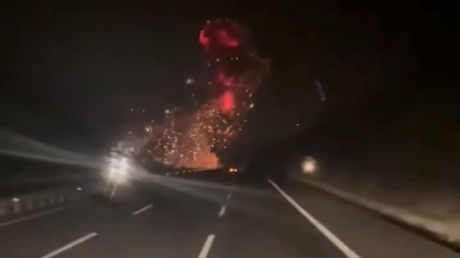
At 12:56 a.m. on February 25, 2026, a Turkish Air Force F-16 Fighting Falcon took off from the 9th Main Jet Base in Balikesir for what was described as a routine mission. Six minutes later, the radar screen went blank. The wreckage was discovered shortly after, scattered across a wide area near the Istanbul-Izmir highway. Major Ibrahim Bolat did not survive the impact. While the Ministry of National Defense has launched the customary technical investigation, the loss of a seasoned pilot and a multi-million-dollar airframe points to a much larger, systemic crisis within the Turkish Air Force (TuAF) that the official press releases are desperate to ignore.
This is not an isolated incident of mechanical failure. It is the latest data point in a dangerous trend affecting one of the largest F-16 fleets in the world. Turkey is currently trapped in a high-stakes waiting room, forced to fly aging airframes well beyond their intended prime while navigating a labyrinth of geopolitical sanctions and delayed modernization programs.
The Aging Viper Dilemma
The F-16 is often called the "backbone" of NATO air power, but even the strongest spine eventually begins to fray. Turkey’s fleet consists largely of Block 30, 40, and 50 variants. Some of these airframes have been in service since the late 1980s. When an aircraft designed for high-G maneuvers reaches forty years of service, metal fatigue is no longer a theoretical risk; it is a mathematical certainty.
Maintenance crews in Balikesir and beyond are working miracles to keep these jets airworthy. However, the "Peace Onyx" program airframes are reaching the end of their 8,000-hour structural lives. While the Service Life Extension Program (SLEP) aims to push that limit to 12,000 hours, those extra 4,000 hours are the most expensive and dangerous to fly. Every takeoff is a gamble against microscopic cracks in the bulkhead that no amount of grease or paint can fix.
The crash in Balikesir happened during a night mission. These are the most demanding environments for both man and machine. If the investigation reveals a flight control malfunction or a sudden engine flameout, it will confirm what many analysts have whispered for years: the TuAF is flying on borrowed time.
Geopolitics and the Maintenance Gap
To understand why a major NATO ally is losing jets in 2026, one must look at the diplomatic wreckage of the last decade. Following the purchase of the Russian S-400 missile system, Turkey was expelled from the F-35 program. This didn't just deny them a fifth-generation fighter; it threw their entire long-term aviation strategy into the trash.
- The F-16 Block 70 Delay: The deal for 40 new "Viper" Block 70 jets and 79 modernization kits has been a political football in Washington for years.
- CAATSA Sanctions: Countering America's Adversaries Through Sanctions Act (CAATSA) made sourcing critical spare parts a logistical nightmare.
- Cannibalization: Unconfirmed reports suggest that ground crews have occasionally had to "cannibalize" grounded jets for parts to keep mission-capable aircraft in the sky.
When spare parts become a luxury, the safety margin thins. The TuAF is currently engaged in a massive effort to "indigenize" their fleet with local software and munitions under the "Özgür" project. While impressive, integrating domestic avionics into decades-old American hardware creates a hybrid system that has never been stress-tested in long-term operational cycles.
The Human Cost of Strategic Shifts
Major Ibrahim Bolat was not a novice. The fact that an experienced pilot could not or did not eject in time—despite reports that the ejection system was activated in the final seconds—suggests an extremely sudden and catastrophic failure.
In military aviation, the "lethal cone" is the window of time where a mechanical failure becomes unsurvivable. If a jet suffers a total hydraulic failure at low altitude during a banking maneuver, even the most elite pilot is a passenger. The Balikesir crash occurred near a major highway, suggesting the pilot may have stayed with the aircraft until the final moments to avoid civilian casualties, a common and tragic hallmark of military aviation disasters.
The Capability Gap is Widening
While Turkey waits for its Block 70 upgrades and looks toward its domestic "KAAN" fifth-generation fighter, its neighbors are not standing still. Greece is integrating the Rafale and moving toward the F-35. The power balance in the Aegean is shifting, and Turkey’s response has been to increase the operational tempo of its existing F-16s to maintain a presence.
This increased tempo is a double-edged sword. More flight hours mean more maintenance requirements. More maintenance requirements, when met with a strained supply chain, lead to accidents. The Balikesir crash is a physical manifestation of a strategic bottleneck.
The Turkish government has recently signaled a renewed interest in rejoining the F-35 program, but the S-400s remain on Turkish soil. Until that deadlock is broken, the TuAF will remain in this dangerous holding pattern. They are forced to rely on a fleet that is physically wearing out while performing high-tempo missions that demand peak performance.
The Immediate Aftermath
In the coming weeks, we will see the typical protocol. There will be a funeral with full military honors. There will be a preliminary report citing "technical issues." There might even be a temporary grounding of specific blocks of the F-16 fleet.
But the real question is whether the Turkish Ministry of Defense will address the underlying reality. You cannot maintain a world-class air force on 1980s hardware in 2026 without paying a price in blood. The investigation into Major Bolat’s death must look past the charred sensors and the twisted turbine blades. It must look at the procurement delays and the political friction that kept a better, safer aircraft from being under him that night.
The wreckage in Balikesir is more than just a downed jet. It is a warning. If the modernization of the Turkish fleet remains a secondary priority to geopolitical posturing, this will not be the last "routine mission" that ends in a highway fireball.
The focus must now shift to the 9th Main Jet Base and the inspection of every airframe currently scheduled for the next night sortie. If the fleet is suffering from structural fatigue, the risk of a repeat performance is not just possible—it is inevitable.
Would you like me to look into the specific timeline of the F-16 Block 70 delivery to see if there are further projected delays?