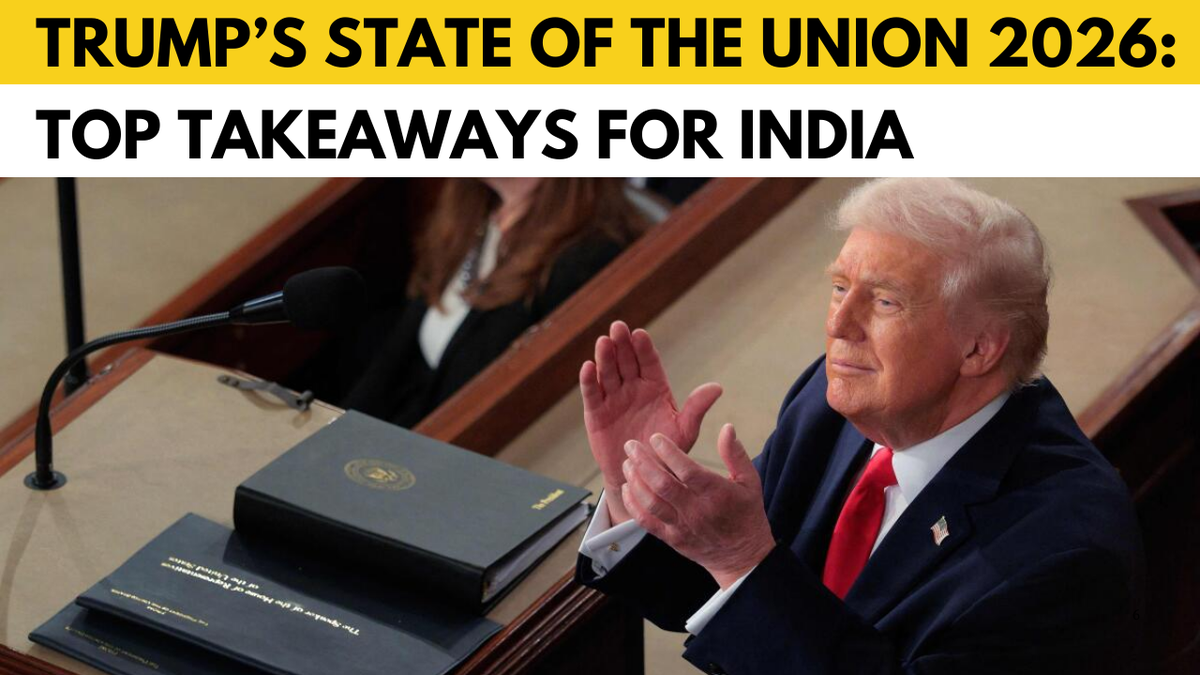
The air inside the House chamber during the 2026 State of the Union was thick with the kind of performative energy only a 108-minute speech can produce. Donald Trump, back for his second term and facing a deeply fractured Congress, used the podium to weave a narrative of a "Golden Age" that felt as much like a campaign rally as a constitutional requirement. But beneath the soaring rhetoric about a "roaring economy" and the prevention of a nuclear apocalypse in South Asia lies a complex web of disputed data, aggressive trade tactics, and a looming military escalation with Iran that reached a breaking point just days after the applause died down.
The Mirage of the India-Pakistan Miracle
One of the night’s most jarring moments came when the President claimed he personally averted a nuclear war between India and Pakistan. According to his account, the threat of 200% tariffs forced both nations to a ceasefire during the flare-up following "Operation Sindoor" in May 2025. He even quoted Pakistani Prime Minister Shehbaz Sharif as saying that 35 million lives were saved by American intervention.
It is a cinematic story. It is also one that New Delhi has spent months dismantling.
Indian officials, led by External Affairs Minister S. Jaishankar, have been uncharacteristically blunt: the United States was "in the United States" while the actual work happened on the ground. The reality of the May 2025 ceasefire was far less theatrical. It was hashed out through established military hotlines between the respective Directors General of Military Operations (DGMOs).
The fallout from this "peace through strength" claim isn't just a matter of hurt feelings. It has fundamentally fractured the U.S.-India partnership. When Prime Minister Narendra Modi refused to back Trump’s bid for a Nobel Peace Prize or acknowledge a formal U.S. role in the truce, the White House retaliated by hiking tariffs on Indian goods from 25% to 50%. This "shattered trust," as analysts at the American Progress institute describe it, has driven India closer to China—symbolized by Modi’s first trip to Beijing in seven years—marking a massive strategic pivot that Washington seems to be ignoring in favor of a victory lap.
Decoding the Golden Age Economy
The President’s economic narrative centered on "plummeting" inflation and a resurgence of American manufacturing. To a family at the grocery store, the reality is a mixed bag of statistical wins and localized pain.
While the year-over-year inflation rate hit 2.4% in January 2026—down from the 2022 peak—the word "plummeting" ignores a critical fact: prices are still higher than they were four years ago. They are simply rising more slowly.
| Item | Status under Trump (2025-2026) | Change |
|---|---|---|
| Eggs (Grade A) | Down | -48% |
| Gasoline | Down | -6% |
| Groceries (Overall) | Up | +2% |
| Electricity | Up | +6.3% |
| Housing | Up | +3.4% |
The administration’s reliance on tariffs as a primary economic tool took a major hit just before the speech when the Supreme Court struck down several "emergency" duties. In the chamber, Trump remained defiant, suggesting that tariffs could eventually replace the income tax entirely. Most economists view this as a mathematical impossibility. Replacing the $2.5 trillion generated by the federal income tax would require a volume of imports—and a level of taxation on those imports—that would effectively collapse global trade and send domestic prices into a vertical climb.
The Invisible Tech Pact
Hidden within the speech was a new initiative to control energy prices by pressuring tech giants. The President announced a "commitment" from major Silicon Valley firms to provide for their own data center electricity needs. With the explosion of generative AI and high-compute workloads, data centers have become an immense drain on the national power grid, contributing to the 6.3% spike in household electricity costs.
The "Trump accounts"—a proposed federal match for savings accounts for children—offered a glimpse into a populist-libertarian hybrid policy. The math, however, is optimistic. The administration claims these accounts could grow to $100,000 by age 18. Achieving that would require a consistent 10% annual return and additional private contributions that most working-class families, currently squeezed by housing and utility costs, simply cannot afford.
The Iran Pivot and the Geneva Ghost
Foreign policy in the speech was a study in omission. While the President spoke of seeking a deal with Iran to thwart its "sinister ambitions," he spent remarkably little time explaining why his administration viewed an attack as imminent.
Days after the speech, the world saw the "how." On February 28, 2026, the U.S. and Israel launched a massive joint strike on Iranian military and governmental sites, reportedly killing Supreme Leader Ayatollah Ali Khamenei. The justification—that Iran was "weeks away" from a nuclear-capable missile that could reach the U.S. homeland—was directly contradicted by a May 2025 assessment from the Defense Intelligence Agency.
The administration’s "maximum pressure" campaign has effectively ended the era of diplomacy. While the White House touts the "obliteration" of nuclear facilities at Natanz and Fordow, international monitors from the IAEA have been barred from the sites. We are left with a leadership vacuum in Tehran and a regional power struggle that could easily spiral into the very "nuclear war" the President claims to have stopped elsewhere.
The Bureaucratic Scalpel
Trump’s boast of "massive bureaucracy cuts" is perhaps his most tangible domestic legacy of the last year. The administration claims to have achieved "negative net migration" for the first time in 50 years, largely through a combination of 2.6 million deportations and what they call "voluntary self-departures" induced by ending release incentives.
This aggressive restructuring has extended to the federal workforce. By cutting deep into the civil service, the administration has centralized power in the Oval Office to a degree not seen in the modern era. Critics argue this has hollowed out the expertise needed to manage complex portfolios like the Anthropic-Pentagon dispute over AI surveillance, where the government has threatened to label private firms as "supply-chain risks" to force cooperation.
The State of the Union was a performance of absolute certainty in an era of profound instability. The "Golden Age" is a powerful brand, but for the allies sidelined by tariff wars and the millions of Americans watching their utility bills rise while the President claims credit for global peace, the brand and the reality are increasingly at odds. The sudden military strike on Iran serves as a reminder that in this administration, the speech is often just the opening act for a much more disruptive second scene.
The next few months will determine if the "Golden Age" is a sustainable era of American dominance or a fragile veneer held together by executive orders and high-stakes gambles.


