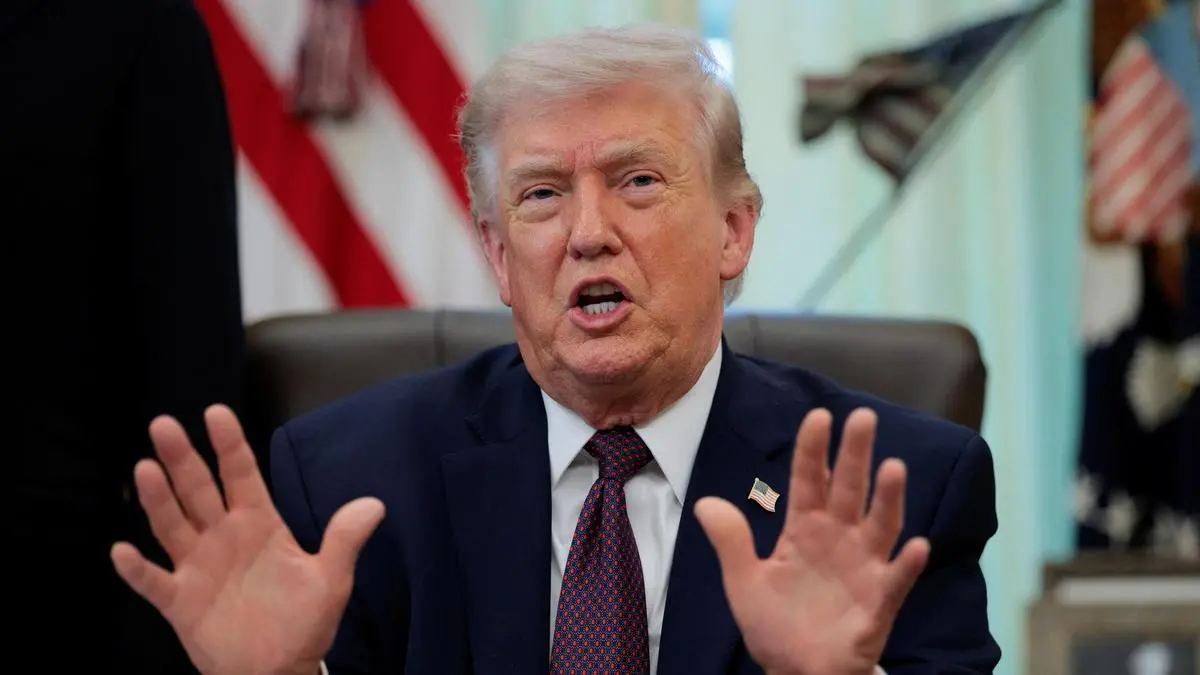
Donald Trump has signaled that the current U.S. military campaign against Iran will end within two to three weeks, claiming the mission to neutralize Tehran’s nuclear ambitions is effectively complete. This timeline, delivered during a Tuesday press briefing at the White House, arrives as domestic gasoline prices soar past $4 per gallon and the New York stock market experiences its most volatile surge in nearly a year. The President’s assertion that a "regime change" has already occurred—linking the death of Supreme Leader Ali Khamenei to recent U.S. strikes—suggests the administration is eager to declare victory and exit before the conflict morphs into a protracted ground war.
While the White House frames this as a masterstroke of "maximum pressure" finally yielding results, the reality on the ground in the Middle East tells a more complex and dangerous story.
The Disconnect Between Rhetoric and Deployment
Despite the President's talk of an exit, the Pentagon is moving in the opposite direction. On the same day Trump promised a swift conclusion, the aircraft carrier USS George H.W. Bush was ordered to the Middle East, accompanied by three destroyers and over 6,000 sailors. They join a surge of 1,500 paratroopers from the 82nd Airborne Division and an additional 5,000 Marines recently funneled into the theater.
These are not the assets of a nation packing its bags.
The 82nd Airborne is specifically trained for "forced entry" operations—the seizing of airfields and hostile territory. Defense Secretary Pete Hegseth pointedly refused to rule out ground troops, noting that the U.S. maintains "15 different ways" to engage the enemy. This creates a glaring strategic paradox: the Commander-in-Chief is signaling a withdrawal to soothe the markets and the electorate, while his generals are positioning the pieces for a potential ground invasion of the Iranian heartland.
The Oil Factor and the $4 Gallon
The primary driver for this sudden rush to the exit is not necessarily military success, but the political carnage caused by energy prices. American voters generally tolerate foreign interventions until the cost is reflected at the pump. With gasoline hitting levels not seen since the peak of the Ukraine crisis in 2022, the administration is facing an internal crisis of its own making.
Trump was explicit about the link. "What I need to do is leave Iran," he told reporters, "and then oil prices will plummet."
The economic stakes are centered on the Strait of Hormuz. Iran’s strategy throughout the 2026 conflict has been to widen the arena, targeting oil infrastructure in Saudi Arabia and the UAE to make the war too expensive for the West to maintain. By promising a withdrawal within 21 days, Trump is attempting to break the "war premium" on oil prices. However, if Tehran views this as a sign of American exhaustion rather than strength, the attacks on tankers and refineries are likely to intensify, not subside.
A Negotiated Peace or a Tactical Pause?
The administration claims to be in "serious discussions" with what it describes as a "new and more reasonable" regime in Tehran. This refers to the power shift following the reported death of Ali Khamenei and the ascent of his son, Mojtaba.
The Muscat Deadlock
Recent indirect talks in Muscat, Oman, paint a less optimistic picture.
- The U.S. Stance: Led by Steve Witkoff and Jared Kushner, the U.S. delegation demanded the total dismantling of Iran’s missile and nuclear programs.
- The Iranian Stance: Foreign Minister Abbas Araghchi has categorized these demands as "unrealistic and excessive," using the talks primarily to delay further U.S. air strikes.
- The Rubio Factor: Secretary of State Marco Rubio has expressed public doubt that a deal is even possible with the current Iranian leadership, regardless of who sits at the top.
The President has issued a stark ultimatum: if the Strait of Hormuz is not "Open for Business" and a deal is not reached shortly, the U.S. will pivot from military operations to total infrastructure destruction. He has threatened to "obliterate" power plants, oil wells, and desalinization facilities—sites that have so far been spared.
The Risk of the "Clean" Exit
The danger of set-to-date withdrawals is historical and well-documented. By announcing a two-to-three-week window, the U.S. risks giving Iranian forces a "clock to run out."
Intelligence suggests that Iranian-backed proxies in Iraq and Syria are already repositioning to fill the vacuum. If the U.S. pulls back without a verified, ironclad agreement on nuclear enrichment and regional interference, the conflict hasn't ended—it has merely been deferred. The "regime change" Trump touts is currently a decapitation of leadership without the destruction of the underlying IRGC infrastructure.
Moreover, the human cost is mounting. Operation Epic Fury has already seen 13 American service members killed and nearly 300 wounded. A premature withdrawal that leaves the job "undone," as Senator James Lankford recently warned, would render those sacrifices politically radioactive.
The next 20 days will determine if this is the end of a war or the beginning of a much larger regional collapse. If the oil prices don't drop and the "new regime" in Tehran refuses to capitulate, the 82nd Airborne won't be heading home; they will be heading inland.
Secure the Strait or blow the grid. That is the binary choice the administration has backed itself into.