The air raid sirens that tore through the Tuesday afternoon quiet in Lviv were not the usual midnight disruptions Ukrainians have learned to sleep through. On March 24, 2026, Russia abandoned its customary cover of darkness, launching more than 550 kamikaze drones in broad daylight as part of a massive 24-hour offensive involving nearly 1,000 aerial assets. This shift to daytime strikes is not merely a change in the clock; it is a calculated attempt to exploit a specific vulnerability in Ukraine’s air defense architecture: the human element of the "Mobile Fire Groups" that have become the country's primary shield against low-cost attrition.
By moving the fight into the light, Moscow is signaling a move from quantitative saturation to qualitative saturation. They are no longer just trying to empty Ukrainian missile magazines; they are trying to break the decision-making cycle of the defenders on the ground. Also making news lately: The Kinetic Deficit Dynamics of Pakistan Afghanistan Cross Border Conflict.
The Calculus of Daylight Attrition
For over two years, the Shahed-style drone has been a nocturnal predator. Darkness provided these slow-moving, lawnmower-sounding drones a layer of protection against visual confirmation. Ukraine countered this by deploying thousands of mobile units equipped with searchlights, thermal optics, and heavy machine guns. These teams became incredibly efficient, often achieving interception rates above 90%.
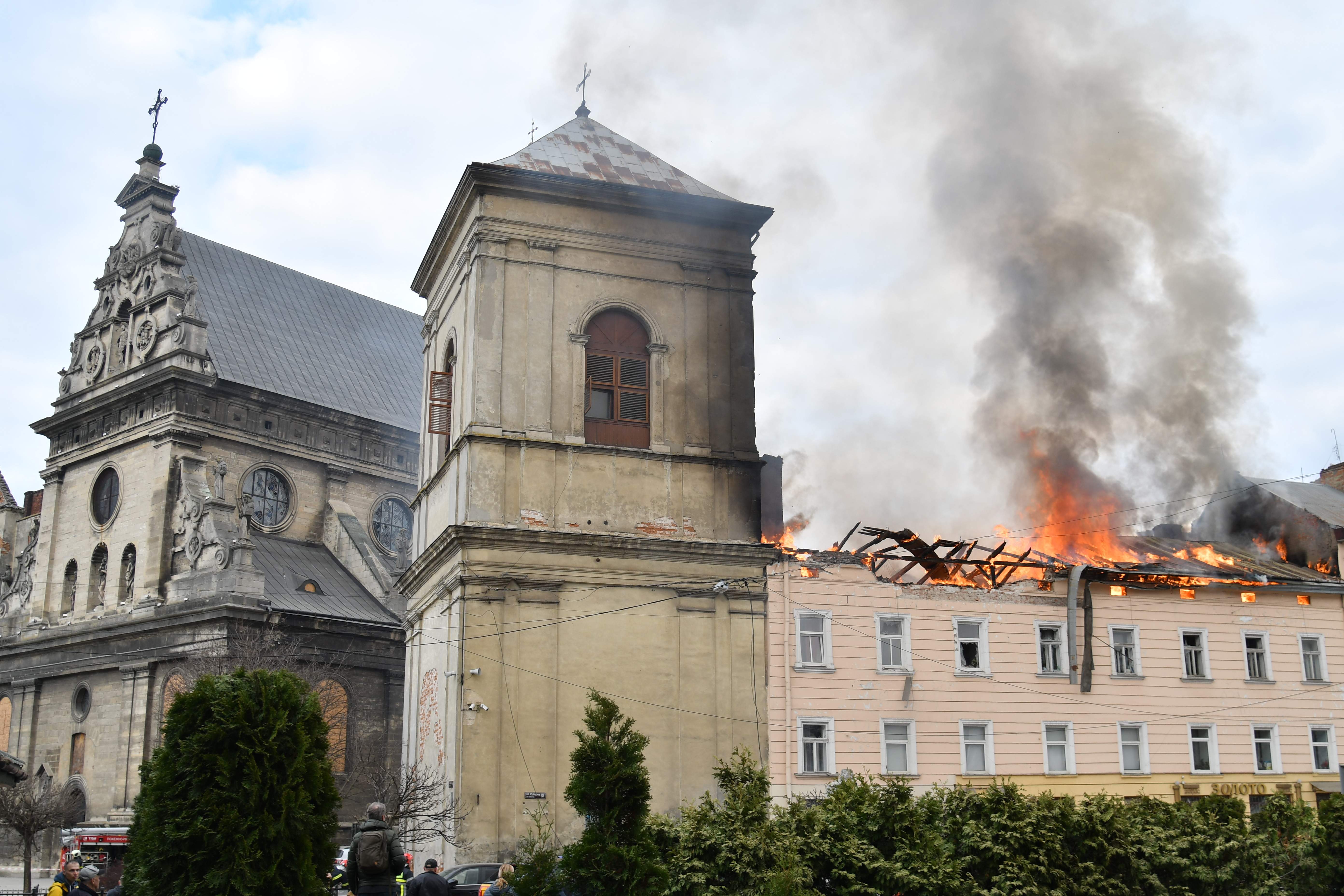
However, the March 24 attack—which hit the historic heart of Lviv, a UNESCO World Heritage site, and killed at least seven people nationwide—revealed a darker logic. Daytime flight allows Russian operators to use high-definition cameras for real-time terminal guidance. Instead of relying on pre-programmed GPS coordinates that can be spoofed by electronic warfare, these drones can now be steered into specific windows of apartment blocks or the open gates of energy substations by an operator watching a live feed. Additional insights into this topic are detailed by NPR.
The Numbers Behind the Surge
| Phase of Attack | Drones Launched | Interception Rate |
|---|---|---|
| Overnight Wave (March 23-24) | 392 | ~93% |
| Daytime Wave (March 24) | 556 | ~97% (Preliminary) |
| Total 24-Hour Period | 948 | 94% |
While the interception rate remains high, the sheer volume means "leakers" are inevitable. In Lviv, the drones struck the 17th-century St. Andrew’s Church and the Bernardine monastery complex. In Ivano-Frankivsk, a National Guard soldier and his 15-year-old daughter were killed just days after he had celebrated the birth of a new child. The psychological toll of a drone gliding past a fifth-floor office window at 2:00 PM is fundamentally different from an explosion heard while huddled in a basement at 3:00 AM.
Tactical Evolution or Desperation
Military analysts who have followed this conflict since 2022 see this as a response to Russia’s failure to achieve a ground breakthrough during the late winter. For the first time in two years, Ukraine actually liberated more land in February 2026 than Russia managed to occupy. The "spring offensive" Moscow is now telegraphing is being preceded by these protracted aerial strikes.
By spreading the attacks over a 24-hour window, Russia is practicing command-cycle compression. They are forcing Ukrainian air defense commanders to stay in a state of high alert indefinitely. This leads to decision fatigue. When a commander has been awake for 20 hours and is suddenly faced with a complex target profile—drones mixed with high-speed ballistic missiles—the probability of a catastrophic error in interceptor allocation increases.
Weaponry in Transition
It isn't just about the quantity of drones. The March 24 barrage included a mix of:
- Shahed-136/131: The workhorse "suicide" drone.
- Gerbera: A newer, smaller drone often used as a decoy or to identify radar positions.
- Stealth-coated UAVs: Drones painted with radar-absorbent materials to delay detection.
Ukraine’s Air Force spokesman noted that the geography of the daytime attack was significantly wider than the night strikes. The drones originated from the north—Sumy and Chernihiv—but tracked deep into the west, hitting targets near the Polish border. This forces Ukraine to keep its limited Patriot and NASAMS batteries spread thin, rather than concentrating them around the capital or the front lines.
The UNESCO Site as a Target
The damage to Lviv’s historic center is a calculated blow. By hitting a UNESCO-protected area, Russia is testing the international community’s resolve. The Bernardine monastery is not a military target by any sane definition. It is a symbol of Ukrainian identity and European heritage.
For the residents of Lviv, which is further from the front line than Vienna is from many European capitals, the "terrorist attack" feel of the daytime strike has stripped away the last remnants of a "safe" rear. When people are running from monuments in the middle of a Tuesday afternoon, the social fabric of the city is the intended target.
The Counter-Strategy
Ukraine is not standing still. President Zelenskyy’s recent appeals for air defense munitions are no longer just about missiles. They are about sensor fusion. Ukraine is now offering its drone-defense expertise to global partners in exchange for the hardware needed to sustain this war of attrition.
The defense is becoming more autonomous. Machine-learning-assisted optical sensors are being integrated into the machine gun mounts of mobile groups, reducing the reliance on human reflexes that can be dulled by exhaustion. The goal is to make the cost of launching a drone higher than the cost of shooting it down—a ratio that currently still favors the aggressor, as a $30,000 drone can occasionally force the use of a $2 million interceptor.
The March 24 assault proved that the air war has entered a permanent, 24/7 phase. There is no longer a "quiet time" in the Ukrainian sky. This evolution suggests that Russia intends to use these massive drone waves as a foundational layer of noise, under which they will attempt to slip more sophisticated, high-velocity missiles.
I can investigate the current production bottlenecks for the electronic components found in these new "Gerbera" decoys if you want to understand how the supply chain is bypassing sanctions.