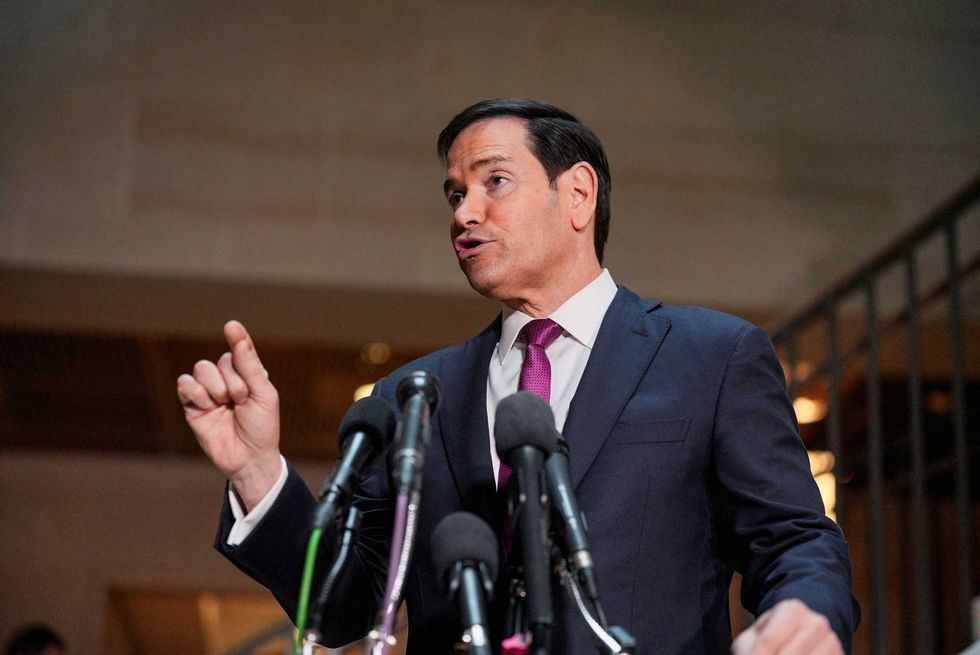
The selection of Marco Rubio as Secretary of State was supposed to be the moment the populist insurgency finally matured into a governing force. Instead, it has become the detonator for a civil war within the Republican upper echelon. While the public sees a unified front at Mar-a-Lago, the reality inside the West Wing is a jagged landscape of ideological purges and personality clashes. The "angry MAGA elites"—a loose confederation of billionaire donors, digital influencers, and isolationist hardliners—are not just annoyed by Rubio. They are terrified that the Florida Senator represents a "neocon" infection that will neutralize the America First agenda from within.
This is not a simple case of hurt feelings. It is a fundamental struggle over the machinery of American power. On one side, you have the institutionalists who believe that to dismantle the "Deep State," you need someone who knows where the bodies are buried. On the other, you have the true believers who view Rubio as the ultimate avatar of the very establishment they were promised would be destroyed. The friction has reached a fever pitch, threatening to stall the administration’s most ambitious foreign policy shifts before the ink is even dry on the executive orders.
The Proxy War for the President's Ear
The animosity toward Rubio did not emerge in a vacuum. It is a proxy war. For months, factions led by figures like Ric Grenell and Tucker Carlson have signaled that any pivot toward traditional interventionism would be viewed as a betrayal. Rubio, with his long history of hawkishness on China, Iran, and Latin America, is the personification of that pivot. To the hardline MAGA base, Rubio isn't just a cabinet pick; he is a glitch in the Matrix.
They remember 2016. They remember the "Little Marco" insults. More importantly, they remember his support for the Gang of Eight immigration bill and his cozy relationship with the intelligence community. When news of his appointment leaked, the digital ramparts of the right-wing internet didn't celebrate. They revolted. This internal combustion is making it nearly impossible for the administration to project a coherent message on the world stage.
The Venezuela Operation as a Stress Test
Nothing illustrates the Rubio-driven divide better than the recent military action in Venezuela. Dubbed "Operation Absolute Resolve," the precision strike to capture Nicolás Maduro was a Rubio-led masterpiece of regime change. It should have been a crowning achievement for a "muscular" America First policy. Instead, it exposed the rotting floorboards of the coalition.
While Rubio and his allies framed the move as a necessary assertion of the Monroe Doctrine, the isolationist wing saw a "forever war" in the making. Senator Rand Paul has already broken ranks, demanding congressional authorization and questioning why a movement built on ending foreign entanglements is suddenly snatching heads of state from their bedrooms.
The internal logic is collapsing. If "America First" means staying out of other people's business, then Rubio’s proactive interventionism is an apostasy. If "America First" means total dominance of the Western Hemisphere, then the isolationists are the ones out of step. This isn't a policy debate; it’s an identity crisis.
Silicon Valley and the New Power Brokerage
Adding a layer of complexity is the influx of tech-heavy influence. The emergence of a "Tech-MAGA" elite, fueled by venture capital and artificial intelligence interests, has introduced a new set of demands. These players are less interested in the culture wars and more focused on securing the supply chains for the next generation of semiconductors and AI hardware.
Rubio has attempted to bridge this gap by leaning into his reputation as a China hawk. He argues that American hegemony is the only thing protecting the tech industry from a "Marxist takeover" of the global digital infrastructure. But even here, he faces resistance. The tech moguls are wary of his penchant for sanctions that might disrupt their global markets. They want a Secretary of State who will open doors, not slam them shut in the name of national security.
- The Neocon Label: Critics use this to paint Rubio as a throwback to the Bush era.
- The Loyalist Test: Purists demand "total submission" to the MAGA creed, something Rubio’s Senate history makes suspect.
- The Policy Drift: There is a growing fear that Rubio will prioritize traditional alliances over "disruptive" bilateral deals.
The Intelligence Community's Last Stand
There is an even deeper game being played. Rubio’s tenure as Vice Chairman of the Senate Intelligence Committee gave him a level of comfort with the "alphabet agencies" that the MAGA vanguard finds loathsome. While the administration's "Border Czar" and other loyalists are busy clearing out the civil service, Rubio is seen as a protector of the professional class within the State Department.
The "angry elites" believe Rubio is providing cover for the very people who tried to subvert the movement in 2020. This has led to an unprecedented level of internal surveillance. Leaks are no longer just coming from disgruntled bureaucrats; they are coming from within the Cabinet itself, aimed at sabotaging Rubio’s initiatives before they can take root.
A Government of Conflicting Rationales
The result is a cabinet that resembles a "clown car" to its detractors and a "team of rivals" to its supporters. But unlike Lincoln’s team of rivals, this group lacks a unifying theory of the case. When Pete Hegseth, JD Vance, and Marco Rubio all give different justifications for a single military action, the world stops listening to the words and starts looking at the cracks.
The tension is most visible during high-stakes briefings. Rubio speaks the language of international law and strategic deterrence. Vance speaks the language of populist grievances. Trump, meanwhile, speaks the language of the deal. These three dialects do not translate well, and the resulting static is creating a vacuum of leadership that America’s adversaries are already beginning to fill.
The infighting over Marco Rubio is not a distraction from the work of governing; it is the work of governing in this era. Every appointment is a battle, and every policy memo is a weapon. The MAGA movement has successfully captured the castle, but now that they are inside, they realize they don't agree on what to do with the crown.
Rubio’s presence in the Cabinet is a bet that the movement can be professionalized without being castrated. It is a bet that the "angry elites" are willing to trade ideological purity for actual results on the ground. But as the backlash intensifies and the polls on the Iran and Venezuela actions turn "brutal," that bet looks increasingly risky. The movement isn't just fighting the "Deep State" anymore; it is fighting its own reflection in the mirror.
The next few months will determine if Rubio is the bridge to a sustainable new world order or the first high-profile casualty of a revolution that eats its own. If he falls, it won't be because of a Democratic filibuster. It will be because the people who put him there decided he was more useful as a scapegoat than a statesman.
Would you like me to analyze the specific financial ties between the "Tech-MAGA" donors and the current State Department's China policy?