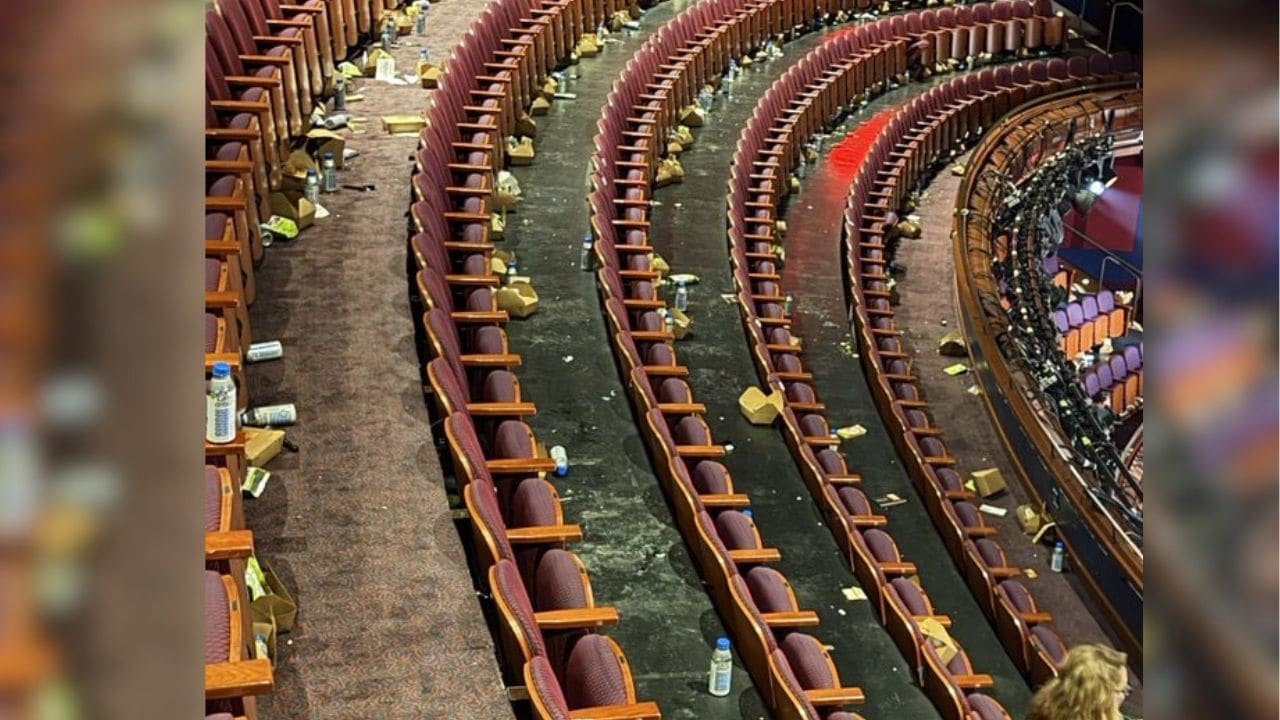
The image currently burning through social media feeds shows a sea of discarded champagne flutes, crumpled programs, and plastic remnants carpeting the floor of the Dolby Theatre. For the public, it is a shocking visual of Hollywood hypocrisy. For those of us who have spent decades behind the velvet rope, it is a predictable symptom of a systemic logistics failure. The 98th Academy Awards ended with a glittery bang, but as the lights went up, the transition from "glamour" to "landfill" happened in a matter of seconds.
The viral photograph captures a moment where the industry's public commitment to sustainability crashed into the reality of live television production. While the Academy of Motion Picture Arts and Sciences (AMPAS) has spent years touting "green" initiatives, the physical footprint of the 2026 ceremony suggests these goals are secondary to the frantic pace of a four-hour broadcast. For an alternative look, consider: this related article.
The Logistics of Elite Waste
The mess isn't just a matter of lazy guests. It is the result of a specific, high-pressure environment where every second of movement is choreographed. During commercial breaks, seat-fillers rush in, security details shift, and catering staff attempt to clear thousands of items in three-minute windows. When the show ends, the priority is immediate evacuation to clear the way for the Governors Ball and other sanctioned after-parties.
Cleaning crews are often prohibited from entering the main house while the broadcast is live to avoid any noise or visual interference with the cameras. This creates a pressure cooker of accumulation. By the time the "Best Picture" winner is announced, the accumulated debris of 3,400 people—who have been sitting, drinking, and snacking for half a day—has nowhere to go but down. Related reporting on the subject has been published by IGN.
The Problem With Single Use Luxury
Despite the optics, the Academy has made attempts to reduce its footprint. The red carpet is traditionally recycled, and plastic water bottles have been largely phased out in favor of aluminum or glass. However, the 2026 debris reveals a massive loophole: the "pre-party" and "seat-side" service.
To keep high-profile talent from leaving their seats for the bar, premium snacks and drinks are delivered directly to the rows. Each of these items requires packaging. Even if that packaging is labeled "compostable," Los Angeles lacks the high-heat industrial processing infrastructure to handle that volume of bioplastics on a single-night turnaround. Most of it ends up in the same bin as the actual trash.
The viral photo highlights a specific failure in the waste stream management of the venue. When bins overflow in the lobby, guests don't go looking for a secondary site; they leave their trash under their $25,000-per-seat chairs.
The Hypocrisy Gap
There is a growing resentment among the viewing public when a stage full of millionaires lectures the world on environmental stewardship while standing atop a mountain of non-biodegradable waste. This isn't just about the optics; it’s about the credibility of the brand.
In 2026, the Academy leaned heavily into a "Future of Film" theme that emphasized digital innovation and reduced physical waste. Yet, the physical reality of the Dolby Theatre told a different story. To the analyst, this gap between rhetoric and reality is more dangerous than a few bad headlines. It suggests a lack of operational oversight.
Why the Vendors Are Failing
The contracts for Oscars night are among the most coveted in the hospitality world. However, these contracts are often awarded based on prestige and menu design rather than the efficiency of their breakdown procedures.
- Labor shortages: Cleaning crews for massive events have seen a 30% turnover rate since 2024.
- Time constraints: The Dolby Theatre must be "show ready" for other events almost immediately, forcing a "scrape and go" approach to cleaning.
- Material choices: "Luxury" often translates to weight and bulk—thick programs, heavy gift bags, and glass—all of which are harder to sort than lightweight alternatives.
We see a pattern where the "front of house" looks like a dream, while the "back of house" is an environmental nightmare. The industry likes to talk about "circular economies," but their actual practice remains strictly linear: buy, use, discard.
A Ghost in the Machine
The real culprit isn't the celebrity who leaves a glass behind. It is the production design.
Modern award shows are built on a "set" mentality. Everything is temporary. The carpet, the floral arrangements, and even some of the seating are brought in for a 48-hour window. This temporary nature breeds a culture of disposability. If the venue were designed with permanent, high-efficiency waste sorting built into the architecture of the seating itself, the "viral trash" wouldn't exist.
Instead, we rely on a manual labor force that is increasingly stretched thin. The viral image isn't just a picture of trash; it is a picture of a labor force that couldn't keep up with the demands of a bloated production.
Rebuilding the Model
Fixing this requires more than just better PR. It requires a fundamental shift in how the Academy handles its physical presence.
- Mandatory Load-In/Load-Out Audits: Every vendor should be required to weigh what they bring in and what they take out.
- Digital-First Materials: The physical program, a major source of the 2026 clutter, should be entirely digital, accessible via the seat’s built-in screens.
- The "Clean Row" Incentive: If Hollywood wants to prove it cares, it needs to treat its theater like a stadium. In some international sporting venues, sections are rewarded for cleanliness. While that sounds "low-rent" for the Oscars, the current alternative is looking like a frat party after-math.
The industry is currently obsessed with its carbon footprint regarding travel and filming locations. It has ignored the glaring, physical mess in its own backyard. The 2026 trash viral moment is a wake-up call that the "glamour" of the Oscars is increasingly seen as an outdated, messy relic of a previous century.
The Economic Cost of Bad Optics
Beyond the environmental impact, there is a business case for cleaning up the act. Sponsors are increasingly wary of being associated with "wasteful" events. When a brand's logo is visible on a discarded napkin in a pile of filth, the marketing ROI takes a hit.
The Academy's board of governors has spent the last year trying to stabilize falling ratings. They have tried new hosts, shorter segments, and more popular film categories. But they haven't addressed the vibe shift. The modern audience, particularly the younger demographic they crave, values authenticity. Nothing screams "inauthentic" like a climate change speech delivered over a floor covered in litter.
The solution isn't to hide the trash better. The solution is to stop producing it.
This means moving away from the "gift bag" culture that generates hundreds of pounds of packaging per guest. It means demanding that the Dolby Theatre—and the city of Los Angeles—provide the infrastructure to actually process what is discarded.
If the Academy can’t manage the waste in a single room for one night, their claims of leading the cultural conversation on global issues will continue to ring hollow. The camera eventually turns away from the stage. When it hits the floor, the image should be as polished as the statue.
Ask the producers how they plan to integrate waste management into the actual show budget, because right now, it looks like an afterthought that has finally caught up with them.