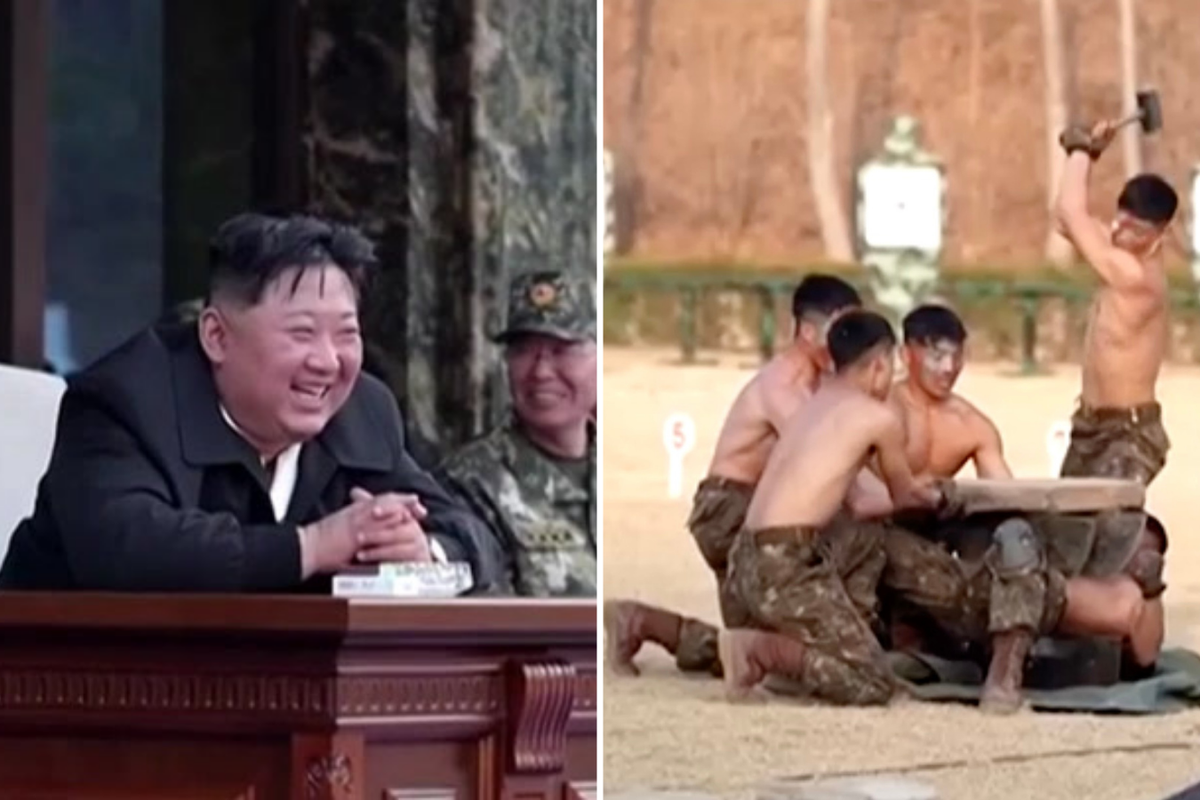
North Korea’s recent military showcase, featuring soldiers smashing concrete blocks with their bare fists and enduring sledgehammer blows to the chest, is not a display of modern combat readiness. It is a calculated piece of theater designed to mask a crumbling conventional military infrastructure. While the footage of Kim Jong Un laughing as troops pummel each other with bricks and axes went viral for its sheer visceral intensity, the performance serves a singular, desperate purpose. It attempts to project "invincibility" through human physical endurance because the regime cannot afford the high-tech sensors, precision-guided munitions, or sixth-generation aircraft that define 21st-century warfare.
To understand why a nuclear-armed state still relies on "iron cloth" kung-fu demonstrations, one must look past the broken masonry. This is a story of a nation doubling down on the cult of the "human bullet" to compensate for a chronic lack of fuel, spare parts, and caloric intake among its rank-and-file.
The Choreography of Pain as a Defense Mechanism
The spectacle of a soldier lying on a bed of nails while a comrade breaks a boulder on his stomach is an ancient trope of martial arts showmanship. In the context of Pyongyang’s military doctrine, it is rebranded as Kyoksol, the North’s specific brand of close-quarters combat. The message sent to the domestic audience is clear. If the Western "imperialists" have better drones, the North Korean soldier has a body harder than the drone’s carbon fiber.
This focus on extreme physical conditioning is a necessity born of poverty. Most North Korean tanks are T-54 or T-62 models, designs that originated in the Soviet Union during the mid-20th century. These machines are largely obsolete in an era of Javelin missiles and thermal optics. When a military knows its hardware cannot survive a direct engagement, it pivots the narrative toward the indomitability of the soldier’s spirit. The "sledgehammer" displays are a psychological hedge. They suggest that even if the lights go out and the fuel runs dry, the Korean People's Army (KPA) remains a force of millions of lethal, hand-to-hand combatants.
Why the Brutality is Staged for the Cameras
The footage released by the Korean Central News Agency (KCNA) is meticulously edited. The bricks are often pre-scored or made of high-lime content to ensure they shatter spectacularly upon impact. This is not to say the soldiers aren't feeling pain. The bruising and bone density required for these stunts are real, but the tactical utility is zero. In a modern conflict, the distance between opposing forces is measured in kilometers, not inches. A soldier who can break an axe handle with his forearm is still vulnerable to a 5.56mm round from 300 meters away.
The "why" behind these displays often points toward internal morale. For a young recruit in a rural province, seeing a peer perform these feats creates a sense of belonging to a supernatural brotherhood. It is a recruitment tool that costs almost nothing. While the United States spends billions on the F-35 program, North Korea spends a few thousand won on concrete slabs and theatrical training. It is the ultimate low-budget deterrent.
The Overlooked Threat of the Asymmetric Pivot
While the world scoffs at the "circus acts" of the KPA, the regime is using these distractions to hide where the real money goes. The irony of Kim Jong Un smiling at men hitting each other with sticks is that he is simultaneously overseeing one of the most sophisticated cyberwarfare and missile programs on the planet.
The resources saved by not modernizing the infantry’s basic equipment—like providing standard-issue body armor or reliable transport—are diverted into the Reconnaissance General Bureau. This is the unit responsible for high-profile hacks and cryptocurrency theft. By keeping the infantry in a state of 1950s-era "physical toughness," the regime maintains a massive, low-cost standing army that serves as a meat-shield for its nuclear and digital assets.
The Logistics of the Human Sledgehammer
- Caloric Deficit: Most KPA soldiers suffer from chronic malnutrition. The "super-soldiers" seen in these videos are a tiny, elite cadre who receive extra rations and specialized training.
- The Showmanship Tax: Training for these events takes thousands of hours away from actual tactical drills, such as small-unit maneuvers or radio communication.
- Psychological Operations (PSYOPS): These videos are distributed specifically to go viral in the West. The regime understands that "weird" or "brutal" content garners more views than standard parade footage, ensuring their message of defiance reaches global feeds.
The Counter-Argument to "Empty Theater"
Some analysts argue that dismissing these displays as mere theater is a mistake. There is a psychological component to warfare that transcends technology. A soldier who is willing to let a comrade swing a sledgehammer at his chest is a soldier who may be less likely to surrender in a trench. This level of indoctrination and physical hardiness creates an "attrition-heavy" environment. If a conflict were to break out on the peninsula, the sheer willingness of the KPA to endure extreme physical hardship would complicate any occupation or ground campaign.
However, historical precedent shows that "spirit" rarely wins against air superiority. During the Gulf War, the Iraqi Republican Guard was touted as a battle-hardened force of elite warriors. They were decimated by precision strikes before they ever saw an American soldier's face. Pyongyang knows this. The bricks and axes are for the cameras; the ICBMs are for the survival of the Kim family.
The Invisible Cost of the Showcase
The men in these videos are likely suffering from long-term traumatic brain injuries and micro-fractures. The "demonstration" is a snapshot of a society that views its citizens as disposable components of a state-wide propaganda machine. Every shattered brick is a symbol of a resource that wasn't used to feed a village or provide basic healthcare.
Behind the laughter of the leadership lies a cold calculation. They are betting that the image of a soldier smashing a stone with his head is enough to make the world forget that the country cannot produce enough electricity to keep its capital lit at night. It is a bluff of the highest order, played out in slow motion and high definition.
The real danger isn't the man breaking the brick. It's the system that needs him to do it to prove it still exists. As long as the world focuses on the brutality of the stunt, the regime succeeds in its primary goal: distraction. The next time you see a video of a North Korean soldier performing an "impossible" feat of strength, don't look at the hammer. Look at the man holding it, and ask what he’s being asked to hide.
Stop treating the KPA as a joke or a circus. Treat them as a regime that has perfected the art of using human suffering as a smoke screen for its survival.
[/article]