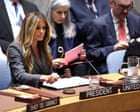
The optics were surgically precise, but the timing was a political landmine. On Monday, Melania Trump became the first spouse of a sitting world leader to preside over the United Nations Security Council, wielding the gavel as the United States assumed its rotating presidency for March. Ostensibly, the session was a high-minded exploration of "Children, Technology, and Education in Conflict." In reality, it was a collision between the First Lady’s soft-power advocacy and the hard-power realities of a new war.
While Mrs. Trump spoke of "democratizing knowledge" through artificial intelligence and protecting the "sacred" nature of learning, the chamber was haunted by reports from the Iranian city of Minab. Just forty-eight hours prior, a missile strike reportedly leveled the Shajareh Tayyebeh girls' elementary school. Iranian state media claims 165 children were killed. The U.S. and Israel, currently engaged in a widening military offensive against Tehran, have stated they are "looking into" the reports. It is a familiar, grisly script in a region where the line between a military target and a classroom is often blurred by "logistics."
The Paradox of the Gavel
The First Lady’s address was remarkably detached from the smoke rising in the Middle East. She spoke with the practiced composure that has defined her public life, framing education as a tool to "elevate our children above ideology." Her central thesis was that technology, specifically AI, could bridge the gap for the 473 million children currently living in or fleeing conflict zones.
"Conflict arises from ignorance," she told the council. "Knowledge creates understanding, replacing fear with peace and unity."
It is a noble sentiment, yet it rings hollow to those on the ground. When a school is reduced to rubble, the immediate need isn't a tablet or an AI-driven curriculum; it is a ceiling that doesn't collapse. The First Lady’s focus on digital education assumes a level of infrastructure that war systematically destroys. While she championed the idea that "almost anyone, anywhere can access a vast universe of data," the reality in Iran and its neighbors is one of widespread internet blackouts and "remote learning" born of necessity because physical buildings are no longer safe.
A Shadow Over the Horseshoe Table
The diplomatic friction was palpable even before the session began. Amir Saeid Iravani, Iran’s ambassador to the UN, did not mince words. He labeled the meeting "deeply shameful and hypocritical," pointing out the cognitive dissonance of the U.S. convening a panel on child protection while its own missiles—or those of its closest ally—are accused of hitting Iranian primary schools.
This isn't just a matter of "he-said, she-said" propaganda. The strike in Minab occurred near an Islamic Revolutionary Guard Corps (IRGC) navy base. Investigative reports suggest the school was situated within a compound housing military-affiliated facilities. This raises the brutal, recurring question of modern warfare: who is responsible when a military objective is placed in the shadow of a playground? International law is clear on the prohibition of using civilian areas to shield military targets, but it is equally clear on the obligation of attacking forces to ensure civilian lives are spared.
In the Security Council, however, these nuances were largely swept aside in favor of broader platitudes. U.N. political chief Rosemary DiCarlo provided the necessary factual weight, noting that schools across Israel, the UAE, Qatar, Bahrain, and Oman have been forced to close. The war is not contained; it is a regional contagion, and children are the primary hosts of the trauma.
The Personalization of Foreign Policy
The decision to put Melania Trump in the President’s chair is a significant departure from standard protocol. Usually, this seat is occupied by a career diplomat or a high-ranking cabinet official like the Secretary of State. By sending the First Lady, the Trump administration is signaling that child welfare is a core pillar of its international agenda—or, perhaps, using her "Be Best" brand to soften the edges of a "Maximum Pressure" military campaign.
There is a precedent for her involvement. Last summer, she reportedly wrote to Vladimir Putin to facilitate the return of Ukrainian children taken to Russia. That effort, while criticized by some as back-channel meddling, did result in families being reunited. It established her as a figure capable of navigating high-stakes diplomacy through the lens of humanitarianism.
But the UN is a different beast. It is a theater of the cynical. While the White House promotes her message of "Peace Through Education," the U.S. military is simultaneously bombing ballistic missile sites and sinking Iranian naval ships. The "window of opportunity" that President Trump cited for these strikes has effectively slammed shut the doors of the very classrooms his wife is pledging to protect.
AI as the Great Equalizer or a Distant Dream
A significant portion of Mrs. Trump’s speech focused on the role of technology. She argued that AI is "redefining who gets to participate in the global economy of ideas." In a vacuum, she is correct. The ability to bypass traditional, often biased, educational systems through digital platforms is a powerful equalizer.
However, the "Brutal Truth" is that technology in conflict zones is more often a weapon than a teacher. Children in these regions face:
- Digital recruitment by armed groups.
- State-sponsored radicalization through controlled platforms.
- Targeted cyberbullying and exploitation.
- Total loss of access due to intentional infrastructure destruction.
The First Lady urged the council to "connect everyone to knowledge through AI." But for a child in a refugee camp in the DRC or a basement in Tehran, the "vast universe of data" is irrelevant without electricity, hardware, and, most importantly, the physical security to use them.
The Strategic Silence
Perhaps the most telling part of the session was what wasn't said. Melania Trump did not mention the Minab strike. She did not mention the three U.S. service members killed in the recent operations, though she offered condolences to families who "lost their heroes." She kept the conversation in the realm of the aspirational, steering clear of the blood and cordite of the previous 72 hours.
This strategic silence allowed her to maintain her image as a beacon of tolerance, but it also highlighted the disconnect between the East River and the Persian Gulf. You cannot "safeguard learning" in the abstract while the literal walls of schools are falling.
The session ended as abruptly as the peace it sought to promote. There was no grand resolution, no binding commitment—only a "pledge to safeguard learning" that carries no legal weight. As the First Lady vacated the chair, the reality of the conflict remained unchanged. The U.S. military operation continues "unabated," and the children of the region remain the most vulnerable collateral in a game played by adults who speak of peace while preparing for more war.
The path to peace may indeed depend on education, but education requires a world that isn't on fire. Until the missiles stop falling, the most advanced AI in the world is just another light flickering in the dark.