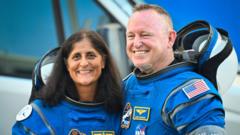
The Boeing Starliner mission did not just fail to meet its objectives; it shattered the remaining facade of aerospace supremacy that the company spent a century building. When NASA officials recently acknowledged that the spacecraft’s thruster failures and helium leaks were too risky for a crewed return, they weren't just making a tactical flight decision. They were issuing a verdict on a corporate culture that has prioritized financial engineering over mechanical engineering for two decades. The decision to return the Calypso capsule empty while leaving Butch Wilmore and Suni Williams to wait for a SpaceX rescue is the most public humiliation in the history of American spaceflight.
This was a disaster born of arrogance. While the immediate technical culprits were failing Teflon seals and manifold leaks, the root cause is a broken procurement model and a legacy giant that forgot how to build hardware. Boeing was given more money, more time, and more leeway than its competitors, yet it delivered a product that NASA ultimately could not trust with human lives.
The Engineering Rot Behind the Thruster Failures
To understand why Starliner stayed docked at the International Space Station (ISS) far beyond its expiration date, you have to look at the Reaction Control System (RCS). These small thrusters are the heartbeat of the spacecraft. They handle the delicate "proximity operations" required to dock and, more importantly, the precise positioning needed for a safe atmospheric reentry.
During the approach to the ISS, five of these thrusters failed. The telemetry was clear, but the "why" was elusive. Post-flight testing at the White Sands Test Facility revealed a startling reality: the thrusters were overheating, causing a small Teflon seal to bulge and restrict the flow of propellant.
Boeing's engineers had modeled the thermal environment of these thrusters, but their models failed to account for the "doghouse" effect—the way the thrusters are clustered in pods that trap heat. When the thrusters fired frequently during docking, the heat buildup was more intense than the simulations predicted. This is a fundamental engineering oversight. It suggests that the testing protocols were designed to pass a checklist rather than to find the breaking point of the hardware.
A Tale of Two Contracts
The disparity between Boeing and SpaceX is the most damning part of this saga. Under the Commercial Crew Program, NASA awarded Boeing a fixed-price contract worth $4.2 billion. SpaceX received $2.6 billion for the same task.
Boeing was the "safe" bet. They were the blue-chip incumbent with deep ties to the halls of power in Washington. SpaceX was the upstart. Yet, SpaceX has been flying operational crew missions since 2020. Boeing, despite having $1.6 billion more in taxpayer funding, has spent the last five years trapped in a cycle of "test, fail, remediate, repeat."
The $4.2 billion wasn't just for a spacecraft; it was for a service. But Boeing treated it like a cost-plus contract of the 1960s, constantly looking for ways to mitigate their internal losses rather than accelerating the development cycle. The result is a spacecraft that is essentially an antique before it even completes its first operational mission.
The Helium Leak That Wouldn't Quit
If the thruster failures were the killing blow, the helium leaks were the slow bleed. Helium is used to pressurize the fuel lines, pushing propellant into the engines. A leak isn't just a loss of gas; it's a systemic vulnerability.
Boeing knew about the first leak before the launch. They decided it was "manageable." Once in orbit, four more leaks appeared. The sheer number of failure points points to a supply chain and assembly crisis. When you have multiple leaks across independent manifolds, you aren't looking at a fluke; you're looking at a systemic failure in quality control.
The decision-making process during the mission was a tug-of-war between Boeing’s "it’s fine to fly" optimism and NASA’s "show me the data" skepticism. In the end, Boeing couldn't prove the spacecraft was safe. In the vacuum of space, "probably safe" is a death sentence. NASA chose the indignity of a SpaceX rescue over the possibility of a catastrophic reentry failure.
The Financialization of Flight
The decline of Boeing’s space division mirrors the decline of its commercial aviation wing. The same culture that led to the 737 MAX disasters—a focus on share buybacks, outsourcing, and the marginalization of senior engineers—is evident in the Starliner program.
For years, Boeing has been bleeding talent to younger, more agile firms like Blue Origin and SpaceX. The engineers who remain are often hamstrung by a management layer that views a spacecraft as a spreadsheet rather than a life-support system. When you prioritize the quarterly earnings call over the vacuum chamber test, the hardware eventually tells the truth.
The "fixed-price" nature of the contract meant that every delay cost Boeing money. To date, the company has taken over $1.5 billion in charges related to Starliner. In a sane business environment, this would trigger a total overhaul of the program. Instead, Boeing has doubled down on the same flawed processes, hoping that political inertia would carry them across the finish line.
NASA's Culpability in the Starliner Myth
NASA is not a neutral observer here. The agency's leadership spent a decade propping up the idea that Boeing was the "primary" partner while SpaceX was the backup. This bias led to a lack of oversight.
The agency’s safety culture, supposedly rebuilt after the Challenger and Columbia disasters, was tested by Starliner. For weeks, the public messaging was a masterclass in obfuscation. They called the stay an "extension" rather than a "stranding." They insisted the craft was "cleared for emergency return" while knowing they wouldn't dare use it for a planned one.
The final decision to use the Crew-9 Dragon for the return was a rare moment of institutional courage. It was an admission that the "Boeing is safer" narrative was dead.
The Technical Debt of Legacy Hardware
Starliner is built on a philosophy of incrementalism. It uses components and designs that are decades old, stitched together with modern software that often doesn't play nice with the heritage hardware.
Contrast this with the SpaceX Dragon. Dragon was built from the ground up as a software-defined vehicle. It is simpler, has fewer moving parts, and was designed for rapid iteration. Boeing tried to build a 21st-century ship using a 20th-century playbook. They are now buried under "technical debt"—the accumulated cost of all the shortcuts and old-school design choices they made early in the program.
The RCS thrusters themselves are a prime example. They are located in the Service Module, which is jettisoned and burned up during reentry. This means engineers can never actually examine the hardware that failed. They are "flying blind," relying on sensors that were never intended to diagnose a meltdown in real-time.
The Geopolitical Fallout
The Starliner failure doesn't just hurt Boeing; it hurts the United States' position in the new space race. With the ISS scheduled for retirement by 2030, the U.S. needs reliable, redundant transportation to Low Earth Orbit (LEO).
Currently, the U.S. is one bird-strike or sensor-glitch away from having no way to get to space. If the SpaceX Falcon 9 fleet is grounded for any reason, the U.S. has zero crew capability. This is the "dissimilar redundancy" that NASA paid $4.2 billion for, and right now, it doesn't exist.
Meanwhile, China’s space program is moving with a speed and internal coherence that should terrify anyone in Arlington or Houston. While Boeing fumbled with a leaky valve, China was landing rovers on the far side of the moon and building a modular space station with clockwork precision.
The Path to Accountability
Fixing Starliner isn't about more testing; it's about a total purge of the program's management philosophy. Boeing needs to stop treating NASA as a captive customer and start treating them as a demanding one.
- Total Thruster Redesign: The current Aerojet Rocketdyne thrusters are clearly not fit for the thermal environment of the Starliner service module. A "patch" won't work. The hardware needs a redesign that accounts for the heat soak issues discovered at the ISS.
- Open Data Transparency: Boeing has been notoriously protective of its proprietary data. This secrecy prevented outside experts from identifying the helium leak risks earlier. If taxpayer money is the fuel, the data must be public.
- Engineering Empowerment: The decision-making power needs to be stripped from the MBAs and handed back to the people who understand fluid dynamics and thermal load.
The End of the Boeing Era
We are witnessing the end of a monopoly. For decades, Boeing was the only name that mattered in American aerospace. They were too big to fail and too important to ignore. Starliner has proven that they are neither.
The empty return of the Calypso capsule is a ghost ship of Boeing’s own making. It is a monument to what happens when a company loses its "north star" and replaces it with a stock price. Butch and Suni will come home on a competitor's ship, wearing suits designed by a company that didn't exist when Boeing started building the ISS.
There is no coming back from this without a radical, painful admission of failure. The aerospace industry doesn't care about your heritage; it only cares about your last thousand lines of code and the integrity of your seals. Boeing failed both.
Every engineer at Boeing should be forced to watch the footage of the empty Starliner undocking from the ISS. It shouldn't be seen as a "learning opportunity." It should be seen as a disgrace. Until the company feels that weight, they will continue to produce hardware that is more dangerous than the vacuum it’s meant to navigate.
Stop looking at the mission as a "setback." It is a systemic collapse.
The next move is for NASA to stop acting like Boeing’s protective parent and start acting like its landlord. The lease is up, the rent is overdue, and the pipes are leaking.