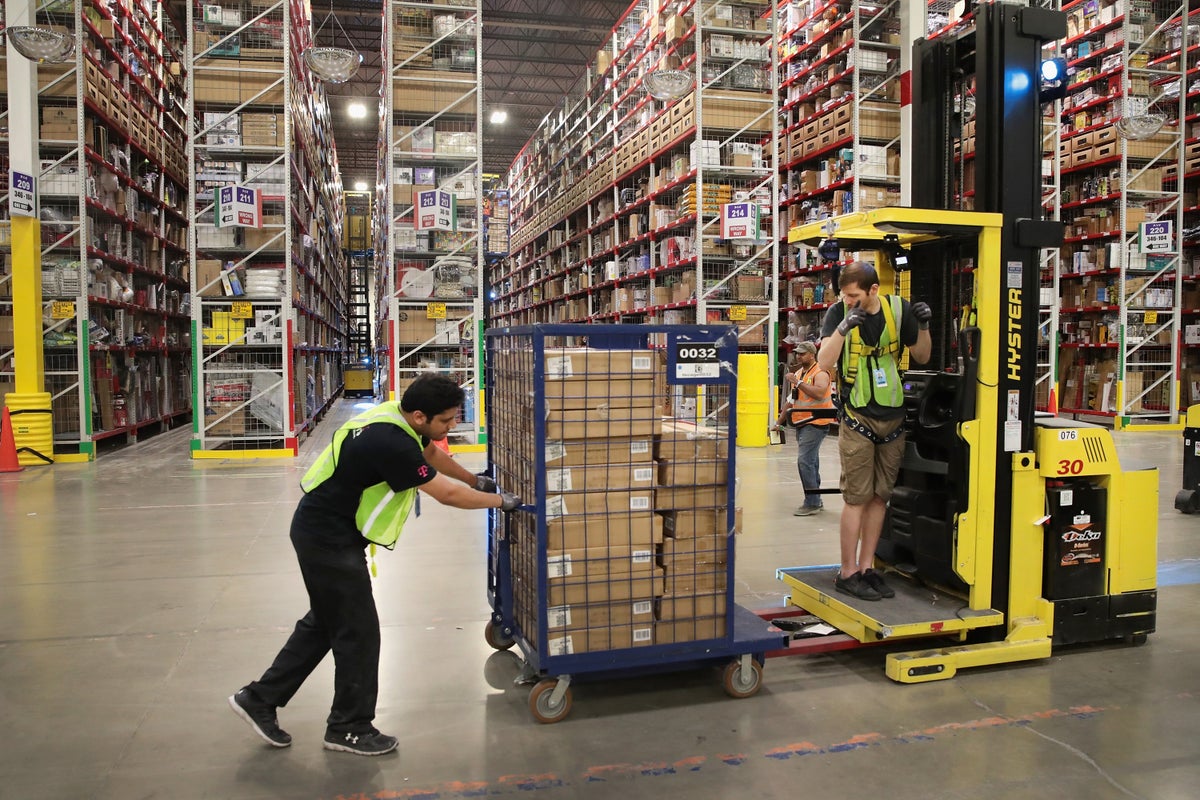
The Amazon logistics machine is built on the premise that human bodies are as replaceable as the cardboard boxes they move. While the company markets its "Safety First" initiatives with bright floor tape and ergonomic posters, the reality inside the fulfillment centers is often a grueling race against an algorithm that does not account for muscle fatigue or spinal integrity. A recent lawsuit involving an employee terminated while recovering from job-related double hernia surgery pulls back the curtain on a system that treats medical leave not as a recovery period, but as a performance failure.
This isn't an isolated incident of administrative oversight. It is the logical endpoint of a management style that prioritizes "Rate"—the number of items scanned per hour—over the biological limits of the workforce. When an employee’s body finally breaks under the weight of repetitive 50-pound lifts, the company’s automated systems often trigger a sequence of events that leads to a pink slip before the surgical stitches are even removed.
The Mechanical Logic of Human Depletion
Amazon operates on a high-velocity turnover model. In many industries, losing a trained employee is a significant financial hit. In the world of "Tier 1" associates, however, the system is designed to absorb high attrition. The logic is simple: it is often cheaper to hire a fresh pair of arms than it is to accommodate the restrictions of a worker who has been injured on the line.
The lawsuit in question highlights a recurring pattern in the logistics sector. An employee develops a double hernia, a classic injury caused by improper strain or excessive repetition. They report the injury, go through the bureaucratic maze of workers' compensation, and eventually undergo surgery. But while the human is on the operating table, the software is still tracking their absence.
The friction occurs when the "Leave of Absence" (LOA) departments and the local facility management fail to communicate. Or, more cynically, when they communicate perfectly to ensure a worker is "cleared" for duty before they are physically capable, setting the stage for a termination based on job abandonment or inability to perform. It is a legal gray area that Amazon has navigated for years, often relying on the fact that most hourly workers lack the resources to sustain a multi-year legal battle against a trillion-dollar entity.
The Algorithm is Your Manager
In a traditional warehouse, a floor supervisor might see a worker wincing and suggest they take a lighter load for the afternoon. At Amazon, your supervisor is a set of data points. If your "Time Off Task" (TOT) exceeds a certain threshold, the system flags you.
This digital oversight creates a culture of fear where employees skip bathroom breaks or work through "minor" pains that eventually bloom into chronic conditions or acute injuries like hernias. When you are managed by an algorithm, there is no room for the nuance of physical recovery. The machine expects 100% output 100% of the time.
The Hernia Factory
Lifting a box once isn't the problem. Lifting 300 boxes an hour, every hour, for a ten-hour "megacycle" shift is where the breakdown happens. Hernias occur when an organ or fatty tissue squeezes through a weak spot in a surrounding muscle or connective tissue. In warehouse environments, this is almost always the result of:
- Repetitive heavy lifting without adequate rest periods for muscle fiber repair.
- Twisting at the torso while holding weight, a common necessity when meeting high-speed sorting quotas.
- Chronic fatigue which leads to the breakdown of proper lifting form.
When these injuries happen, the company's first line of defense is often to claim the injury was "pre-existing" or occurred outside of work hours. By shifting the burden of proof onto the employee, the company delays the medical intervention that could have prevented a permanent disability.
A Legal Strategy of Attrition
The legal filings against the retail giant often paint a picture of a "Catch-22" for injured workers. To keep their jobs, they must return to work. To return to work, they must be "100% healed"—a standard that Amazon frequently demands yet refuses to facilitate through light-duty assignments.
If a worker cannot return to their original, grueling role, the company may claim they have no "reasonable accommodation" available. This effectively allows them to fire the worker legally under the guise of an inability to fulfill the job description. The recent lawsuit suggests that the plaintiff was fired even after following every protocol, indicating a breakdown in the system—or perhaps, a system working exactly as intended to purge "low-utility" assets.
The Cost of Convenience
We live in an era of one-hour delivery and seamless logistics. That speed has a human cost that is rarely reflected in the Prime subscription fee. The "injury pipeline" is a hidden subsidy for the modern economy. By externalizing the cost of worker injuries—pushing them onto public disability systems or the workers' own depleted savings—Amazon maintains its competitive edge.
Industry analysts have long warned that Amazon is "running out of people" to hire in certain geographic regions because of its reputation and high turnover. Yet, the company’s reliance on automation suggests they are simply trying to bridge the gap until the "human element" can be removed from the warehouse floor entirely. Until then, the humans currently occupying those roles are being treated as stop-gap components with a limited shelf life.
Navigating the Workers Comp Minefield
For any warehouse worker facing a similar situation, the path forward is treacherous. The company’s internal HR systems, often outsourced to third-party administrators like Sedgwick, are notorious for lost paperwork and denied claims.
To survive the process, documentation must be exhaustive. Every conversation with a manager, every medical note handed to a learning lead, and every timestamped photo of a work station must be saved. The moment an injury occurs, the relationship between the employer and the employee changes from collaborative to adversarial.
The False Promise of Safety Committees
Amazon frequently touts its "WorkingWell" program and on-site physical therapy. Critics and former employees often describe these as "safety theater." Stretching circles and ergonomic tips are useless if the underlying production quotas remain unchanged. You cannot stretch your way out of a double hernia caused by a quota that ignores human physics.
True safety reform would require a fundamental slowing of the line. It would require the "Rate" to be flexible based on the age, physical condition, and shift length of the worker. But in the world of high-frequency trading and precision logistics, "slow" is a dirty word.
The Power Imbalance
The core of the problem is the staggering power imbalance between a frontline associate and the corporate infrastructure. When an associate is fired, they lose their income and, crucially, their health insurance—often right when they need it most for post-operative care. This creates a desperate situation where workers are pressured to sign NDAs or modest settlement agreements just to keep the lights on.
The legal system is slowly catching up, but it is a reactive force. For every lawsuit that makes the headlines, thousands of other workers disappear into the "voluntary resignation" statistics, too exhausted or discouraged to fight back.
Strategic Moves for Reform
If the industry is to move away from this disposable-human model, several things must change:
- Federal Oversight of Quotas: Regulatory bodies must treat warehouse "Rates" as a safety hazard equivalent to exposed wiring or toxic fumes.
- Mandatory Light Duty: Companies over a certain valuation should be legally required to provide light-duty roles for employees injured on-site, rather than opting for termination.
- Third-Party LOA Audits: The systems that manage medical leave should be audited by independent bodies to ensure that "clerical errors" aren't being used as a tool for illegal terminations.
The double hernia lawsuit is a warning shot. It serves as a reminder that behind every "shipped" notification is a person whose physical future is being wagered against a delivery deadline.
You should audit your own workplace's injury reporting procedures immediately to ensure you have a paper trail that exists outside of company-controlled servers.
.png?width=1200&auto=webp&trim=0%2C0%2C0%2C0)