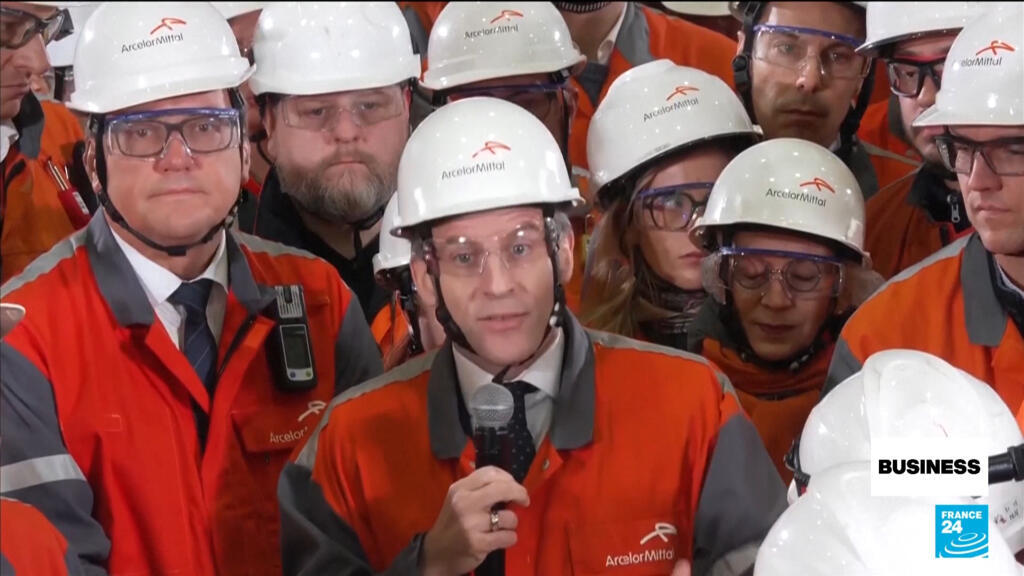
Emmanuel Macron did not just visit a steel mill in Dunkirk to celebrate a factory upgrade. He went there to witness the high-stakes survival strategy of European heavy industry. ArcelorMittal’s €1.3 billion investment in low-carbon furnaces is the centerpiece of a desperate race to decouple steel production from the coal-fired blast furnaces that have defined the continent’s skyline for a century. This is not merely an environmental pivot. It is a calculated move to keep French manufacturing alive in an era where carbon taxes threaten to make traditional smelting a financial impossibility.
The project centers on replacing coal with hydrogen and electricity. By installing a Direct Reduced Iron (DRI) plant and two electric arc furnaces, ArcelorMittal aims to slash carbon emissions at the Dunkirk site by roughly 5.7 million tonnes annually. That is a staggering figure, representing a significant chunk of France's industrial carbon footprint. But the transformation of a massive integrated steelworks is a messy, expensive, and technically volatile process that relies on variables far outside the control of any CEO or President.
The Chemistry of Survival
To understand why this costs €1.3 billion, one must look at the brutal physics of iron making. Traditionally, steel starts in a blast furnace where iron ore meets coke—a purified form of coal. The coal acts as both a fuel and a reducing agent, stripping oxygen from the ore to create molten iron. This process is incredibly efficient but chemically predisposed to vomit carbon dioxide into the atmosphere.
The new Dunkirk setup bypasses the blast furnace entirely. The DRI plant uses gas—initially natural gas, eventually hydrogen—to remove oxygen from the iron ore pellets. This solid "sponge iron" is then melted in electric arc furnaces (EAF). When the electricity comes from France’s nuclear-heavy grid and the gas is replaced by green hydrogen, the carbon footprint of a steel beam effectively vanishes.
The math is simple. The execution is not.
The Nuclear Subsidy Shadow
While the €1.3 billion figure catches headlines, the silent partner in this deal is the French taxpayer. The European Commission approved a €850 million French state aid package to support this specific transition. This is a massive injection of public capital into a private multinational, justified under the "Green Deal Industrial Plan."
The French government is essentially subsidizing the risk of being a first mover. If Macron didn’t provide this bridge, ArcelorMittal could easily shift its primary production to regions with cheaper energy or laxer environmental laws. By anchoring this technology in Dunkirk, France is betting that "Green Steel" will command a premium price in the coming decade.
However, this creates a precarious dependency on the price of electricity. An electric arc furnace is a ravenous consumer of power. For Dunkirk to remain competitive, EDF (the state-owned energy giant) must provide massive, consistent blocks of nuclear power at prices that don't fluctuate with global gas markets. If French nuclear availability falters, as it did during the maintenance crises of 2022, the economics of this €1.3 billion furnace evaporate overnight.
The Hydrogen Mirage
There is a significant gap between the announcement of "low-carbon" steel and the reality of "zero-carbon" steel. For the first several years of operation, the Dunkirk DRI plant will likely run on natural gas. While this is cleaner than coal, it is still a fossil fuel.
True "Green Steel" requires green hydrogen, produced via electrolysis using renewable or nuclear energy. The scale of hydrogen needed to feed a plant of Dunkirk’s size is astronomical. Currently, the infrastructure to produce, store, and transport that much hydrogen does not exist at scale in Northern France.
Critics argue that by building these plants now, we are putting the cart before the horse. We are building the furnaces before we have the fuel. ArcelorMittal is betting that the infrastructure will catch up. If it doesn’t, they will be left with an incredibly expensive fleet of furnaces running on imported natural gas, vulnerable to the same price shocks that crippled European industry following the invasion of Ukraine.
Global Market Distortions
ArcelorMittal does not operate in a vacuum. While Dunkirk goes green, massive capacity is still being added in India, China, and Southeast Asia using traditional, high-emission blast furnaces. These regions often benefit from lower labor costs and fewer environmental constraints.
The European Union's answer to this is the Carbon Border Adjustment Mechanism (CBAM). This is essentially a carbon tariff designed to level the playing field by taxing imported steel based on its emissions profile.
It is a protectionist wall built of climate data.
For the Dunkirk investment to pay off, the CBAM must be airtight. If overseas competitors find loopholes—such as "resource shuffling," where they ship their cleanest steel to Europe while using dirty steel at home—ArcelorMittal will be left holding a very expensive, very green, and very uncompetitive bag.
The Human Element in the Heat
Beyond the billions and the carbon molecules, there is the reality of the workforce. Operating an electric arc furnace and a DRI plant requires a different skill set than managing a traditional blast furnace. The transition involves a fundamental retraining of thousands of workers in Dunkirk.
Modern steelmaking is becoming less about brawn and more about software and precision electrical engineering. The "veteran" steelworker who understands the temperament of a 50-year-old blast furnace by the sound of the air and the color of the flame is being replaced by technicians monitoring digital twins and hydrogen flow rates. This cultural shift within the mill is often more difficult to manage than the mechanical installation.
The Real Stake for Macron
For Emmanuel Macron, Dunkirk is a laboratory for "reindustrialization." For decades, France watched its industrial base erode as production moved east. By positioning France as a leader in decarbonized heavy industry, he is attempting to reverse a half-century of decline.
He is banking on the idea that the world’s carmakers and construction giants will eventually be forced—either by regulation or consumer pressure—to buy steel that doesn't cost the Earth. It is a gamble that assumes the global economy will value carbon reduction more than the lowest possible unit price.
Technical Volatility and the Scrap Problem
There is another hidden hurdle: the raw materials. Electric arc furnaces typically thrive on high-quality steel scrap. However, as more of the world moves toward EAF technology, the demand for scrap is skyrocketing. Prices are rising, and many countries are beginning to treat steel scrap as a strategic national resource, even banning its export.
The Dunkirk project uses DRI to offset the need for scrap, but the quality of the iron ore used in DRI plants must be significantly higher than what a blast furnace can tolerate. This tightens the supply chain, making ArcelorMittal dependent on a few specific mines in places like Brazil and Canada. Any disruption in that specific niche of the mining industry could choke the Dunkirk plant regardless of how much electricity EDF provides.
A Blueprint or a Warning?
The success of the Dunkirk project will be the bellwether for the rest of the European "Rust Belt." If ArcelorMittal can prove that a massive, integrated site can flip from coal to electricity without collapsing under the weight of its own capital costs, other majors like ThyssenKrupp and Tata Steel will have a proven roadmap.
If it fails—if the electricity costs are too high, the hydrogen doesn't arrive, or the carbon tariffs are ignored—it will signal the end of primary steelmaking in Europe. We would become a continent that merely shapes and coats steel imported from elsewhere, losing the fundamental ability to create the backbone of modern civilization from raw earth.
The €1.3 billion being spent in Dunkirk isn't just an investment in a furnace. It is a ransom payment to keep the future of European manufacturing from being exported.
Analyze your own supply chain's exposure to the upcoming Carbon Border Adjustment Mechanism (CBAM) to determine if your procurement costs will spike as these green transitions go live.