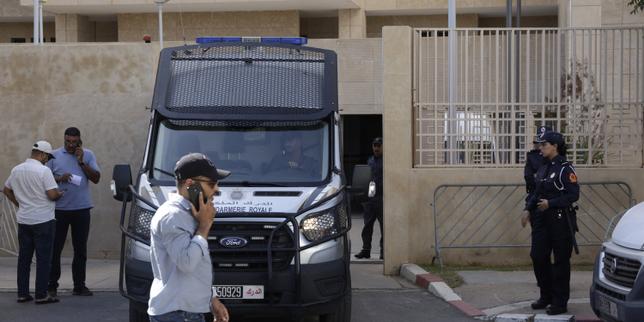
Ibtissame Lachgar is currently serving a prison sentence in Morocco under conditions that have led to a permanent physical disability. The co-founder of the Mouvement Alternatif pour les Libertés Individuelles (MALI) has reportedly lost the use of her arm due to a lack of adequate medical intervention while incarcerated. This is not a simple case of administrative negligence. It is the culmination of a decade-long friction between a provocative activist and a state apparatus that uses "morality laws" to silence political subversion. Lachgar’s appeal for a royal pardon is a desperate measure that highlights the narrowing path for secular activism in the North African kingdom.
The Long Road to a Prison Cell
To understand why Lachgar is in this position, one must look past the specific charges that led to her current detention. For over fifteen years, she has been the most visible face of radical secularism in Morocco. She didn't just advocate for change; she staged it. From organizing "picnics" during Ramadan to protest fasting laws to campaigning for abortion rights and LGBTQ+ protections, Lachgar intentionally targeted the red lines of Moroccan society.
The state’s response has rarely been a direct confrontation on the merits of her activism. Instead, the strategy involves a slow grind of judicial harassment. Activists in this region are seldom jailed for their ideas. They are jailed for "insulting public officials," "drunkenness," or "disturbing public order." These charges create a shield of plausible deniability for the government when dealing with international human rights observers. By framing the issue as a criminal matter rather than a political one, the state attempts to strip the activist of their martyr status.
A Broken Body in a Tightening System
The reports emerging from the Oukacha prison in Casablanca describe a catastrophic failure of the duty of care. Lachgar suffered an injury that, under normal circumstances, would require immediate orthopedic surgery and physical therapy. Instead, she was left in a cell. The loss of function in her arm is a physical manifestation of the broader "civil death" many activists face when they enter the Moroccan penal system.
Prison conditions in Morocco are frequently criticized by local NGOs, but for high-profile political prisoners, the experience is often defined by isolation. The psychological toll is matched by the physical deterioration. When an activist like Lachgar loses the use of a limb, it serves as a grim warning to others. The message is clear: the state does not need to execute you to end your career as a dissident. It only needs to wait while the system breaks you.
The Paradox of the Royal Pardon
Lachgar’s call for a royal pardon—a grâce royale—is a complex political maneuver. In Morocco, the King holds the ultimate judicial authority to commute sentences. Asking for a pardon is often interpreted as an admission of the state's supremacy. For a radical activist who has spent her life challenging traditional power structures, this is a bitter pill to swallow.
However, the petition is also a strategic move to place the responsibility for her health directly on the monarchy. By appealing to the King, her supporters are bypassing the Ministry of Justice and the prison administration, signaling that the "democratization" of the judicial system has failed. If the pardon is granted, she regains her freedom but at the cost of acknowledging the King’s role as the "benevolent protector." If it is denied, the state risks turning a functional disability into a symbol of state-sponsored cruelty.
The International Community’s Selective Hearing
There is a glaring discrepancy in how Lachgar’s case is being handled by international feminist organizations compared to activists in other regions. When women are imprisoned in Iran or Saudi Arabia, the global outcry is immediate and sustained. Morocco, often viewed as a "stable ally" and a "moderate" bridge between the West and the Arab world, frequently receives a pass.
This geopolitical convenience has left Moroccan activists in a blind spot. European governments, particularly France and Spain, are hesitant to pressure Rabat on human exchange or human rights issues due to critical cooperation on migration control and counter-terrorism. Lachgar is essentially a casualty of this stability. Her body is being traded for regional security.
The Shrinking Space for MALI
The Mouvement Alternatif pour les Libertés Individuelles was once a vibrant, if controversial, force. Today, it is under siege. Many of its members have fled the country or gone silent. The strategy of "public provocation" that Lachgar pioneered is no longer viable in an era where digital surveillance makes it impossible to organize without the state knowing every move.
The Moroccan state has mastered the art of "legalistic repression." It passes progressive-sounding laws—like the 2011 Constitution or the 2018 law on violence against women—while simultaneously maintaining a penal code that criminalizes consensual sex between adults, breaking the fast in public, and "shaking the faith" of a Muslim. This duality allows the government to present a modern face to the World Bank while maintaining a traditionalist grip on the domestic population.
Beyond the Medical Emergency
Focusing solely on Lachgar’s arm misses the structural reality of the Moroccan "Makhzen" (the ruling elite). The goal of the current detention is not just to punish a crime, but to exhaust the individual. It is an endurance test designed to see who breaks first: the activist’s resolve or their physical health.
The medical neglect reported in this case isn't necessarily a top-down order to maim a prisoner. It is often the result of a system that views "troublemakers" as unworthy of the limited resources available in the public health or prison sectors. When a guard or a prison doctor sees a woman who has "insulted the nation" by demanding secular rights, the motivation to provide high-quality care vanishes.
The Role of the Moroccan Diaspora
While the domestic movement is under immense pressure, the Moroccan diaspora in Europe has become the primary megaphone for Lachgar’s plight. Protest rallies in Paris and Brussels are attempting to force the hand of the Moroccan consulates. These groups are pointing out the hypocrisy of a state that markets itself as a destination for high-end tourism and "cultural tolerance" while leaving a prominent female intellectual to rot in a cell without medical care.
But social media campaigns have their limits. The Moroccan government has proven remarkably resilient to "Twitter storms." They know that as long as the phosphate exports continue and the border guards keep the migrant boats at bay, the Western powers will not move beyond "expressing concern."
The Future of Secular Activism in North Africa
Lachgar’s situation is a bellwether for the future of individual liberties in the region. If a well-known activist can lose the use of a limb due to state neglect without a massive domestic or international repercussion, it sets a new, lower bar for the treatment of all detainees. It signals that the era of "soft" authoritarianism in Morocco might be hardening.
The tragedy is that the reforms Lachgar fought for—bodily autonomy, freedom of conscience, and the separation of religion and state—are the very things Morocco needs to truly modernize. By breaking the people who ask for these changes, the state is effectively sabotaging its own long-term development.
A Final Appeal to Human Rights Standards
If the Moroccan state wishes to maintain its image as a regional leader in human rights, the resolution of the Lachgar case is the only metric that matters right now. A royal pardon would provide an immediate exit from this humanitarian crisis, but it does not fix the underlying issues. The penal code remains a weapon. The prisons remain opaque.
The immediate priority is the preservation of life and physical integrity. Every day that passes without Ibtissame Lachgar receiving specialist care for her arm is a day that the Moroccan judiciary confirms its critics' worst fears. The world is watching, even if it is currently pretending to look the other way.
You can verify the status of current human rights petitions through the Moroccan Association for Human Rights (AMDH) to see how these legal appeals are being processed in real-time.