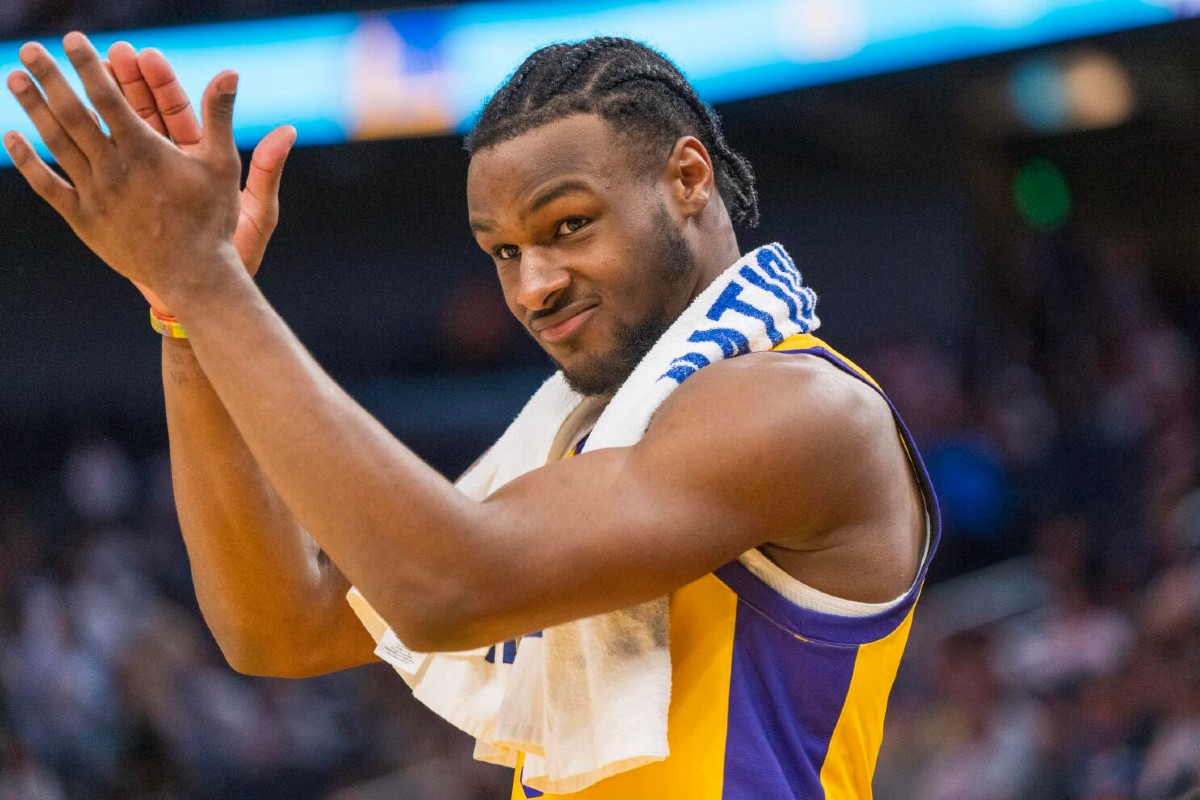
The narrative surrounding Bronny James has shifted from a question of nepotism to a debate over professional readiness. For months, the conversation focused on whether the Los Angeles Lakers used a second-round pick to appease LeBron James. However, the real story lies in how Bronny has navigated the immense pressure of the G League and the NBA spotlight to carve out a functional identity as a perimeter defender and high-IQ connector. He hasn't just survived the initial scrutiny; he has demonstrated a specific, scalable skill set that justifies a long-term roster spot regardless of his father’s impending retirement.
NBA front offices are rarely sentimental. While the marketing value of a father-son duo is undeniable, the Lakers are a championship-obsessed organization that does not hand out minutes for optics alone. Bronny’s development represents a new template for "project" players in the modern era—prospects who lack elite scoring volume but possess the physical tools and mental makeup to impact winning in small, vital windows.
The Defensive Floor and the Reality of NBA Length
Scouts often talk about a player’s "floor." For Bronny, that floor is built on a frame that defies his 6-foot-2 height. His wingspan and lateral quickness allow him to gatekeep elite ball-handlers, a trait that was evident during his brief stint at USC and has become more pronounced in the professional ranks. Unlike many rookies who struggle with the speed of NBA rotations, Bronny exhibits a veteran’s understanding of positioning.
He stays attached to the hip. He fights through screens with a level of physicality that usually takes years to develop. This isn't just about effort; it is about functional strength. The ability to absorb contact from a driving guard and remain vertical is the difference between a foul and a forced turnover. In the Lakers' defensive scheme, which often relies on versatile switching, having a guard who can hold his own against larger wings is a luxury.
The numbers in the box score rarely capture the "gravity" of a point-of-attack defender. When Bronny is on the floor, the opposing team's primary initiator has to work harder just to get into the set. This disruption ripples through the entire possession. It buys time for help-side defenders to reset. It forces the offense into second and third options that they didn't want to explore.
Redefining the Role of the Modern Guard
We are living through an era where every guard is expected to be a flamethrower from deep. If you can’t hunt your own shot, you’re often viewed as a liability. Bronny challenges this notion by leaning into the "3-and-D" archetype, even if the "3" is still a work in progress.
His value is found in the connective tissue of the offense. He makes the extra pass. He sets the screen that frees up the primary scorer. He cuts at the exact moment the defense loses focus. These are "winning plays" that don't show up in a highlight reel but earn the trust of coaching staffs.
- Ball Security: He rarely forces passes into tight windows, maintaining an assist-to-turnover ratio that suggests a high level of composure.
- Rebounding: His verticality allows him to crash the boards and ignite fast breaks, a critical component of the Lakers' transition game.
- Screen Navigation: He understands how to use his body to shield defenders, a nuance often missed by players with more "explosive" scoring resumes.
The Psychological Burden of the James Surname
It is impossible to discuss Bronny without acknowledging the weight of his last name. Most second-round picks can toil in obscurity, making mistakes and learning the ropes away from the national media. Bronny does not have that privilege. Every missed jumper is a headline; every defensive lapse is a viral clip.
The most impressive aspect of his first year hasn't been a dunk or a block, but his poise. He carries himself with a quiet professionality that suggests he has been preparing for this scrutiny his entire life. This mental toughness is a legitimate scouting asset. In the playoffs, when the pressure reaches a fever pitch, you want players who aren't rattled by the noise.
There is a historical precedent for this. We've seen "legacy" players struggle under the expectations of their fathers, but we’ve also seen the likes of Stephen Curry and Jalen Brunson use their upbringing as a blueprint for professional excellence. They grew up in NBA locker rooms. They saw the work required behind the scenes. Bronny possesses that same "incidental" education. He knows what a professional routine looks like because he’s watched the greatest practitioner of it for two decades.
The G League as a Laboratory
The decision to move Bronny between the main roster and the South Bay Lakers was not a demotion. It was a strategic necessity. In the G League, he gets the repetitions he needs to find his offensive rhythm. The speed of the G League is closer to the NBA than college, and it provides a "laboratory" environment where Bronny can experiment with his shooting and playmaking without the stakes of a Lakers loss.
We saw a similar trajectory with Austin Reaves and Alex Caruso. They were unheralded players who found their rhythm in South Bay. They used that platform to refine their defensive positioning and shooting until they became indispensable to the NBA roster. Bronny is following that same path.
The Lakers' developmental staff has focused on his catch-and-shoot mechanics. His release is smoother. His footwork is more consistent. While the percentages aren't yet at an elite level, the process is sound. This is the difference between a player who is simply a "legacy" and a player who is a "prospect."
Why the Bronny-LeBron Narrative is a Distraction
Critics argue that Bronny’s presence on the Lakers is purely a perk for his father. This perspective ignores the reality of the NBA draft. The 55th pick is notoriously a low-percentage bet. History shows that most players taken in the late second round never log meaningful minutes. By drafting Bronny, the Lakers took a flyer on a high-IQ, physically gifted guard with an elite defensive upside.
If Bronny were named "Bronny Smith," would we still be debating his "merit"? Probably not. We would be discussing him as a promising young defender who needs time to develop his offensive game. The name doesn't just open doors; it also creates a standard that few 19-year-olds could ever hope to meet.
We have to look at the roster construction. The Lakers needed cheap, productive talent. Bronny fits that mold. He’s not a player who demands 30 minutes a night or a high usage rate. He’s a player who fits into a role. He does the dirty work that stars often avoid. He is a defensive pest. He is a reliable passer. In a league that is increasingly built around star power, these "glue guys" are the difference between a first-round exit and a deep playoff run.
The Financial and Strategic Logic
From a business perspective, the Bronny signing was a masterclass. It kept LeBron James engaged and satisfied. It increased the Lakers' brand value globally. But more importantly, it secured a young asset on a team-friendly contract. In a world of restrictive salary caps and "second aprons," having a cost-controlled player with high upside is a necessity for any championship contender.
The Lakers are playing the long game. They aren't just building for today; they are building for a post-LeBron world. Bronny’s development is a part of that transition. He is a bridge between the era of LeBron and whatever comes next for the franchise.
The skeptics will always be there. They will point to his scoring averages and his father's influence. But if you watch the tape—the defensive slides, the screen navigation, the unselfish passing—you see a player who belongs. Bronny James is not just a Laker because of his name. He is a Laker because he understands the job. He doesn't need to be LeBron. He only needs to be the best version of himself, a high-level role player who impacts the game in ways that matter.
Watch the next time he enters the game in the second quarter. Notice how the defensive intensity of the unit increases. Watch how he communicates on switches. This is the hallmark of a professional. This is why he is on the court. The "nepotism" tag is a convenient label for those who don't want to do the work of actually watching the basketball.
The reality is that Bronny has already won. He has navigated the most difficult developmental environment in sports history and emerged as a functional NBA player. Whether LeBron is on the court with him or watching from the sidelines, Bronny’s future in the league is now firmly in his own hands.