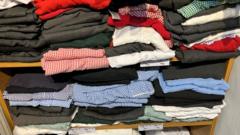
Across London, a quiet logistical rebellion is taking shape in church halls and community centers. These are the front lines of the school uniform reuse movement, a direct response to a cost-of-living crisis that has turned a basic educational requirement into a significant financial barrier. While local government initiatives aim to alleviate the pressure, the underlying issue isn't just a lack of second-hand clothes. It is a systemic failure in how school apparel is designed, branded, and sold.
The average cost of a secondary school uniform in the UK now hovers around £422 per year. For a family with two children, that is a mortgage payment or a month’s worth of groceries. When London councils launch "reuse schemes," they are essentially subsidizing a private market that has grown bloated on exclusive supply contracts and "logo-creep."
The Monopoly in the Playground
Most parents aren't struggling because they can't find a pair of grey trousers. They are struggling because they are forced to buy a specific blazer from a specific supplier that has an exclusive deal with their child’s school. This is where the "free market" of the high street dies.
When a school mandates a blazer with an embroidered crest, a specific pleated skirt, or branded sports socks, they strip away a parent’s ability to shop at supermarkets or discount retailers. This exclusivity creates a captive audience. Suppliers know that parents have no choice but to pay the premium, often resulting in markups that bear little relation to the quality of the polyester blend.
The 2021 Education (Guidance about Costs of School Uniforms) Act was supposed to fix this. It instructed schools to keep branded items to a "minimum." However, the definition of "minimum" is being stretched to its breaking point. Many schools have complied by making the blazer the only mandatory branded item, but then they set the price of that single jacket at £80 or more.
Why Reuse Schemes are Only a Band-Aid
London’s new wave of reuse hubs—from Hackney to Havering—are doing vital work. They prevent thousands of tons of textiles from hitting landfills and provide a lifeline for families. But we have to look at the math.
A reuse scheme relies entirely on the quality of the initial garment. If a blazer is poorly made, it won't survive two years of playground wear-and-tear to be passed on to another student. The irony is that the high-cost, "exclusive" uniforms are often not built for longevity. They are built for a specific aesthetic. When a school changes its logo or transitions to academy status, an entire inventory of perfectly functional clothing becomes obsolete overnight. This is the antithesis of sustainability.
Furthermore, the social stigma attached to second-hand clothing hasn't entirely vanished, despite the eco-conscious branding of these schemes. For a teenager, a faded blazer or a slightly bobbled jumper can be a badge of poverty. Until reuse is the default for everyone—not just the "needy"—it remains a tiered system.
The Hidden Cost of the PE Kit
If the blazer is the financial anchor, the PE kit is the weight that sinks the ship. We are seeing a trend where schools require not just a t-shirt, but branded shorts, branded socks, and even branded waterproof jackets for outdoor games.
There is no educational justification for a twelve-year-old to wear a specific brand of moisture-wicking fabric to play football for 40 minutes once a week. Yet, these items are often the hardest to find in reuse banks because they are high-wear items. They get muddy, they get lost, and they get torn. By the time a student outgrows them, they are usually unfit for another's use.
The Sustainability Gap
- Polyester Dependency: Most affordable uniforms are made from virgin plastics. They shed microplastics every time they are washed.
- The "One-Size" Problem: Children grow in spurts. A system that requires expensive, tailored items rather than adjustable, generic ones is designed for waste.
- Supply Chain Opacity: While we focus on the cost at the till, we rarely ask where these £10 trousers come from. The rush to find "cheaper" alternatives often leads back to overseas factories with questionable labor standards.
The Architecture of a Better System
If we want to move beyond charity-based reuse and toward a functional economy, the rules of the game need to change.
First, the "sole supplier" model must be dismantled. Competition is the only thing that will naturally drive prices down. If a school wants a specific crest, they should provide an iron-on or sew-on patch that can be applied to a generic blazer bought anywhere. This simple shift would immediately decouple the school’s identity from the supplier’s profit margin.
Second, we need to standardize colors. There is no reason for "bottle green" to have twelve different shades across twenty different schools. If all schools in a borough used the same base colors, the secondary market would explode with liquidity. A parent moving two miles away wouldn't have to bin an entire wardrobe.
The Role of the Manufacturer
The companies producing these garments have a responsibility that they are currently dodging. Extended Producer Responsibility (EPR) is a concept gaining ground in other sectors, and it belongs here. Manufacturers should be incentivized to create "circular" uniforms—clothes designed to be repaired, redyed, and eventually recycled back into new fiber.
Currently, the incentive is the opposite. A garment that lasts four years is a lost sale. A garment that lasts one year is a recurring revenue stream.
Moving Toward Mandatory Neutrality
Some schools are already leading the way by banning branded items entirely. They provide a list of colors and let parents figure out the rest. The result is a diverse mix of supermarket basics and hand-me-downs that, from a distance of ten feet, looks exactly like a traditional uniform. The "prestige" of the school is maintained through the behavior and achievement of the students, not the embroidery on their chests.
The current London schemes are a testament to community spirit, but they are also a confession of failure. Every time a parent has to queue at a pop-up bank for a blazer, it is a sign that the primary market has priced them out of their child's education.
We should stop celebrating the "launch" of reuse schemes as an innovation. Instead, we should view them as an emergency intervention in a market that has lost its way.
Pressure your local school board to audit their uniform policy. Ask for the breakdown of the "exclusive" contracts. Demand the right to buy generic. The solution isn't just to recycle the waste of a broken system; it's to stop the waste from being manufactured in the first place.