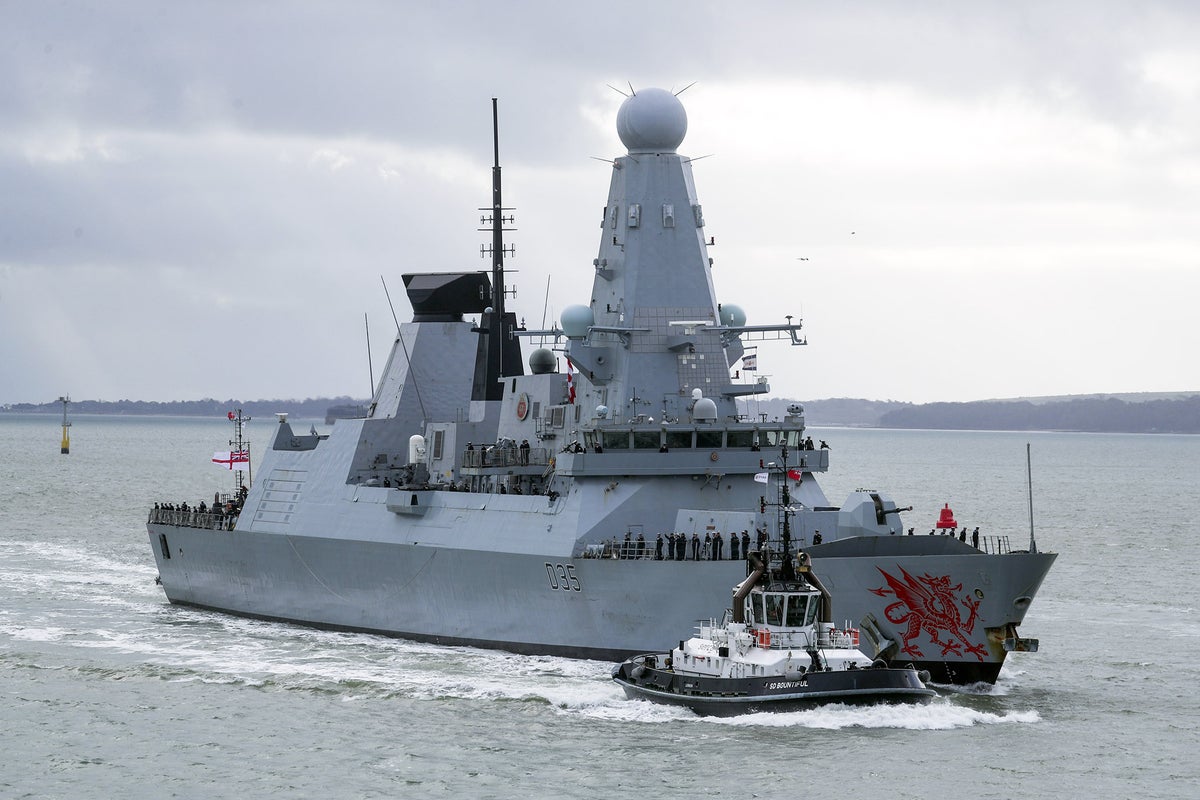
The deployment of a Royal Navy destroyer to the Middle East marks a calculated gamble by Prime Minister Keir Starmer to maintain British relevance in a region rapidly being reshaped by Donald Trump’s aggressive return to "maximum pressure." While the official narrative focuses on maritime security and the protection of trade routes, the tactical reality is far more complex. Starmer is sending a clear signal to both Tehran and Washington that the United Kingdom will not sit on the sidelines as the geopolitical map of the Levant and the Gulf is redrawn.
This move comes at a moment of extreme volatility. Donald Trump, the presumptive architect of the next phase of American foreign policy, has already signaled that the window for diplomatic niceties with Iran has slammed shut. By declaring it "too late" for talks, Trump has effectively stripped away the remaining scaffolding of the nuclear deal era. Britain, long a proponent of the "pathway to dialogue," now finds its naval assets operating in a theater where the rules of engagement are being dictated by a White House that views hesitation as a weakness.
The HMS Diamond or its equivalent is not just a collection of missiles and radar; it is a floating piece of sovereign territory thrust into a zone where the Houthi rebels and their Iranian patrons are testing the limits of Western resolve. Starmer’s decision to move now suggests an awareness that the UK cannot afford a rift with the incoming US administration over Middle Eastern security.
The Strategy of Forced Alignment
Britain is currently walking a tightrope between its European security commitments and its foundational "Special Relationship" with the United States. For Starmer, the deployment serves as a physical down payment on that relationship. By putting British skin in the game before Trump even takes the oath of office, the Labour government is attempting to inoculate itself against charges of being "soft" on global threats.
The "too late" rhetoric from the Trump camp isn't just a campaign slogan. It represents a fundamental shift in how the US intends to handle the IRGC and its network of proxies. Under previous administrations, naval deployments were often used as deterrents meant to preserve a status quo. Now, these assets are positioned as the vanguard of a potential kinetic confrontation.
If the US moves to completely choke off Iranian oil exports again, the Royal Navy will find itself in the crosshairs of an asymmetrical response. The Houthis have already proven that low-cost drones can challenge billion-dollar destroyers. Starmer knows this. He also knows that standing back would leave the UK isolated when the Trump administration begins demanding a unified front against Tehran.
Naval Power in an Age of Cheap Drones
There is a glaring technical disparity that industry analysts have been warning about for years. We are sending sophisticated Type 45 destroyers to fight "lawnmowers with wings." While the Sea Viper missile system is world-class, the cost-to-kill ratio is unsustainable. Every time a British warship intercepts a Houthi drone, it spends millions of pounds to destroy a target that costs less than a used hatchback.
This isn't just a budget issue; it's a strategic vulnerability. Iran and its proxies are playing a game of attrition. They don't need to sink a British ship to win. They only need to make the cost of remaining in the Red Sea and the Gulf of Oman prohibitively expensive for a cash-strapped Ministry of Defence.
The deployment of a warship under these conditions is a test of the Royal Navy’s logistical endurance. Can the UK maintain a persistent presence when the threat is constant, low-level, and unpredictable? Starmer’s gamble relies on the hope that British presence acts as a psychological deterrent, but the "too late" posture from Washington suggests that deterrence may no longer be the objective. The objective may now be provocation or total containment.
Trump’s Shadow Over Whitehall
Inside the corridors of the Foreign, Commonwealth & Development Office, there is a palpable sense of urgency. The "too late" comment regarding Iran talks has effectively killed the hope for a revived JCPOA (Joint Comprehensive Plan of Action). For years, British diplomats have been the "good cops" in the room, trying to keep Tehran at the table. That era is over.
Trump’s return implies a return to a transactional foreign policy. If the UK wants favorable trade terms or US support in Eastern Europe, it must show utility in the Middle East. Starmer’s warship is a piece on a much larger chessboard.
- Intelligence Sharing: The UK relies heavily on US signals intelligence in the region.
- Operational Support: British ships often operate under the umbrella of US-led task forces like Operation Prosperity Guardian.
- Diplomatic Cover: Without Washington’s backing, British influence in Gulf capitals wanes significantly.
The danger for Starmer is that by leaning too far into the Trump doctrine, he risks alienating his own backbenchers and European allies who still cling to the idea of a negotiated settlement. However, the Prime Minister seems to have calculated that the cost of an angry Washington is higher than the cost of a frustrated Brussels.
The Iranian Response to Maritime Pressure
Tehran has never been one to ignore a naval buildup on its doorstep. The IRGC (Islamic Revolutionary Guard Corps) views the presence of British and American warships not as a stabilizing force, but as an occupational threat. Historically, when the West increases its naval footprint, Iran increases its "grey zone" activities.
We should expect an uptick in ship seizures, mysterious "limpet mine" attacks, and harassment by fast-attack craft. By deploying a warship now, Starmer is essentially accepting the risk of a naval incident that could escalate into a broader conflict. This isn't a "routine patrol." It is a high-stakes mission in a region where a single miscalculation by a junior officer on either side can trigger a regional war.
The "too late" warning from Trump suggests that the US is already looking past diplomacy. If the US decides to strike IRGC infrastructure, a British warship in the vicinity will be seen by Tehran as a co-belligerent, whether it fires a shot or not. This is the reality of the "interoperability" that the Royal Navy prides itself on—it creates a shared fate.
The Economic Stakes of the Red Sea
Beyond the high politics of Trump and Starmer lies the brutal reality of global trade. The Suez Canal is the jugular vein of the UK economy. When the Houthis disrupt shipping, inflation in the UK ticks upward. Energy prices become volatile. The cost of living crisis, which Starmer was elected to solve, is directly linked to the security of the Bab el-Mandeb strait.
Sending a warship is an attempt to reassure the markets. It is an effort to tell shipping giants like Maersk and MSC that the Royal Navy can guarantee safe passage. But a single destroyer is a band-aid on a gunshot wound. To truly secure these lanes, a much larger, more aggressive force would be required—one that the UK likely cannot sustain on its own for an extended period.
The irony is that the more the West militarizes the sea lanes, the more it validates the Houthi narrative of "resisting Western imperialism," which in turn drives recruitment and further attacks. It is a feedback loop that has no clear exit strategy.
Breaking the Cycle of Reactive Deployment
The fundamental flaw in British Middle East policy over the last decade has been its reactive nature. We send ships because something happened, or because the Americans are sending ships, or because we need to look like a "Global Britain." We rarely send them as part of a coherent, long-term regional strategy that survives a change in US administration.
Starmer’s current deployment is no different. It is a reaction to the vacuum left by the collapse of diplomacy and the looming shadow of Trump’s second term. To move beyond this, the UK would need to define what its own interests are in the Middle East independent of Washington’s "maximum pressure" rhetoric.
Is the goal to contain Iran at all costs? Is it to protect trade? Or is it simply to stay in Trump’s good graces? Currently, the government is trying to do all three, and the result is a mission creep that puts British sailors in harm's way for a policy that is being written in Mar-a-Lago rather than 10 Downing Street.
The naval presence is a stopgap. The real work is happening in the classified briefings where British officials are trying to figure out how to handle a US President who views the Middle East as a theater for "winning" rather than a region to be managed. If Trump truly believes it is "too late" for talks, then the warship Starmer just sent is not a diplomat; it is a combatant waiting for a target.
The British public has been told this is about security. The reality is that it is about survival in a world where the old rules of international diplomacy have been discarded. The ship is in the water, the missiles are armed, and the clock is ticking on a regional explosion that no one seems able—or willing—to stop.
Watch the Strait of Hormuz. That is where the tension will eventually snap. When it does, the UK will have to decide if it is willing to follow the Trump administration into a conflict that has no defined end date and no clear victory condition. For now, the warship serves as a placeholder for a policy that Starmer hasn't fully articulated to the British people.
Ensure the crews are prepared for long-duration, high-intensity electronic warfare. The next battle won't be fought with broadsides, but with signal jamming and GPS spoofing. If the Royal Navy can't win the "invisible war," the physical warship will be little more than a target in a very crowded, very dangerous pond.


