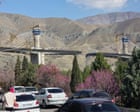
The headlines are screaming about "decisive strikes" and "crippling blows." They see a collapsed span of concrete and steel in the Persian Gulf and call it a victory. They see a logistical nightmare for Tehran and assume the board has been reset.
They are wrong.
The destruction of Iran’s largest bridge—the Shahid Kalantari or a similar vital artery—isn't a checkmate. It’s a loud, expensive distraction that ignores the fundamental mechanics of 21st-century asymmetrical warfare. We are stuck in a 1944 mindset, thinking that if we break the physical tracks, the train stops moving. In the modern Middle East, the train doesn't need tracks; it’s a swarm of low-cost drones and decentralized proxies that don't give a damn about a bridge.
The Logistics Fallacy
Conventional military analysts love infrastructure targets because they are easy to see on a satellite feed. You hit a bridge, the "before and after" photos look great in a briefing, and everyone goes home feeling like they’ve won.
But look at the math. A bridge is a static, multi-billion dollar asset. It takes years to build and seconds to destroy. However, the utility of that bridge is being replaced by distributed logistics. Iran has spent the last decade perfecting the art of "smuggling by a thousand cuts." They don't need a six-lane highway to move the components for a Shahed-136 drone. They need a pickup truck, a dhow, and a coastline that is impossible to fully monitor.
By focusing on the "largest bridge," the administration is playing into a vanity trap. You’ve destroyed a civilian economic asset. You’ve inconvenienced the population. But have you stopped the Quds Force? Not even close. You’ve actually given them a gift: a narrative of martyrdom and a reason to spike oil prices by threatening the Strait of Hormuz.
Why Kinetic Force is the New Blockbuster Video
We are witnessing the obsolescence of the "Big Strike" doctrine. When the US or its allies drop a precision-guided munition on a bridge, we are trading a $2 million missile for $500 million in concrete. On paper, that’s a win. In reality, it’s a strategic failure because it doesn't address the Network Effect.
The Iranian military apparatus is not a vertical hierarchy; it is a horizontal network. Breaking a physical link in a network is meaningless if the data (or the weapons) can be rerouted through three other nodes. While we celebrate the "destruction" of a bridge, Tehran is already rerouting supplies through the rugged terrain of the Zagros Mountains or utilizing the Caspian sea routes.
I’ve seen this play out in corporate turnarounds. The failing CEO fires the most expensive vice president to "send a message" and save on salary. But the underlying rot—the inefficient processes and the toxic culture—remains. The company still goes under. Dropping a bridge is the geopolitical equivalent of firing a VP. It’s optics over operation.
The Crude Reality of Energy Markets
Let’s talk about the "more to follow" threat. It’s designed to project strength, but it actually signals a lack of options. If the goal is to stop Iranian regional influence, you don't hit a bridge. You hit the financial interfaces.
The real infrastructure of the Iranian regime isn't made of rebar. It’s made of digital ledgers, dark fleet tankers, and shadow banking systems in Dubai and East Asia.
- The Shadow Fleet: Iran moves its oil through a ghost fleet of aging tankers that switch off transponders.
- The Crypto Pivot: Sanctions are increasingly bypassed through decentralized finance.
- The Yuan Trade: The increasing integration with Chinese credit systems makes physical blockades less relevant every day.
By blowing up a bridge, you aren't touching the money. In fact, you’re likely increasing the risk premium on Brent Crude. If oil jumps $10 a barrel because of "instability," Iran makes more money on its smuggled exports than it lost in the value of the bridge. We are literally subsidizing their recovery with our own fear-driven market volatility.
The Tactical Error of "More to Follow"
Publicly threatening "more to follow" is a classic blunder of escalation. It removes the element of surprise and forces the adversary into a corner where they must respond to save face.
In intelligence circles, the most effective strike is the one no one talks about. The "Stuxnet" approach—where hardware fails for "unknown" reasons—is infinitely more devastating than a missile. When a bridge blows up, it’s a rallying cry. When a power grid quietly desynchronizes or a refinery's logic controllers melt down without a single explosion, it breeds paranoia and internal finger-pointing.
The current strategy is too loud. It’s a heavy-metal concert in a room where we should be playing chess.
The Myth of the "Crippled" Economy
Every time a major piece of infrastructure is hit, the pundits claim the Iranian economy is "on the brink." This shows a fundamental misunderstanding of resilient, sanctioned economies.
The Iranian economy has been "on the brink" for forty years. They have built an entire ecosystem around bypassing traditional constraints. Their domestic manufacturing for military hardware is decoupled from the civilian economy. You can starve the people of a bridge to get to work, but the IRGC's underground missile cities stay fully stocked.
We are attacking the wrong target set because we are measuring success by the volume of the explosion rather than the degradation of the enemy's will or capacity.
A Superior Strategy: The Digital Siege
If you actually want to dismantle a regime’s capability without starting a regional conflagration, you don't look for the biggest bridge. You look for the smallest bottleneck.
- Intercept the Sub-Components: Stop trying to hit the finished missile. Hit the specialized carbon fiber imports. Hit the high-end sensors sourced through front companies in Europe.
- Weaponize the Currency: Don't just sanction banks; flood the market with counterfeit digital signals or disrupt the internal payment processors that the average Iranian uses. Make the regime's money literally unusable in their own streets.
- Target the Technocrats: The regime relies on a small cadre of engineers and logistics experts. These people are not martyrs. They are professionals. Make it clear that their personal assets, their families' ability to travel, and their digital footprints are entirely compromised.
The bridge strike is a relic. It belongs to an era when "winning" meant planting a flag on a hill. In the current era, winning means making your opponent's hardware irrelevant.
The High Cost of Physicality
There is a cost to these strikes that the "tough talk" ignores: the cost of rebuilding our own credibility when these actions fail to produce results. Every time we "warn" Tehran and then hit a non-essential target, the deterrence factor drops.
Deterrence is not about what you do; it's about what the enemy thinks you can do. By hitting a bridge, we’ve shown our hand. We’ve shown that we are still targeting 20th-century assets. We’ve shown we are willing to risk civilian collateral damage for a headline.
If I were a strategic planner in Tehran, I wouldn't be shaking in my boots. I’d be calculating the insurance payout and planning the next drone swarm. They know that as long as we are focused on the "largest bridge," we aren't looking at the small, cheap, and deadly tools they are actually using to win.
Stop cheering for the fireball. Start looking at the ledger. We aren't winning the war; we're just paying for the fireworks.