Breast cancer doesn't wait for you to find a permanent address. It doesn't care if you've got a P.O. box or if you're sleeping in a tent on 5th Street. But the healthcare system usually does. For years, the barrier between life-saving diagnostics and the women living in Los Angeles’ Skid Row has been more than just a few miles of pavement. It’s been a chasm of bureaucracy, fear, and flat-out logistics.
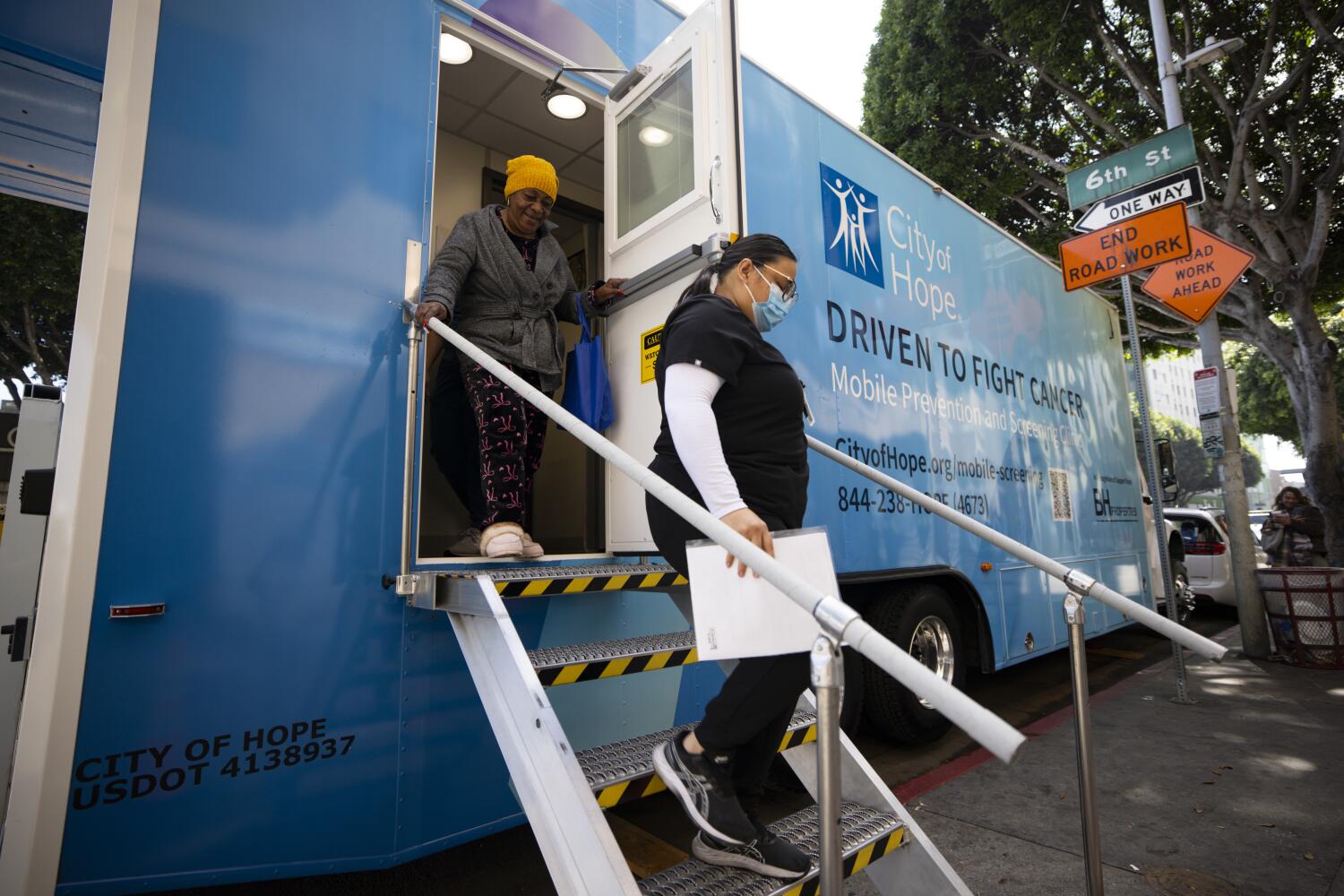
That’s why seeing a massive, high-tech mobile clinic parked among the rows of makeshift shelters isn't just a nice community service project. It’s a direct challenge to the idea that high-quality medicine belongs only in glass towers. Bringing mammograms to women on Skid Row is about meeting people exactly where they are—no excuses, no complex scheduling, and no judgment. Recently making headlines in related news: The NIH CDC Merger is a Management Shell Game That Guarantees the Next Public Health Failure.
The Reality of Healthcare Deserts in the Heart of the City
You’d think being in the middle of a major metropolis like LA would mean being surrounded by medical options. It’s the opposite. Skid Row is a healthcare desert. Most of the women living here are dealing with "competing priorities." When you aren't sure where your next meal is coming from or where you’ll safely sleep tonight, a routine breast exam feels like a luxury you can't afford.
Statistics from the American Cancer Society show that early detection can result in a five-year survival rate of nearly 99%. But that's only if you catch it. For women in underserved urban areas, the diagnosis often comes too late. We're talking Stage III or Stage IV, where the options are brutal and the outcomes are grim. Additional information into this topic are explored by Medical News Today.
A mobile clinic strips away the biggest hurdles. You don't need a car. You don't need to navigate three different bus transfers while carrying everything you own. You just walk up.
Why Trust is the Real Medicine
It’s not enough to just show up with a fancy machine. I’ve seen plenty of well-intentioned programs fail because they didn't understand the culture of the streets. There’s a massive amount of distrust toward institutional medicine here. Many of these women have had terrible experiences with ER doctors or social workers who looked down on them.
The mobile units that actually work are the ones staffed by people who know how to talk to the community. They partner with local organizations like the Downtown Women’s Center. They use "promotoras" or community health workers who live and work in the area.
When a woman sees her friend getting a screening and coming out okay, she’s ten times more likely to step inside that van. It’s about social proof. It's about feeling seen as a human being, not just another case file or a statistic on a grant application.
Breaking Down the Tech Inside the Van
Don't let the "mobile" part fool you. These aren't stripped-down versions of what you'd find at Cedars-Sinai. Most modern mobile mammography units are equipped with 3D digital breast tomosynthesis.
- 3D Imaging: This allows radiologists to look at the breast tissue in layers, which is huge for detecting small tumors that might be hidden by dense tissue.
- Instant Connectivity: The images are sent via secure satellite or 5G links to radiologists who can read them almost in real-time.
- Privacy: These vans are designed with internal changing rooms and climate control. They offer a level of dignity that’s often stripped away in standard public clinics.
The Massive Gap in Follow Up Care
The mammogram is only step one. The biggest "gotcha" in mobile health is what happens if the scan shows something suspicious. A piece of paper with a phone number isn't a plan. It’s a dead end.
Effective programs on Skid Row have a built-in "warm handoff." If a scan looks bad, a patient navigator is assigned immediately. This person’s entire job is to help the woman get to her biopsy, find a way to pay for treatment through programs like Medi-Cal, and provide emotional support. Without this, the mobile clinic is just a diagnostic tool that tells people they’re sick without giving them a way to get well.
Healthcare providers often underestimate the anxiety involved here. Imagine being told you might have cancer and then having to go back to a tent. The psychological weight is crushing. The follow-up care must be as mobile and flexible as the screening itself.
Practical Steps for Supporting Community Health
If you want to help change the trajectory of women's health in these neighborhoods, don't just send a check to a generic charity. Look for the groups on the ground.
- Support Local Non-Profits: Look for organizations specifically targeting Skid Row, such as the JWCH Institute. They run the clinics that actually have the trust of the residents.
- Volunteer for Outreach: Many of these mobile events need non-medical volunteers to help with registration or simply to sit and talk with women while they wait for their appointments.
- Advocate for Policy Change: Push for legislation that funds mobile health specifically. It’s cheaper for the taxpayer to fund a $300 mammogram today than a $200,000 late-stage cancer treatment tomorrow.
Taking the clinic to the sidewalk is the only way to close the survival gap. We’ve got the technology. We’ve got the data. Now we just need to keep showing up until the "survival rate" isn't determined by a zip code. It's time to stop expecting the most vulnerable people to find their way into our complex systems and start bringing the system to them.