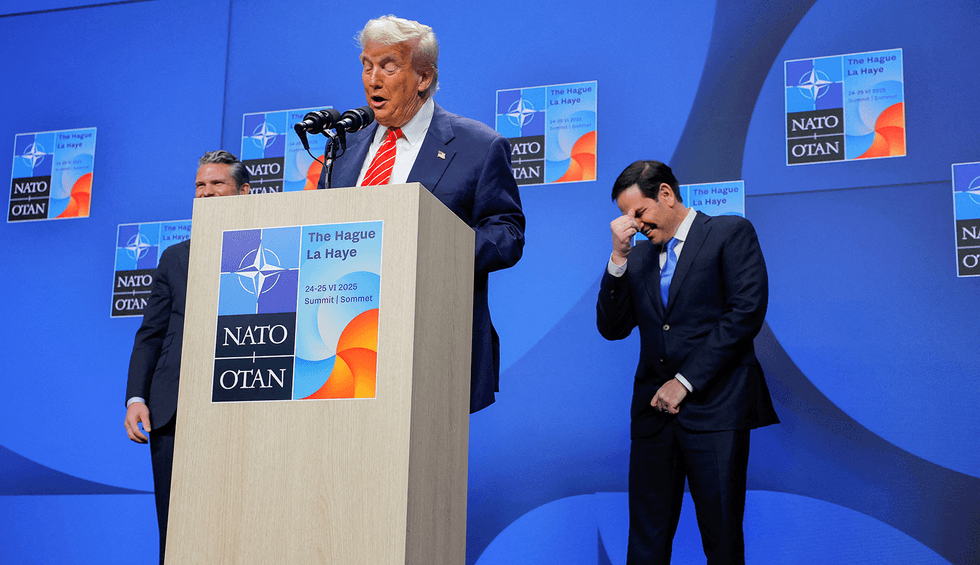
The political commentariat is obsessed with a binary that doesn't exist. They see Donald Trump sitting in a courtroom or a briefing and they diagnose a "serious bind." They claim he is trapped between the optics of looking "weak" by staying quiet or looking "bored" because he isn't the center of the universe. This isn't just a lazy take; it’s a fundamental misunderstanding of high-stakes attention economics.
The "bind" is a projection. Biographers and pundits love to psychologize public figures because it’s easier than analyzing the mechanics of their brand. They assume that for a man built on noise, silence is a vacuum. They’re wrong. Silence, in the context of a hyper-saturated media environment, is a weapon of mass distraction.
The Fallacy of the Weakness Trap
The mainstream argument suggests that if Trump doesn't lash out, he loses his "tough guy" persona. If he sits still, he's "defeated." This ignores twenty years of reality television and fifty years of New York real estate posturing. In those worlds, the highest form of power isn't the loudest shout—it’s the visible display of being "above it."
When an industry insider sees a CEO looking bored during a hostile takeover hearing, we don't see weakness. We see someone who has already priced in the loss and is mentally moving to the next asset. Boredom is the ultimate flex. It signals to your base—and your enemies—that the current proceedings are beneath your pay grade.
The biographer’s "bind" assumes Trump cares about the rules of the room. He doesn't. He cares about the rules of the screen. On a screen, a man who looks bored by a "serious" legal proceeding tells his audience that the proceeding itself is a joke. It’s not a lack of focus; it’s a curated apathy.
The Architecture of Strategic Apathy
Let’s dismantle the idea that "looking bored" is a liability. In branding, there is a concept called Brand Friction. Most politicians try to reduce friction by appearing engaged, empathetic, and serious. They want you to believe they are working hard.
Contrarian figures—the ones who actually move the needle—increase friction. They make it difficult for the establishment to categorize them. By appearing "bored," Trump creates a cognitive dissonance for his detractors. They want him to be a cornered animal. Instead, he acts like a guy waiting for a delayed flight.
- Lowering the Stakes: If the protagonist of the drama isn't acting like it's a drama, the audience eventually loses interest.
- Narrative Hijacking: By refusing to play the "defendant" role, he forces the media to talk about his reaction rather than the evidence.
- Energy Conservation: In a 24-month campaign cycle, outrage is a finite resource. You don't spend it in a courtroom; you save it for the rally.
I’ve watched founders lose everything because they couldn't stop talking during a crisis. They felt they had to "defend their honor." The ones who survived were the ones who could sit in a room, look the lawyers in the eye, and act like they were thinking about what to have for dinner. That isn't boredom. It's psychological warfare.
The Biographer’s Blind Spot
Biographers are historians of the past, not architects of the future. They rely on "traditional" markers of presidential dignity—things like gravitas, attention to detail, and respect for institutions. Using these metrics to judge a post-institutional candidate is like using a map of London to navigate Tokyo.
The biographer's "bind" is based on the 19th-century idea of the "Great Man." But we live in the era of the "Great Content Creator." In this era, the only sin is being invisible.
"Looking weak" is only a risk if your audience expects you to be a traditional hero. Trump’s audience doesn't want a hero; they want a wrecking ball. A wrecking ball doesn't look "weak" when it’s not swinging; it’s just waiting for the next hit.
The Math of Performance
Consider the attention ROI. Every minute spent looking "serious" in a courtroom is a minute spent validating the authority of that courtroom.
$ROI = \frac{Attention : Captured}{System : Validation}$
If you want to dismantle the system, you must minimize the denominator. You validate the system by participating in its rituals with a straight face. You disrupt the system by showing it that it cannot command your focus. The "serious bind" vanishes when you realize that the goal isn't to win the legal argument in the court of law, but to win the cultural argument in the court of public perception.
Stop Asking the Wrong Questions
The media asks: "Is he losing his grip?"
The public asks: "Why are we still talking about this?"
The contrarian truth is that the more "bored" or "uninterested" a candidate appears in the face of institutional pressure, the more they signal to their followers that the institutions are irrelevant. This isn't a mistake. It’s a masterclass in delegitimization.
If you’re a leader facing a crisis, the worst thing you can do is look like you’re trying. Effort is the smell of desperation. The biographer thinks he’s trapped. In reality, he’s just refusing to play the game on their terms.
The next time you see a headline about a "serious bind" or a "looming disaster" based on a public figure's body language, ask yourself who benefits from that narrative. It’s usually the people who are terrified that the old rules of "seriousness" no longer apply.
The status quo demands your attention. Denying them that attention isn't a sign of weakness. It’s an act of war.
If the world is burning and you’re checking your watch, you aren't the victim. You’re the one holding the match.
Stop looking for the "bind." Start looking for the exit. It’s usually right behind the person who looks like they don't care.
Show up. Stay quiet. Let them exhaust themselves trying to make you flinch.