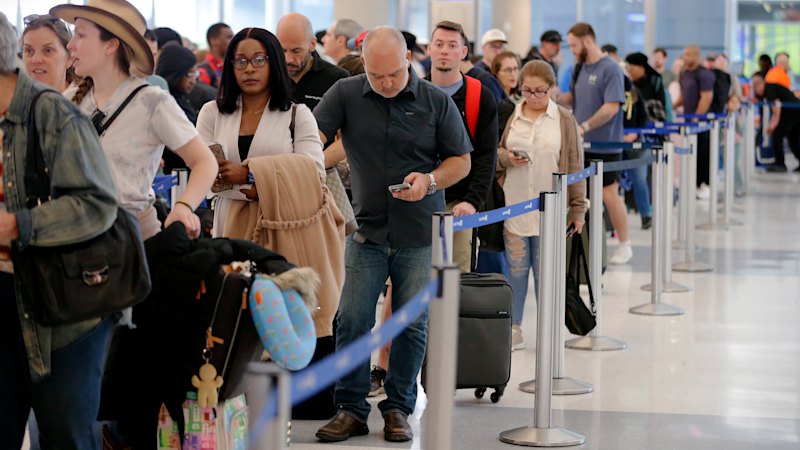
The proposal to redeploy Immigration and Customs Enforcement (ICE) agents into major American airports is not a simple logistical shift. It is a political maneuver designed to exert maximum pressure on a stalled Congress by targeting the nation’s most sensitive economic arteries. By threatening to pull enforcement personnel from the southern border and interior operations to staff TSA checkpoints and international terminals, the administration is effectively weaponizing the infrastructure of travel to win a funding war.
If implemented, this move would fundamentally alter the experience of every traveler in the United States. It is not just about longer lines at security. It is about a structural breakdown of how the Department of Homeland Security (DHS) manages its limited resources. When agencies are forced to choose between monitoring a physical border and checking passports in Atlanta or O’Hare, the resulting gaps in security are inevitable. The immediate goal is to make the "border crisis" a visible, frustrating reality for the average citizen who may never visit a border town but definitely plans to fly for the holidays.
The Logistics of a High Stakes Bluff
Moving ICE agents into airports is a massive undertaking that ignores the specific training required for aviation security. ICE is primarily an investigative and removal body. Their agents are trained for surveillance, raids, and long-term casework, not the rapid-fire document verification and rhythmic passenger flow required at a busy terminal.
Forcing these agents into a role normally held by Customs and Border Protection (CBP) officers or TSA agents creates a vacuum elsewhere. Every agent standing at a boarding gate is an agent not tracking down high-level criminal targets or managing detention facilities. This is "robbing Peter to pay Paul" on a federal scale. The administration’s gamble relies on the hope that the threat of travel chaos will force the hand of fiscal hawks in Washington before the first ICE badge ever appears at a civilian luggage carousel.
Why Airports Became the Primary Battlefield
Airports are the most visible touchpoints of federal authority for most Americans. While the southern border feels distant to a voter in Maine or Washington state, the local airport is a vital link to their livelihood and family. By shifting the theater of the funding debate to the airport, the administration bypasses the abstract arguments of policy and enters the realm of personal inconvenience.
The Economic Ripple Effect
The aviation industry contributes more than 5% to the American GDP. Any policy that introduces friction into this system has immediate financial consequences.
- Carrier Delays: Airlines operate on razor-thin schedules. A fifteen-minute delay at security can cascade into hours of late departures.
- Reduced Spending: Frustrated travelers spend less at airport concessions, hitting a secondary layer of the economy.
- Business Travel Erosion: If flying becomes a multi-hour ordeal of administrative red tape, corporations shift to virtual meetings, draining revenue from the travel sector.
The threat of ICE intervention serves as a warning shot to the business community. It signals that if the government remains unfunded, the friction will be felt at every level of commerce. It is a blunt instrument used to provoke an outcry from stakeholders who usually stay out of immigration debates.
The Hidden Cost of Personnel Redistribution
Beyond the immediate visual of agents in hallways, there is the matter of the "surge" mechanics. When federal agencies surge personnel, they don't just move people; they move money. Travel stipends, housing allowances, and overtime pay for displaced agents burn through budgets faster than standard operations.
If ICE agents are moved to airports because of a "funding impasse," the irony is that the move itself will likely cost millions of dollars that the agency claims it doesn't have. This suggests that the plan is less about operational efficiency and more about creating a crisis to justify a solution. It’s a classic play in the bureaucratic handbook: make the problem so painful for the public that the public demands a check be written.
Security Gaps and Investigative Paralysis
We must look at what happens in the shadows when the spotlight moves to the airport. ICE’S Homeland Security Investigations (HSI) wing deals with human trafficking, intellectual property theft, and transnational gangs. These investigations take months, sometimes years, of dedicated legwork.
When you pull agents for "airport duty," you aren't just pausing a clock. You are losing leads. You are allowing criminal organizations to breathe. The long-term cost of a three-month "airport surge" could be a decade of lost progress in dismantling cartels. This is the trade-off that rarely makes it into the soundbites. The administration is prioritizing a short-term political win over the long-term integrity of domestic investigations.
The Precedent of Presidential Overreach
This isn't the first time an executive has used agency reassignments to bypass a stubborn legislature, but the scale here is unprecedented. Using ICE as a pawn in a budget fight sets a dangerous standard for how federal agencies are managed. It suggests that any department can be uprooted and repurposed if it serves as a useful lever against a political opponent.
Constitutional Friction
Legal experts have already begun questioning the statutory authority to use ICE agents for duties that fall strictly under the purview of other sub-agencies. While the President has broad powers over the executive branch, those powers are not absolute. Using a specialized investigative force for general security screening might violate the very appropriations acts that the administration is currently fighting to renew.
Reality on the Tarmac
For the agents themselves, this is a morale killer. Most joined ICE to perform specific, high-impact law enforcement duties. Being told they are now glorified line-minders at JFK is an insult to their training. High turnover rates are already a problem within DHS; this kind of volatility only serves to push experienced officers toward the exit. When experience leaves, mistakes happen.
In an airport environment, a mistake isn't just a paperwork error. It can be a security breach that puts lives at risk. The "funding impasse" becomes a secondary concern if the very people tasked with keeping the system safe are distracted, demoralized, and doing a job they weren't hired for.
A Calculated Chaos
The strategy is clear: create enough friction in the lives of the traveling public that the political cost of holding out on funding becomes too high for Congress to bear. It is a high-stakes game of chicken where the passengers are the ones stuck on the tracks.
If you find yourself standing in a four-hour line this summer, flanked by agents who look like they belong in a tactical raid rather than a security checkpoint, know that you are a participant in a very deliberate piece of political theater. The goal isn't better security. The goal is to make the silence of a stalled budget loud enough for everyone to hear.
Check your flight status and arrive three hours early. The border has officially come to the boarding gate.


