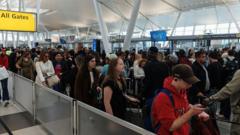
The air inside Terminal 3 feels thin, brittle with the collective anxiety of five hundred people trying to be somewhere else. It is the scent of stale coffee, recycled oxygen, and the low-frequency hum of a system grinding its gears. Normally, the TSA line is a rhythmic, if irritating, dance. Shoes off. Laptops out. The steady beep of the metal detector acting as a metronome for the modern traveler.
But today, the rhythm is broken.
As the Department of Homeland Security shutdown drags into another week, the cracks aren't just visible; they are walking toward you in different uniforms. You expect the familiar blues of the Transportation Security Administration. Instead, you see the tactical gear of Immigration and Customs Enforcement. ICE is at the airport. They aren't there for a raid. They are there to check your carry-on.
The Friction of a Fraying Safety Net
Washington calls it a "contingency plan." On the ground, it feels like a fever dream. When the gears of government lock up because of a budgetary stalemate, the personnel don't simply vanish. They get moved like chess pieces across a board that no longer makes sense. The President’s directive to deploy ICE agents to assist at airport checkpoints is a desperate patch on a leaking hull.
Consider a traveler like Maria. She isn't a political operative. She is a sales consultant with a 6:00 AM flight to Chicago and a toddler who refused to wear socks this morning. She stands in a line that snakes past the Cinnabon and into the baggage claim area. She watches an ICE agent—someone trained for high-stakes enforcement and border interdiction—awkwardly gesturing for a businessman to remove his belt.
The friction is palpable. ICE agents are trained for a specific, often confrontational mission. TSA agents are trained for high-volume screening and customer interaction. Forcing the former into the role of the latter creates a psychological dissonance that ripples through the terminal. It changes the temperature of the room. People stop complaining about the wait and start looking at the floor.
The Math of a Shutdown
The numbers behind this shift aren't just digits on a spreadsheet; they are the grocery budgets of federal employees. Tens of thousands of TSA workers are currently expected to show up for work without a paycheck. Many can’t. They are calling out sick because they have to pick up shifts at grocery stores or drive for ride-share apps just to keep the lights on.
When the "sick-out" rate hits a certain threshold, the airport doesn't just slow down. It threatens to stop.
To prevent a total collapse of the nation’s travel infrastructure, the administration is pulling from the only reservoir of federal manpower available: ICE. But this is a zero-sum game. Every agent standing at a magnetometer in Atlanta is an agent not performing their primary duty elsewhere. We are robbing Peter to pay Paul, and Peter is starting to look exhausted.
The irony is thick enough to choke on. The very department tasked with "Homeland Security" is being hollowed out by the people who lead it. Security is not a static state; it is a performance of consistency. When you replace a seasoned screener who has looked at ten thousand X-ray bags with a field agent who is used to serving warrants, the margin for error doesn't just move. It expands.
A Language of Authority
There is a specific body language associated with different types of law enforcement. A TSA agent is a gatekeeper. An ICE agent is an enforcer. When these worlds collide in the sterile environment of an airport terminal, the message to the public becomes blurred.
Imagine a hypothetical scenario in a mid-sized hub like Indianapolis. A long-term permanent resident, someone who has lived in the U.S. for twenty years with a valid green card, walks up to the podium. Instead of the usual TSA officer, they are met by an agent wearing a badge that, for many communities, represents the fear of separation. Even if that agent is only there to verify a boarding pass, the heart rate of the traveler doubles.
The airport, once a neutral space of transit, becomes a site of intense scrutiny. The "human element" isn't just about the people working; it's about the emotional toll on the people passing through. We are witnessing the militarization of the mundane.
The Invisible Stakes of Fatigue
We often talk about "security" as if it’s a hardware issue. Better scanners. Faster software. Facial recognition. In reality, security is almost entirely a human psychological endeavor. It relies on the vigilance of people who are rested, fed, and focused.
A TSA agent who is worried about their mortgage being three days late is a distracted agent. An ICE agent who has been pulled away from their specialty to perform a job they weren't hired for is a frustrated agent. These are the invisible stakes. You won't see them in a press release, and you won't hear them mentioned in a briefing from the Oval Office.
But you can feel them. You feel them in the way the line stalls when someone forgets a bottle of water. You feel them in the sharp, clipped tones of the officers who are tired of being the face of a crisis they didn't create.
The shutdown creates a vacuum, and power—especially executive power—abhors a vacuum. By moving ICE into the airports, the administration is attempting to project a sense of "robust" control. But look closer. It isn't a show of strength. It is a confession of fragility. It is an admission that the standard systems of our society are so brittle that a two-week political spat can force us to reconfigure our national police force.
Beyond the Boarding Pass
The real story isn't the policy. The real story is the guy in the uniform who hasn't been paid in twelve days, looking at the woman in the business suit who is terrified she's going to miss her connection, while both of them are being watched by an ICE agent who would rather be anywhere else.
This is the choreography of a government in stasis.
The planes still take off. The engines still roar. From thirty thousand feet, the world looks exactly the same as it did a month ago. The borders are where they always were. The cities are glowing grids of light. But down on the ground, in the fluorescent purgatory of the security line, something fundamental has shifted.
We are learning what happens when the people we rely on to keep the world moving are treated as collateral. We are seeing what it looks like when the lines between immigration enforcement and public safety are erased in the name of expediency.
The suitcase clicks shut. The bin slides through the X-ray. You grab your shoes and run for Gate B12. You made it. But as you sit in that cramped middle seat, looking out at the tarmac, you can’t shake the feeling that the person who checked your ID wasn't looking at your name. They were looking right through you, past the terminal, toward a future where the rules are whatever someone decides they need to be this morning.
The light on the wing pulses—red, then white, then gone.