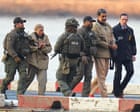
The arrest of an Arizona gun dealer for allegedly funneling high-powered weaponry to the Sinaloa and Jalisco New Generation cartels (CJNG) is not an isolated lapse in judgment by a rogue businessman. It is the logical outcome of a porous regulatory system that treats the sale of weapons capable of piercing light armor with the same administrative lightness as selling a used sedan. While the Department of Justice outlines a conspiracy involving dozens of straw purchasers and hundreds of military-style firearms, the reality on the ground in the Southwest suggests we are watching a massive, decentralized logistics operation that the federal government is fundamentally unequipped to stop.
The dealer at the center of this investigation served as a critical node, a bridge between the legal American consumer market and the paramilitary requirements of the world’s most violent criminal organizations. By allegedly looking the other way as "straw buyers"—clean-record fronts for the cartels—cleared out his inventory, this merchant didn't just break the law. He provided the tactical superiority necessary for the Sinaloa Cartel to maintain its grip on the northern corridors and for CJNG to continue its aggressive expansion across the Mexican interior.
The Logistics of a Cartel Purchase
Cartels do not send "soldiers" in tactical gear to buy rifles in Phoenix or Tucson. They use a sophisticated recruitment network that identifies "clean" residents—often people in desperate financial straits, college students, or even grandmothers—who can pass a background check without a hitch. These individuals are paid a few hundred dollars to sign Form 4473, the federal document that swears the buyer is the actual transferee of the firearm.
In this specific case, the dealer’s role was more than passive. Federal investigators suggest a level of coordination that transcends simple negligence. When a single shop begins moving an "unusual volume" of .50-caliber sniper rifles and FN SCAR platforms, the red flags are not just visible; they are deafening. These are not hunting rifles. They are weapons of war designed for long-range engagement and the disablement of vehicles. When these weapons appear in bulk in a border state, there is only one destination.
Why Arizona is the Cartel Armory
Arizona’s firearms laws are some of the most permissive in the United States, making it a natural staging ground for southward trafficking. Unlike California, which has strict "assault weapon" bans and limits on magazine capacity, Arizona allows the sale of the exact hardware the cartels crave.
- Private Sale Loophole: While the dealer in question was a Federal Firearms Licensee (FFL), the surrounding culture of secondary markets allows for untraceable transfers.
- Bulk Purchase Alerts: Under current law, FFLs must report the multiple sale of handguns to the same person, but the reporting requirements for long guns—the rifles actually used in cartel combat—are far less stringent or nonexistent in many jurisdictions.
- Geographic Proximity: The Interstate 10 and Interstate 15 corridors provide direct, high-speed routes from the Phoenix metro area to the border crossings at Nogales and Douglas.
The cartels view the Arizona retail market as a "just-in-time" supply chain. They don't need to maintain massive stockpiles when they can simply trigger a fresh round of straw purchases to replace losses from seizures or skirmishes with the Mexican military.
Two Masters One Supply Chain
What makes this investigation particularly chilling is the allegation that the dealer was supplying both the Sinaloa Cartel and the CJNG. These two organizations are currently engaged in a brutal, multi-front war for control of the fentanyl and cocaine trade. In the world of illicit arms, there is no brand loyalty.
By arming both sides, a corrupt dealer creates a self-sustaining market. Every rifle sold to one side necessitates a counter-purchase by the other. This isn't just a violation of the Gun Control Act; it is a profit-driven escalation of a foreign conflict. The "iron river" of guns flowing south is the direct counterpart to the "white river" of drugs flowing north. You cannot have one without the other.
The Limits of ATF Enforcement
The Bureau of Alcohol, Tobacco, Firearms and Explosives (ATF) is often criticized for failing to catch these dealers sooner. However, the agency operates under handcuffs forged by decades of lobbying.
The ATF is prohibited by law from maintaining a searchable, centralized electronic database of firearm sales. When a gun is found at a crime scene in Culiacán, the "trace" involves federal agents manually calling the manufacturer, who directs them to the wholesaler, who directs them to the retail dealer. That dealer then has to go into a back room and flip through physical paper files to find out who bought the gun. This deliberate inefficiency is a gift to the cartels. It ensures that by the time an investigation identifies a pattern, the dealer has already moved hundreds of units and the straw purchasers have vanished.
The Economic Incentive of Treason
Why would a legitimate business owner risk a life sentence in federal prison? The answer is the staggering markup of the black market. A high-end semi-automatic rifle that retails for $1,500 in a Scottsdale gun shop can easily fetch $5,000 to $8,000 once it crosses the border into Mexico. For a dealer willing to process "bulk" orders, the profit margins are astronomical.
This isn't a "crime of passion" or a political statement about the Second Amendment. It is a calculated business decision where the risk of federal prosecution is weighed against the certainty of immediate, massive liquidity. For years, the risk was low. The ATF’s budget was stagnant, and "lie and buy" cases were rarely a priority for U.S. Attorneys. That changed with the Bipartisan Safer Communities Act, which finally made straw purchasing a stand-alone federal crime with significant teeth. We are now seeing the results of that legislative shift.
The Human Cost of the Paperwork
The guns sold by this Arizona dealer are not disappearing into a void. They are being used to assassinate journalists, kidnap civilians, and engage the Mexican Army in open urban warfare. When a .50-caliber round is fired in Michoacán, the trigger was pulled by a cartel sicario, but the weapon was provided by an American businessman who prioritized his bottom line over the stability of a neighboring nation.
The defense will likely argue that the dealer followed the letter of the law—that he ran the background checks and the "paperwork looked fine." This is the standard shield for "willful blindness." In the industry, everyone knows what a straw purchase looks like. They know when a young man with no visible means of support walks in and wants to buy three Barrett sniper rifles. They know, and they choose to take the cash anyway.
Reforming the Broken Oversight
If the United States is serious about stopping the flow of weapons to cartels, it cannot rely on the occasional high-profile arrest. The entire oversight mechanism requires a structural overhaul.
- Mandatory Electronic Records: The requirement for paper-only records must be abolished. Law enforcement needs a real-time, searchable database to identify clusters of suspicious sales before the weapons cross the border.
- Universal Background Checks for All Transfers: Closing the "private sale" loophole removes the shadow market that thrives alongside corrupt FFLs.
- Enhanced Penalties for Bulk Long-Gun Sales: The same scrutiny applied to multiple handgun sales must be applied to the semi-automatic rifles that serve as the cartels' primary tools of intimidation.
The Arizona dealer case proves that the cartels don't need to steal weapons or smuggle them from overseas. They can buy them over the counter in a suburban strip mall, provided they find a dealer willing to trade human lives for a fatter bank account. The "iron river" isn't a force of nature; it is a man-made system, and until the cost of participation outweighs the profit, the water will keep rising.
Watch the court filings in the coming months for the names of the straw purchasers. They are the foot soldiers in this domestic armory, but the dealers are the generals.
Check your local FFL's public inspection records via the ATF's FOIA reading room to see how often your regional shops are cited for "failure to record" violations.