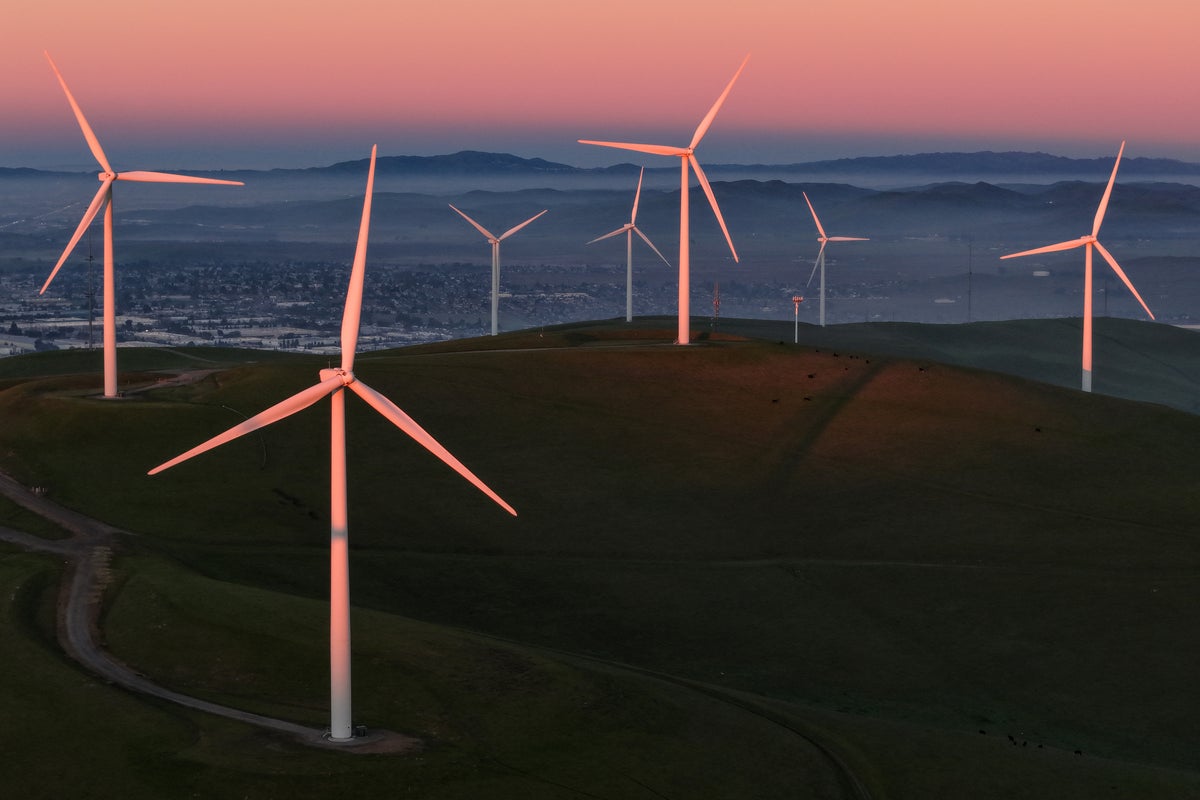
The horizon line off the coast of New Jersey used to be a simple, unbroken stroke of blue. It was a visual promise of emptiness. But for the engineers, investors, and laborers tied to the nascent offshore wind industry, that emptiness was supposed to be filled with the rhythmic sweep of three-hundred-foot blades. They saw a forest of steel rising from the seabed. Now, they see a ledger. Specifically, a ledger with a $1 billion line item intended to make sure those blades never spin.
Money usually moves to build things. We are accustomed to the language of investment, where capital flows into concrete, copper, and fiber optics to birth something new. The proposal currently circulating within the Trump transition team flips that script. It suggests a massive federal payout—a "buyout" of sorts—offered to energy giants to simply pack up and go home. This isn't just a policy shift. It is an attempt to pay for the preservation of a view, a legacy, and a specific version of the American energy map.
The Skeleton in the Surf
Consider a site supervisor we’ll call Elias. He isn't a politician. He’s a man who wears a hard hat and worries about the structural integrity of monopiles driven into the shifting sands of the Atlantic shelf. For years, Elias and thousands like him have operated under the assumption that the "Green Revolution" was an inevitable tide. They watched billions of dollars in private capital pour into leases. They saw specialized vessels, ships that look like giant floating tables with legs, crawl across the ocean floor.
Now, Elias sits in a trailer in a staging port, reading reports that the federal government might offer his employers a billion-dollar "exit fee."
The logic is blunt. The incoming administration views these towering turbines not as progress, but as "bird-killing," "whale-hurting" eyesores that drive up electricity costs. Rather than just revoking permits—which triggers endless, expensive lawsuits—the team is weighing a more transactional path. They are looking at the price of surrender. If you pay a company enough to cover their sunk costs, they might just walk away without a fight.
The Math of Undoing
A billion dollars sounds like a gargantuan sum. In the world of energy infrastructure, however, it is a calculated gamble. The Vineyard Wind project off Massachusetts or the Ocean Wind projects off New Jersey involve capital expenditures that make a billion dollars look like a rounding error. But the "buyout" strategy targets the friction.
Every turbine requires a labyrinth of federal approvals. Bureau of Ocean Energy Management (BOEM) permits, environmental impact statements, and coastal zone management clearances. The Trump team knows that if they simply pull the rug out, the courts will be tied up for a decade. Litigation is slow. It is messy.
By dangling a billion-dollar carrot, the administration aims to bypass the judicial stick. It is an offer of a "clean break." For a CEO answerable to shareholders who are already nervous about high interest rates and supply chain snags, a billion-dollar check to stop working might be more attractive than a ten-year legal battle to keep working.
The Invisible Stakes
We often talk about energy in terms of Megawatts and carbon footprints. We forget the humans standing on the docks.
The wind industry isn't just a collection of Danish and Spanish energy conglomerates. It is a sprawling network of American welders in Virginia, cable manufacturers in South Carolina, and tugboat captains in Rhode Island. When a project is cancelled, a vibration runs through the entire coastal economy. It isn't just the loss of future energy; it's the sudden evaporation of a career path.
Imagine a young technician who spent two years training to service nacelles three hundred feet in the air. He bought a house based on the promise of a twenty-year maintenance contract. To him, that $1 billion payout isn't a "strategic pivot." It is a tombstone. It represents the government paying his employer to make his job disappear.
The Ghost of the Horizon
There is an emotional core to this debate that numbers cannot capture. For opponents of offshore wind, the turbines are an intrusion on the sublime. They represent a "globalist" aesthetic forced upon local fishing communities. To them, the $1 billion is a small price to pay to keep the ocean "wild."
But the "wild" ocean is already a workspace. It’s a highway for container ships and a hunting ground for commercial trawlers. The conflict isn't between nature and industry; it's between two different types of industry. One is the legacy of oil, gas, and the unobstructed view. The other is a high-tech, vertical expansion of the grid.
The transition team's proposal treats the ocean like a real estate development where the neighbors are being paid "hush money" to stop a construction project.
A Precedent of Deconstruction
If this plan moves forward, it sets a jarring precedent for how America does business. Usually, the sovereign risk—the risk that a government will change the rules mid-game—is something investors associate with developing nations or volatile regimes.
When the United States government begins paying companies not to build authorized infrastructure, the message to the global market is clear: your permits are only as good as the current election cycle. This creates a hidden cost that far exceeds $1 billion. It adds a "political risk premium" to every bridge, every road, and every power plant planned for the next fifty years.
Investors don't like uncertainty. They like it even less when that uncertainty is weaponized.
The Silence of the Sea
The ocean is a noisy place. The crashing of surf, the drone of engines, the pings of sonar. But the loudest sound in the coming months will be the silence coming from the boardrooms of these energy giants. They are currently weighing the value of a bird in the hand—the billion-dollar buyout—against the two birds in the bush represented by a future of renewable energy.
The administration’s gambit is a bet on corporate pragmatism over ideological commitment. They believe that, at the end of the day, a company's first loyalty is to the balance sheet. If the government makes it more profitable to quit than to persevere, the turbines will never rise.
As the sun sets over the Atlantic, the horizon remains clear for now. There are no flashing red lights of turbine towers. There is only the dark water and the cold wind. Somewhere, in a quiet office in Washington, a pen is hovering over a proposal that would keep it that way forever, turning the sea into a billion-dollar monument to what might have been.
The cost of a view has never been higher.