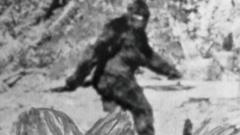
For years, the pursuit of Sasquatch was a fringe hobby relegated to the backwoods and grainy VHS tapes, but a massive longitudinal study of 160 active hunters reveals a much grittier reality. This isn’t about blurry photos. It is about a specific psychological and sociological phenomenon where hundreds of individuals dedicate their life savings and decades of time to a hunt that never ends. Researchers found that these hunters aren’t just looking for a primate; they are seeking a connection to a wilder world that modern society has systematically paved over.
The study, which tracked these subjects over a decade, shows that the "hunt" functions as a form of resistance against the hyper-digital life. Most participants weren't uneducated or delusional. They were engineers, mechanics, and teachers who felt a profound sense of loss in their daily routines. They used Bigfoot as a catalyst to reclaim a sense of mystery.
The High Cost of the Infinite Search
Most people assume Bigfoot hunting is a cheap weekend hobby involving a camo jacket and a flask of whiskey. They are wrong. To the serious practitioner, this is a capital-intensive operation that rivals small-scale military reconnaissance. The 160 subjects interviewed revealed a staggering financial commitment. We are talking about thermal imaging cameras that cost five figures, custom-built off-road vehicles, and expensive long-term leases on private timberlands.
The financial drain often leads to what social scientists call "sunk cost devotion." Once a hunter has spent $50,000 and lost a marriage over the search, admitting there is nothing out there becomes an existential impossibility. The search must continue because the alternative—that the money and time were wasted—is too painful to bear. This creates a feedback loop where the hunter interprets any snapped twig or distant howl as "the big one," justifying the next round of investment.
Data Over Evidence
One of the most striking findings from the years of interviews is the shift from "sighting" to "data collection." In the past, a hunter just wanted to see the creature. Today, the 160 subjects were obsessed with environmental DNA, bioacoustics, and migratory patterns. They have adopted the language of legitimate biology to shield themselves from ridicule.
By framing their work as "citizen science," they gain a veneer of authority. They aren't just guys in the woods anymore; they are field researchers. This shift is significant because it moves the goalposts. You don't need a body to prove you're a researcher; you just need a hard drive full of audio files. This allows the community to sustain itself indefinitely without ever producing a single biological specimen. It is an industry built on the process, not the product.
The Social Architecture of the Woods
While the public image of a Bigfoot hunter is a lone wolf, the reality is a deeply interconnected social network. The researchers noted that these 160 individuals formed a "shadow community." They have their own hierarchies, their own celebrities, and their own bitter internal feuds.
The Gatekeepers of the Myth
In this world, status is everything. Those who claim to have "frequent encounters" or "habituation sites" hold the most power. However, that power is fragile. The interviews showed a high level of paranoia within the group. Hunters are terrified of "claim jumpers" who might find their secret spots or, worse, skeptics who might debunk their latest evidence. This creates an environment of extreme secrecy that mimics the intelligence community more than it does a nature club.
Digital Echo Chambers in the Wilderness
Technology hasn't helped the search as much as it has fueled the obsession. The subjects reported spending more time on forums and private Discord servers than actually hiking through the brush. These digital spaces act as echo chambers where any shred of skepticism is purged. When 160 people are all telling each other that the blurry shadow in a photo is definitely a seven-foot-tall biped, the collective certainty becomes impenetrable.
The Psychological Pivot
Why do they keep going? The researchers spent a significant amount of time trying to crack the "why." They found that for many, Bigfoot is a placeholder for something else. It represents the "Great Unknown" in a world where every square inch of the planet is mapped by satellites.
The hunters described a feeling of "re-enchantment." When they are in the woods, the world becomes dangerous and exciting again. Every shadow could be a discovery. This psychological high is addictive. It provides a sense of purpose that a 9-to-5 office job simply cannot match. The creature itself is almost secondary to the feeling of being the one who might find it.
The Ethics of the Unending Hunt
There is a darker side to this dedication. The interviews revealed a pattern of "obsessive passion" that often damaged the subjects' real-world lives. Researchers noted significant rates of isolation. Some hunters stopped attending family events or shifted their entire careers to be closer to "hotspots."
There is also the question of the impact on the environment. The influx of hunters into remote areas brings noise, trash, and disruption to actual endangered species. In their quest to find a mythical animal, these enthusiasts often overlook the real biological crises happening right under their feet. They are looking for a ghost while the forest burns.
The Commercialization of the Search
Bigfoot is big business. Beyond the individual hunters, there is an entire infrastructure designed to sell them gear, tickets to conferences, and television subscriptions. The 160 subjects were the primary consumers of this industry. They are the ones buying the specialized "Sasquatch-grade" microphones and attending the $300-a-head seminars.
This commercial layer adds another reason why the search will never end. There is too much money at stake. If Bigfoot were found—or proven not to exist—the industry would collapse. The "hunt" requires a perpetual state of "almost found it." This tension is what keeps the magazines selling and the TV shows in production.
A Legacy of Footprints
What is the final takeaway from a decade of studying these people? It is that the Bigfoot hunter is a modern archetype. They represent the human refusal to accept that the world is fully known. They are the last of the explorers, even if they are exploring a map that might be blank.
The researchers concluded that even if science definitively proved Bigfoot was a myth tomorrow, these 160 people would likely keep going. They aren't looking for a monster. They are looking for a version of themselves that isn't bored.
Stop looking for the creature and start looking at the man holding the camera. That is where the real story lies. The footprints in the mud are rarely from a Sasquatch; they are the tracks of someone trying to walk away from the modern world. If you want to understand the mystery, you have to understand the need for the mystery. Without it, the woods are just trees, and the world is just a map. For the 160 hunters, that is a reality too quiet to live in.