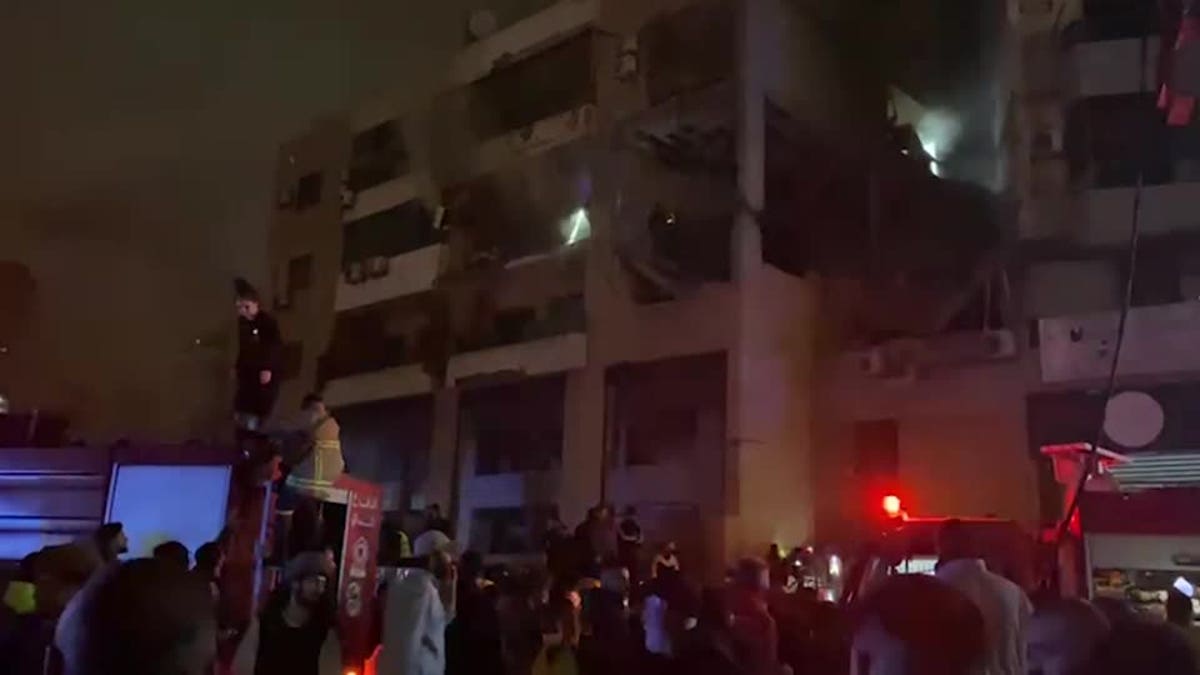
The headlines are screaming about "all-out war" again. They do this every time a building collapses in Dahiyeh or a drone buzzes a Galilee chicken coop. The Indian Express and their cohort of legacy desk-jockeys want you to believe we are on the precipice of a World War III-style conflagration. They treat every Israeli airstrike in Beirut as a "live update" toward Armageddon.
They are wrong.
The media is obsessed with the mechanics of the exchange—the number of sorties, the caliber of the missiles, the frantic diplomacy at the UN. They miss the fundamental reality of the Levant in 2026: this isn't an escalation toward a big war. This is a brutal, high-stakes equilibrium that neither side can afford to break.
The "Lazy Consensus" suggests that we are one miscalculation away from a total regional meltdown. In reality, the "miscalculations" are the only thing keeping the peace.
The Beirut Boogeyman
When Israel hits Beirut, the narrative is always about the "red line." We are told that Lebanon’s capital is the ultimate sanctuary, and touching it invites a rain of 150,000 rockets that will "darken the skies of Tel Aviv."
I have spent a decade watching these "red lines" move like shadows. In 2006, a strike on Beirut was a regime-threatening event. Today, it is a Tuesday.
The reason isn't that Hezbollah has grown weak; it's that Hezbollah has grown up. They are no longer just a guerrilla outfit; they are the de facto custodians of a failing state. If Hezbollah triggers the "big one," they lose their grip on the Lebanese carcass. They aren't protecting Lebanon from Israel; they are protecting their own political survival from the consequences of their own rhetoric.
The Indian Express frames these strikes as a prelude to a ground invasion. It’s a fundamental misunderstanding of Israeli military doctrine post-2006. Israel doesn't want to govern southern Lebanon. They don't even want to occupy it. They want to turn it into a high-tech buffer zone where nothing larger than a toaster can move without being vaporized by an AI-slotted Spike missile.
The Iran-Israel Shadow Box
Everyone asks: "When will Iran join the fight?"
The answer: They already have, and they’ve already reached their limit.
The "People Also Ask" sections of the internet are obsessed with the "direct confrontation" between Tehran and Jerusalem. This premise is flawed. Iran’s entire regional strategy—the "Axis of Resistance"—is designed specifically to avoid a direct confrontation.
The IRGC (Islamic Revolutionary Guard Corps) understands a math problem that Western journalists ignore.
$$F = \frac{MA}{D^2}$$
In this simplified geopolitical force equation, the effectiveness of Iranian power ($F$) is a function of their Mobilized Assets ($MA$) divided by the Square of the Distance ($D$) from their borders. Iran is a master of "force at a distance." If they get into a direct, kinetic, state-on-state war with Israel, $D$ goes to zero, and their asymmetric advantage evaporates. They become a target for the F-35s they can't see and the cyber-warfare they can't stop.
Tehran isn't waiting for the right moment to strike. They are waiting for the storm to blow over so they can go back to the status quo. The status quo is where they win. Total war is where they disappear.
The Iron Dome Fallacy
Legacy news outlets love to show videos of the Iron Dome intercepting Grad rockets. It’s "War as Spectacle." They frame it as a shield that allows Israel to act with impunity.
But here is the truth that the defense contractors won't tell you: The Iron Dome is a strategic trap for Israel.
By making the Israeli public feel safe, it removes the political pressure to find a permanent solution. It creates a "subsidy for conflict." Because the cost of being attacked is lowered, the incentive to decisively end the threat is also lowered.
I’ve seen military planners in Tel Aviv lose sleep over this. They know that every $50,000 Tamir interceptor used to down a $500 Iranian-made drone is a losing trade in the long run. Israel is winning the tactical battles and losing the economic war of attrition.
The "unconventional advice" for Israel? Stop relying on the shield. A shield doesn't win a war; it just makes the losing process more comfortable.
The Myth of the "Innocent" Lebanese State
The Indian Express and others often paint the Lebanese government as a helpless bystander caught between two giants. This is a convenient fiction.
The Lebanese state is not a bystander; it is a host. The Lebanese Armed Forces (LAF) receive hundreds of millions in US aid while operating in the same geographic space as Hezbollah without ever a hint of friction.
If you want to understand why the "Beirut airstrikes" aren't stopping, look at the Lebanese elite. They use the threat of Israel to distract from the fact that they have plundered the national treasury. War is the ultimate distraction for a failed central bank.
The Energy Angle: The Real Reason for Restraint
While the news focuses on religious ideology and historical grievances, the real map of the conflict is underwater.
The Karish gas field and the maritime border agreements between Israel and Lebanon are the strongest peace treaties ever signed in the Middle East. They aren't written on paper; they are built with pipelines.
Israel needs the gas revenue. Lebanon—starving and dark—desperately needs the hope of future gas revenue. You don't blow up your neighbor's house when you share a plumbing system that is the only thing keeping you both fed. This is the "nuance" the live updates miss. The missiles fly high, but the money stays low, and the money usually wins.
The Collapse of the "Axis"
The most contrarian take of all? The "Axis of Resistance" is currently experiencing its own version of a corporate mid-life crisis.
- Hamas is tactically shattered.
- Hezbollah is overstretched, acting as a police force in Syria and a government in Lebanon.
- The Houthis are a wildcard, but they are geographically irrelevant to the survival of the Israeli state.
The Indian Express writes as if these groups are a monolithic, synchronized army. They aren't. They are a loose confederation of local interests that use Iranian branding for prestige. When the pressure gets high enough, they will look out for themselves, not for "Palestine" or "The Ummah."
Stop Asking "What Happens Next?"
The media wants you to look at the horizon for a massive explosion. You should be looking at the ground for a slow, grinding rot.
There will be no "Day After" because the "Day Before" never ends. This is a permanent state of managed chaos. The airstrikes in Beirut are not the start of a war; they are the maintenance of a border.
The real danger isn't a mushroom cloud over the Galilee. It’s the slow-motion transformation of the entire region into a series of militia-run fiefdoms where the "Live Updates" are just a way to keep the populations terrified enough to keep the same failed leaders in power.
The Indian Express is selling you a thriller. The reality is a tragedy of repetitive, calculated violence where everyone knows their lines and no one wants to leave the theater.
If you’re waiting for the "Total War," you’re going to be waiting a long time. The players are too smart for that, and too cowardly to try anything else.
Stop reading the live blogs. They are reporting on the smoke. The fire was put out by mutual exhaustion years ago.