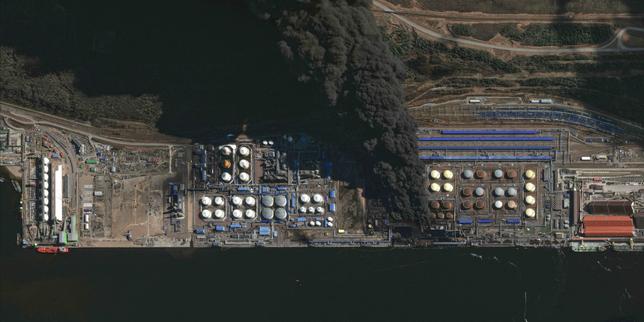
The geographic insulation that once protected Russia’s most lucrative energy hubs has evaporated. For decades, the Ust-Luga and St. Petersburg oil terminals were considered safe rears, situated over 800 miles from the Ukrainian border. That distance is no longer a shield. Recent drone strikes against these facilities do more than just ignite storage tanks. They signal a fundamental shift in the cost-benefit analysis of the Kremlin’s energy exports. By successfully striking the Baltic coast, Ukraine has effectively expanded the active combat zone to include the very infrastructure that finances the Russian state.
This is not a random act of harassment. It is a targeted decapitation of the logistics chain. When a drone hits a refinery or a loading port in the Baltic Sea, it creates a ripple effect that touches global insurance premiums, shipping schedules, and the internal stability of the Russian ruble. The "shadow fleet" of tankers used to bypass Western sanctions now faces a physical threat that no amount of shell-company maneuvering can mitigate.
The Engineering of Long Range Attrition
To understand how a domestic drone program can reach the Gulf of Finland, one must look past the headlines of "suicide drones." These are not the small quadcopters seen in frontline trench footage. We are seeing the deployment of fixed-wing, long-range loitering munitions that utilize a sophisticated mix of inertial navigation and visual odometry.
Russia’s integrated air defense system (IADS), built around the S-400 and Pantsir-S1 units, was designed to stop high-performance jets and cruise missiles. It was not optimized for low-altitude, low-RCS (radar cross-section) composite drones that fly at speeds barely faster than a Cessna. These drones "hug" the terrain, following riverbeds and valleys to stay below radar horizons. By the time they arrive at a massive, static target like an oil terminal, the defensive window has closed.
The vulnerability of an oil port is its density. You have thousands of tons of volatile hydrocarbons concentrated in unarmored steel tanks. A single successful hit doesn't just damage the tank; it creates a thermal event that can take days to extinguish and months to repair. This is the definition of asymmetrical warfare. A drone costing roughly $50,000 can cause hundreds of millions of dollars in infrastructure damage and lost revenue.
The Economic Fracture Point
For the Kremlin, the Baltic ports are the crown jewels. While the Black Sea ports are closer to the conflict, the Baltic terminals handle a massive percentage of Russia’s crude and refined product exports to the global market. If these ports become unreliable, the entire Russian fiscal budget begins to wobble.
Energy analysts have long noted that Russia’s "war chest" is essentially a giant gas station. When the pumps break, the army stops moving. The psychological impact on the shipping industry is equally devastating. International ship owners, even those willing to risk sanctions for high profits, will balk at sending multi-million dollar vessels into a port that might be under fire. We are seeing the beginning of a "war risk" premium being applied to the Baltic Sea, a body of water that was once a sleepy commercial lake.
The Failure of Electronic Warfare Over the Interior
The fact that these drones are reaching the Baltic implies a significant gap in Russia’s internal Electronic Warfare (EW) blanket. Russia is widely considered a world leader in GPS jamming and spoofing. However, you cannot jam everything, everywhere, all the time without grounding your own civil and military aviation.
Ukrainian engineers have adapted by using "dead reckoning" and autonomous terminal guidance. Even if the GPS signal is lost 100 miles from the target, the drone's onboard computer can compare the terrain below it to pre-loaded satellite imagery. It finds its way to the port without needing a single satellite ping. This technological cat-and-mouse game has shifted in favor of the attacker because the defender has to protect every square inch of a massive coastline, while the attacker only has to find one hole in the net.
Reassessing the Grey Zone
The Western response to these strikes has been one of quiet observation mixed with diplomatic anxiety. There is a persistent fear in Washington and Brussels that striking Russian oil infrastructure will lead to a spike in global gasoline prices. This is a narrow view. The global market is remarkably resilient, and the actual volume lost in these strikes is often replaced by increased production elsewhere.
What is not easily replaced is the specialized equipment required to run these terminals. Much of the high-end pumping and refining technology in the Baltic ports was installed by Western firms like Siemens or Honeywell. Under current sanctions, Russia cannot simply buy spare parts for a cracked distillation tower or a sophisticated loading arm. These strikes aren't just causing fires; they are causing permanent degradation of Russian industrial capacity.
The Logistics of a Siege Without a Navy
Ukraine is achieving a maritime blockade without a traditional navy. By utilizing land-based drone launchers, they have turned the Baltic and Black Seas into "no-go" zones for Russian state interests. This is a nightmare scenario for a country that relies on sea lanes for its economic survival.
The military reality is that Russia now has to pull air defense units away from the front lines in the Donbas to protect its domestic refineries. Every Pantsir battery sitting in a parking lot in St. Petersburg is a battery that isn't protecting a Russian supply depot in occupied territory. This dilution of forces is a primary objective of the Ukrainian deep-strike campaign.
The Structural Fragility of the Energy State
The Kremlin’s biggest weakness is its centralization. Because the economy is so heavily weighted toward a few massive export points, those points become "single points of failure." If the Ust-Luga complex is knocked offline for an extended period, the Russian state loses the ability to process and ship a significant portion of its daily output. You cannot simply put millions of barrels of oil in a suitcase and move them somewhere else.
This is the hard truth of the current phase of the war. The conflict is no longer confined to a strip of dirt in eastern Ukraine. It has moved into the boardrooms and the engine rooms of the Russian energy sector. The Baltic Sea, once the safe corridor for Peter the Great’s "window to Europe," has become a front line.
The strategic map has been rewritten. When the smoke clears from a port fire in the Baltic, it reveals a Russian military-industrial complex that is overstretched, technologically outpaced, and economically exposed. The drones will keep coming because they have proven that the Russian heartland is no longer off-limits. The tactical success of these strikes is measurable in charred metal and lost barrels, but the strategic victory is the realization that no part of the Russian economy is beyond the reach of a determined, decentralized adversary.
The only remaining question is how many more terminals must burn before the cost of the war exceeds the value of the oil.