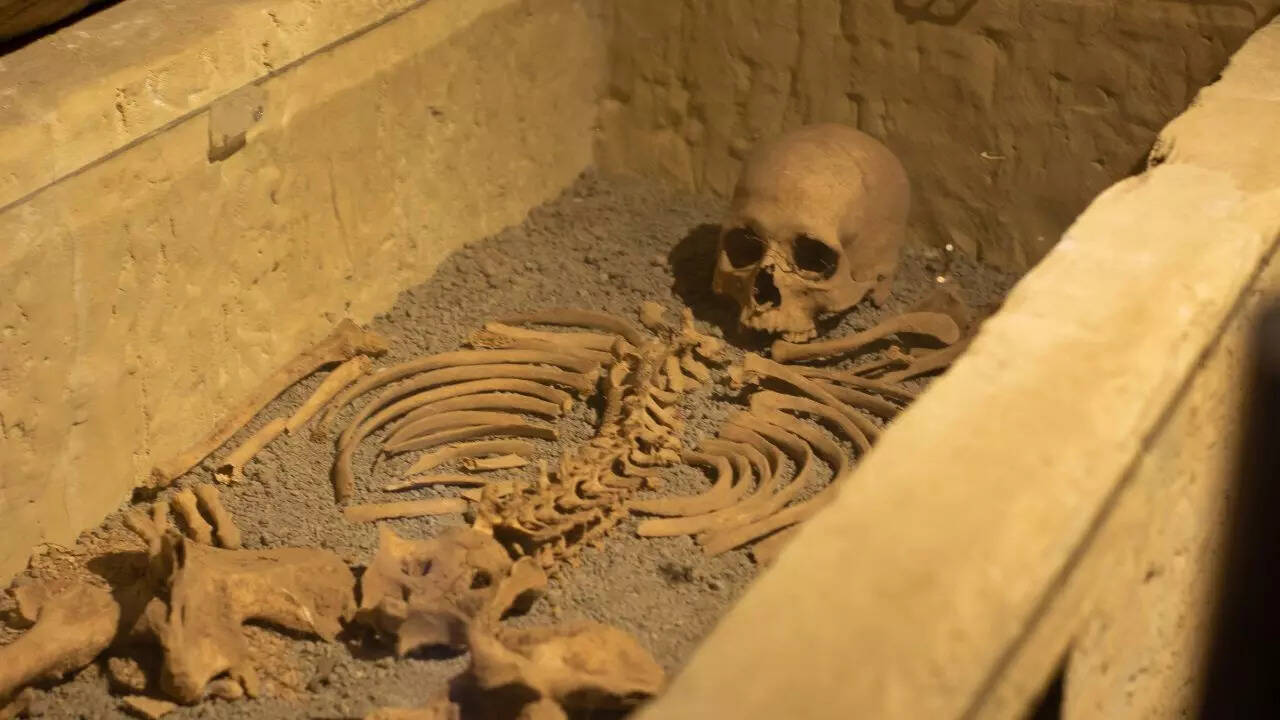
Imagine a massive storm hitting the Baltic coast in 1898. The waves are violent, chewing away at the shoreline near what's now Bagicz, Poland. As the ground gives way, something heavy and dark tumbles out of the cliffside and lands on the beach. It isn't a rock or a piece of modern debris. It’s a hollowed-out oak log, nearly two millennia old, and it contains the remarkably preserved remains of a young woman.
This isn't a tall tale. It’s the start of one of the most intriguing archaeological puzzles in Northern Europe. For over a century, she's been known as the Princess of Bagicz. But as we’ve dug deeper into the science, the "princess" label is starting to look like a bit of a Victorian oversimplification.
What the Baltic Waves Revealed
The discovery happened during a period of intense coastal erosion. When locals found the coffin, they didn't just find bones. They found a woman wrapped in animal skins, adorned with intricate bronze jewelry and a unique bead made of cowrie shell—an item that shouldn't have been there.
The burial dates back to the 1st or 2nd century AD, a time when the Roman Empire was at its peak to the south, while the Germanic tribes of the Wielbark culture dominated this coastal region. The level of preservation was startling. The tannins in the oak combined with the specific soil conditions of the cliff acted as a natural preservative, keeping her story intact for nearly 1,900 years.
The Mystery of the Cowrie Shell
The most jarring detail wasn't the bronze. It was that single cowrie shell. These shells aren't native to the cold, brackish waters of the Baltic Sea. They come from the Indian Ocean or the Red Sea.
Think about the logistics of that for a second. In an era without paved highways or global shipping manifests, a small shell traveled thousands of miles across mountain ranges, through war zones, and over various tribal borders to end up in a grave on a Polish beach. It’s a massive neon sign pointing to an incredibly sophisticated trade network. It suggests that even the "barbarians" at the edge of the known world were connected to a global economy that stretched to the tropics.
She Probably Wasn't a Princess
We love calling every high-status female burial a "princess." It sells newspapers and makes for great museum plaques. But "Princess of Bagicz" is likely a misnomer. Recent osteological shifts and DNA analysis suggest something much more grounded, yet equally fascinating.
Researchers like Dr. Marta Chmiel-Chrzanowska have spent years re-examining these remains. The "Princess" was likely a woman of significant standing within a local elite group, sure. But her bones tell a story of health and diet that reflects a specific lifestyle. She lived a relatively comfortable life, but "princess" implies a political structure that doesn't quite fit the tribal dynamics of the Wielbark culture.
She was a person of influence. Maybe a healer, a matriarch, or the daughter of a wealthy trader. Her status was earned or inherited within a community that valued her enough to inter her in a labor-intensive oak coffin rather than the more common cremation practices of the time.
Why the Oak Coffin Matters
In the 1st century, burying someone in a "monoxylon"—a coffin carved from a single tree trunk—was a statement. It required a massive, healthy oak and hours of grueling manual labor with basic tools.
- Oak was sacred. Many Germanic and Celtic tribes viewed the oak as a symbol of strength and a link to the divine.
- Resource intensity. You don't waste an entire oak tree on someone the community doesn't respect.
- Symbolic protection. The log wasn't just a box; it was a vessel, possibly intended to help the deceased navigate the afterlife.
The fact that her community chose this method tells us she was central to their social fabric. They wanted her to stay intact. They wanted her remembered.
The Science of the Strontium
If you want to know where someone is from, you look at their teeth. Strontium isotope analysis acts like a biological GPS. The minerals in the water you drink as a child get locked into your tooth enamel forever.
Analysis of the Bagicz remains shows she wasn't a traveler from a distant land. She was local. She grew up eating food grown in the soil of the Pomeranian region. This makes the cowrie shell even more interesting. She didn't bring it with her from a far-off home; the shell came to her. She was the recipient of high-end luxury goods from the Roman trade routes that funneled amber south and brought exotic trinkets north.
The Tragedy of the Missing Context
One of the biggest frustrations for modern historians is how the site was initially handled. In 1898, archaeology was often closer to treasure hunting than science. The cliff was unstable, the locals were curious, and many of the smaller artifacts or environmental clues were lost or destroyed before they could be properly documented.
We have the "what," but the "how" and "why" are buried under a century of coastal erosion and incomplete notes. We're lucky the jewelry and the primary skeleton made it to a museum in Szczecin at all.
A Window into the Wielbark Culture
The Wielbark culture is often overshadowed by the Roman Empire, but they were a powerhouse in their own right. They were known for their distinct funeral rites and their role in the "Amber Road" trade.
The Princess of Bagicz serves as a bridge between two worlds. She represents the point where the wild, tribal north met the commercial interests of the Mediterranean. When you look at her bronze clasps (fibulae), you see craftsmanship that rivals anything coming out of Roman workshops.
Why You Should Care Today
It's easy to dismiss a 1,900-year-old skeleton as a museum curiosity. But the Bagicz find reminds us that globalization isn't a modern invention. People have always been mobile. We've always wanted beautiful things from far-away places.
She lived in a world undergoing massive climate shifts and political upheaval, not unlike our own. The way her people honored her—with the best they had to offer—is a very human impulse that hasn't changed in two millennia.
If you're ever in Northwest Poland, the National Museum in Szczecin holds the remains and the artifacts. Seeing the jewelry in person makes the "Princess" feel less like a mystery and more like a person. You can see the wear on the bronze. You can imagine her wearing these pieces at a feast or a ritual.
Stop thinking of history as a series of dry dates. It's a collection of people who lived, breathed, and eventually fell out of a cliffside to remind us they were here. The next time you're at the beach, look at the cliffs. You never know what's waiting for the next big storm to shake it loose.
Go visit the National Museum in Szczecin to see the collection for yourself. It’s the only way to truly appreciate the scale of the oak coffin and the delicate detail of the bronze work that survived nearly two thousand years of salt and soil.