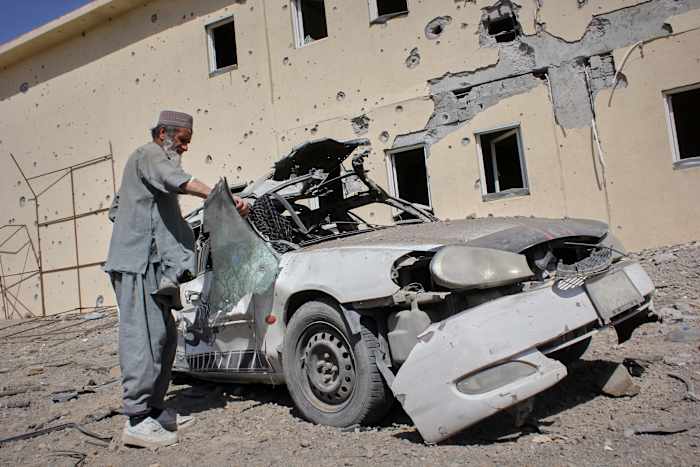
The reported deaths of 67 Afghan security personnel over a five-day engagement period signify more than a localized border skirmish; they represent a breakdown in the informal "non-escalation" protocols that have historically governed the Durand Line. When state-level actors transition from defensive posturing to high-intensity kinetic exchanges, the shift is rarely a byproduct of accidental friction. Instead, it reflects a calculated recalibration of the Strategic Depth Doctrine and a testing of the Afghan interim government's internal cohesion.
The Triad of Border Instability
To understand why a 2,640-kilometer boundary has suddenly catalyzed into a high-casualty theater, one must examine the intersection of three distinct operational variables.
1. The Territorial Sovereignty Paradox
The Durand Line remains a fundamental point of friction because of a deep-seated ontological disagreement. Islamabad views the line as a permanent, internationally recognized border. Kabul—regardless of which faction holds power—historically views it as a colonial imposition that bisects the Pashtun heartland. This creates a Zero-Sum Territorial Game. Every kilometer of fencing or every new border outpost is viewed by Pakistan as a security necessity and by Afghanistan as a provocative annexation.
2. The Transnational Militancy Feedback Loop
The primary driver of the current escalation is the presence of the Tehrik-i-Taliban Pakistan (TTP) on Afghan soil. Pakistan’s security establishment operates under the Direct Attribution Model: any attack originating from across the border is treated as having the tacit or explicit approval of the Afghan authorities. When Afghan security forces provide "cover fire" or logistical sanctuary to non-state actors, they inadvertently invite state-on-state kinetic responses.
3. Domestic Legitimacy Pressure
The Afghan interim government faces a "Legitimacy-Capability Gap." To maintain the loyalty of its hardline rank-and-file, it must project an image of an unyielding defender of Afghan soil. Simultaneously, Pakistan’s military leadership faces domestic political pressure to demonstrate that its "Hard Power" capabilities can secure the western frontier.
Quantifying the Kinetic Shift: The 67-Casualty Metric
The figure of 67 Afghan security members killed indicates a significant change in the Rules of Engagement (ROE). In standard border friction, casualties are usually in the single digits, resulting from small-arms fire or mortar exchanges. A body count of this magnitude suggests the deployment of:
- Precision Stand-off Weaponry: The use of heavy artillery and potentially unmanned aerial vehicles (UAVs) to target fixed Afghan positions.
- Massing of Fires: A transition from reactive fire to "Suppression and Destruction" missions intended to neutralize Afghan border outposts entirely.
- Tactical Asymmetry: Afghan forces, largely configured as a light infantry insurgency-turned-border-guard, lack the mechanized depth and integrated air defense to counter a conventional military’s coordinated fire plan.
The casualty ratio reveals a technological and structural imbalance. While Afghan forces may possess high morale and terrain knowledge, they are currently unable to match the Integrated Fire Control systems utilized by the Pakistan Army.
The Logistics of Escalation: Why 5 Days?
The duration of the fighting—five consecutive days—is a critical data point. In the geography of the Spin Boldak or Torkham corridors, five days of sustained combat is the limit of "spontaneous" escalation. Beyond the 72-hour mark, every round fired is a logistical choice.
The persistence of the engagement suggests that neither side’s local commanders were given "Cease and Desist" orders by their respective central hubs. This implies that the escalation served a Signaling Function. Pakistan is signaling that the era of "strategic patience" regarding cross-border TTP movement is over. Kabul is signaling that it will not be coerced into a submissive border management role, even at the cost of significant personnel attrition.
Economic and Humanitarian Bottlenecks
The kinetic exchange does not exist in a vacuum; it immediately triggers a Secondary Crisis Loop via the closure of key Transit Trade Routes.
- The Torkham-Chaman Chokepoint: These crossings facilitate billions in annual trade. When fighting intensifies, the closure of these gates acts as an informal economic sanction. Perishable goods rot, and the Afghan economy, already starved of liquidity, loses vital customs revenue.
- The Refugee Lever: Pakistan hosts millions of Afghan refugees. Historically, border escalations are followed by increased pressure on refugee communities, using "repatriation" as a demographic counter-pressure against Kabul’s security policies.
The Structural Failure of Bilateral Mechanisms
The current bloodshed highlights the obsolescence of existing conflict-resolution frameworks. The "Joint Border Commissions" and "Flag Meetings" between local commanders are insufficient when the root cause of the conflict is a high-level strategic disagreement.
The primary structural bottleneck is the Lack of a Hot-Line. Without a reliable, high-level communication channel between the General Staff in Rawalpindi and the Ministry of Defense in Kabul, tactical errors on the ground rapidly scale into strategic disasters. The fog of war at 8,000 feet in the Hindu Kush is dense; a single misinterpreted mortar round can trigger a divisional-level response.
Strategic Forecast: The Path of Managed Hostility
The most probable trajectory is not a full-scale war, which neither economy can afford, but a transition into a state of Managed Hostility. This involves:
- Kinetic Zoning: Periodic, high-intensity strikes by Pakistan against suspected militant hubs, followed by Afghan retaliatory shelling, followed by a temporary, fragile truce.
- Infrastructure Weaponization: Continued fencing of the Durand Line despite Afghan opposition, leading to localized skirmishes as a "New Normal."
- Proxy Re-calibration: Pakistan may shift from seeking cooperation from the Afghan interim government to actively undermining its internal stability if the TTP threat remains unaddressed.
The Afghan leadership must now calculate whether the symbolic value of contesting the Durand Line outweighs the material cost of losing an entire battalion’s worth of manpower every week. If the 67 deaths do not result in a policy shift in Kabul, the next phase will likely involve the introduction of Aerial Interdiction within Afghan airspace, marking a terminal breakdown in bilateral relations.
The immediate strategic requirement is the establishment of a Demarcated Buffer Zone where heavy weaponry is prohibited. Without a physical and technical separation of forces, the current attrition rate will become the baseline, turning the Durand Line into a permanent active front rather than a managed border. Kabul’s move must be to decouple its border defense from its ideological stance on the Durand Line’s legality, or risk a sustained degradation of its security forces that it cannot replace.