The current phase of the Russo-Ukrainian War is defined by a hard physical ceiling on kinetic output and a diminishing return on territorial reclamation via conventional maneuver. For Kyiv, the challenge is no longer merely one of tactical proficiency, but of managing a multi-variable equation where Western political cycles, internal demographic limits, and industrial lead times intersect. Zelensky’s recent diplomatic posture signals a pivot from the "total liberation" rhetoric of 2023 toward a framework of structured endurance. This shift acknowledges a brutal reality: Ukraine must synchronize its political survival with the sluggish replenishment cycles of the North Atlantic Treaty Organization (NATO) defense industrial base.
The Triad of Ukrainian Strategic Sustainability
Ukraine’s ability to remain a sovereign belligerent rests on three interdependent pillars. If any one of these pillars experiences a structural failure, the other two become irrelevant.
- Kinetic Parity via Precision Asymmetry: Ukraine cannot match Russia in raw shell-for-shell volume. Therefore, success depends on maintaining a specific ratio of precision-guided munitions (PGMs) to unguided mass. This is the only way to offset the Russian advantage in "dumb" artillery and glide bombs.
- Demographic Preservation: Unlike Russia, which has historically utilized a high-attrition, low-value approach to infantry, Ukraine faces a demographic bottleneck. Every tactical decision must be weighed against the long-term viability of its labor force and future gene pool.
- Extrinsic Fiscal Continuity: Ukraine is an economy in a state of total mobilization, yet it is tethered to external central banks. The predictability of aid is more important than the quantity; a $60 billion package delivered over 12 months allows for long-range planning, whereas the same amount delivered in unpredictable tranches creates operational paralysis.
The Cost Function of Territorial Defense
The geography of the current frontline has reached a state of high entropy. Russia has constructed what is arguably the most complex defensive network in modern history, characterized by deep minefields, "dragon’s teeth" anti-tank obstacles, and persistent drone surveillance.
The cost of reclaiming a square kilometer of occupied territory has increased exponentially since the Kharkiv and Kherson counter-offensives. This is due to the Defensive Multiplier Effect. In standard military theory, an attacker typically requires a $3:1$ ratio in force concentration to overcome a defender. In the context of contemporary Electronic Warfare (EW) and First-Person View (FPV) drone saturation, this ratio often climbs to $5:1$ or higher.
Ukraine’s strategic adjustment involves shifting the focus from Territorial Reclamation to Systemic Degradation. By using long-range assets like ATACMS and Storm Shadow missiles to strike logistics hubs, oil refineries, and command centers within Russian territory or deep in the rear, Ukraine aims to increase the "internal friction" of the Russian war machine. The goal is to make the cost of holding the territory higher than the value derived from it.
The Bottleneck of Western Industrial Lead Times
A significant friction point in Zelensky’s strategy is the mismatch between the "speed of the battlefield" and the "speed of the factory." The West is currently operating on a peace-time industrial footing while attempting to supply a high-intensity, industrial-scale war.
- 155mm Shell Production: While European and American production is scaling, the lead time for new production lines is measured in years, not months.
- Air Defense Interceptors: Systems like Patriot and IRIS-T are highly effective but are produced in small annual quantities. Russia’s strategy of mass-producing low-cost Shahed drones is designed to "bleed" these expensive interceptors, creating a deficit in protection for critical infrastructure.
- Technological Half-Life: The effective lifespan of an EW frequency or a drone software patch on the Ukrainian front is roughly six to eight weeks. After this period, the adversary typically develops a countermeasure. This necessitates a "Hot DevOps" cycle where frontline feedback is integrated into manufacturing in real-time—a capability where Ukraine currently leads, but requires Western capital to scale.
The Logic of Diplomatic Inevitability
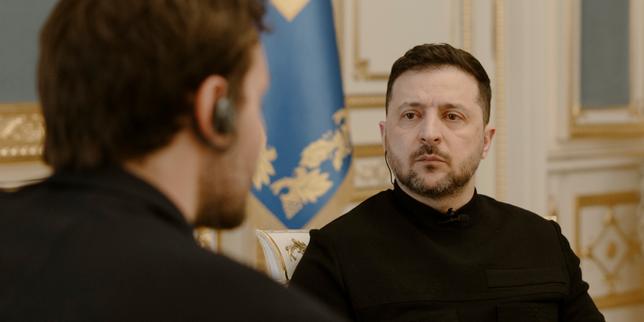
Zelensky’s outreach to international media, including Le Monde, serves as a mechanism for "expectation management." By discussing the possibility of a "just peace" or structured negotiations, he is not signaling a surrender, but rather preparing the global stage for a scenario where the war ends through a combination of military exhaustion and diplomatic leverage.
The "Zelensky Peace Formula" is less a list of demands and more a framework for collective security. It attempts to shift the burden of Ukrainian security from a bilateral US-Ukraine agreement to a multilateral European-led architecture. This is a hedge against political volatility in Washington. The logic follows that if Ukraine is integrated into the European defense supply chain, its security becomes a matter of European internal policy rather than discretionary foreign aid.
Strategic Friction and the Fallacy of Frozen Conflicts
Many analysts suggest a "Korean Scenario" or a frozen conflict. This is a flawed comparison because it ignores the Kinetic Evolution of the Russo-Ukrainian war. Unlike the 1950s, modern sensors and long-range strike capabilities mean there is no such thing as a "quiet" sector.
A frozen conflict in Ukraine would merely be a re-arming period for Russia. Without a definitive security guarantee—likely NATO membership or a massive, permanent standing military presence—any "pause" is a tactical intermission for the Kremlin. Ukraine’s strategy must therefore prioritize Permanent Deterrence over a Temporary Ceasefire.
The Logistics of Energy as a Weapon of Attrition
Russia has shifted its targeting logic to focus on Ukraine's energy generation capacity rather than just the distribution grid. By destroying thermal and hydroelectric power plants, they are attempting to make Ukrainian cities uninhabitable during the winter months, triggering a new wave of refugees and de-stabilizing the domestic economy.
Ukraine's response is the decentralization of energy. By moving toward smaller, modular gas turbines and renewable clusters, they can reduce the "target profile" of the national grid. However, this transition requires massive capital investment during an active conflict, creating a paradox where Ukraine must rebuild its economy while simultaneously fighting for its existence.
The Calculus of Russian Internal Stability
The final variable in the Ukrainian strategy is the endurance of the Russian state. The Russian economy has transitioned to a war footing, with defense spending reaching approximately 6% of GDP. While this has stimulated growth in the short term, it creates significant inflationary pressure and "cannibalizes" other sectors of the economy.
Ukraine’s strategic goal is to sustain the war long enough for the structural imbalances in the Russian economy to manifest as social or political instability. This is not a "bet on a coup," but a calculated wait for the Break-Even Point of Aggression, where the domestic cost of continuing the war exceeds the perceived geopolitical benefits for the Kremlin elite.
The Immediate Operational Imperative
The strategic priority for the next 12 to 18 months is not a "Grand Counter-offensive" but the establishment of a Strategic Defensive Perimeter. This involves:
- Deep Echelon Fortification: Constructing redundant defensive lines across the entire 1,000km front to minimize the risk of a Russian breakthrough.
- Autonomous Strike Expansion: Scaling the production of domestic long-range drones to maintain a constant threat to Russian domestic infrastructure, regardless of Western policy shifts on missile usage.
- Manpower Reform: Implementing a transparent and sustainable mobilization system that balances the need for fresh troops with the need to keep the high-tech economy functioning.
Success will be measured not by the movement of the frontline, but by the maintenance of the Attrition Ratio. As long as Ukraine can destroy Russian assets at a rate that exceeds Russia's ability to replace them—while keeping its own losses below the threshold of social collapse—it maintains a path to a sovereign conclusion. The victory condition is the preservation of the Ukrainian state and its integration into the Western security and economic sphere, regardless of the final location of the border markers.