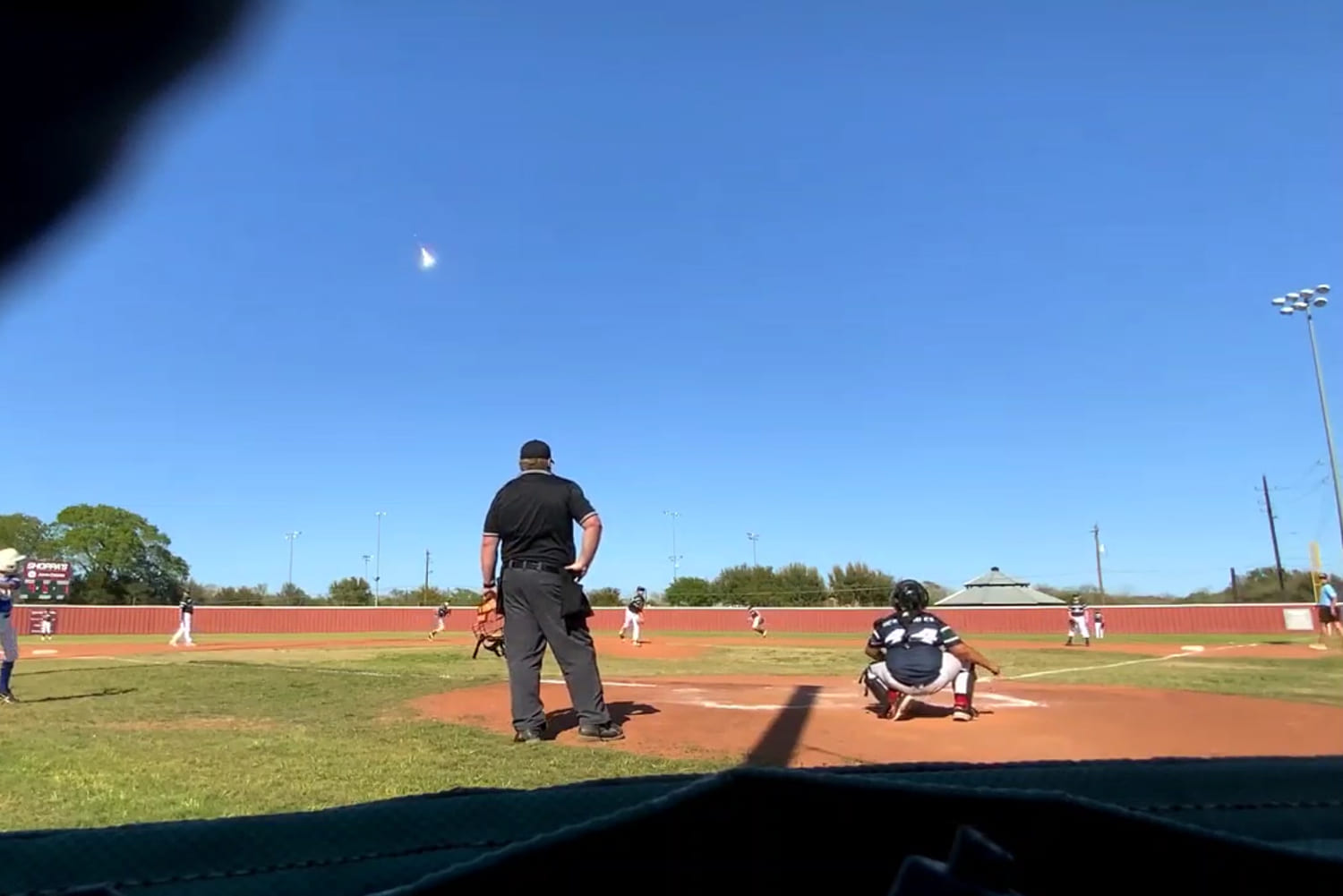
The recent atmospheric entry over Texas serves as a case study in the conversion of kinetic energy into acoustic and thermal signatures. When a meteoroid enters the Earth’s atmosphere at velocities ranging from 11 km/s to 72 km/s, it transitions from a vacuum to a fluid medium of increasing density. This encounter is not a gradual descent but a high-stakes collision with the atmosphere that triggers a sequence of physical phenomena: fragmentation, ionization, and the generation of N-wave pressure profiles commonly recognized as sonic booms.
The Kinematics of Bolide Atmospheric Entry
The primary driver of the observed Texas event is the relationship between the object’s mass, its entry angle, and its velocity. Unlike a controlled re-entry vehicle designed with ablative shielding and specific lift-to-drag ratios, a natural bolide is an unrefined mass of rock or iron.
The physics of this entry can be categorized into three distinct phases:
- The Pre-Heating Phase: Occurring in the thermosphere, where the mean free path of molecules is large. At this altitude, individual molecular collisions begin to excite the surface atoms of the meteoroid.
- The Continuum Flow Regime: As the object reaches the denser mesosphere and stratosphere (approximately 50-80 km), the air can no longer be treated as individual particles. A bow shock forms in front of the leading edge. The temperature in this shock layer can exceed 10,000 K, causing the surrounding air to ionize and create the visible "streak" or plasma trail reported by observers.
- The Fragmentation Point: Most stony meteoroids possess internal fractures. The aerodynamic pressure exerted on the leading face eventually exceeds the internal compressive strength of the rock. This leads to a catastrophic breakup, significantly increasing the total surface area and, by extension, the rate of energy release.
Quantifying the Sonic Boom: The N-Wave Pressure Profile
Public reports of "ground-shaking" or "explosive" sounds are the result of the meteoroid’s supersonic velocity relative to the local speed of sound. As the object penetrates the lower atmosphere, it pushes air aside faster than the air can naturally displace. This creates a conical shock wave—the Mach cone.
The intensity of the sonic boom heard in Texas is governed by the Mach number ($M = v/a$) and the altitude of the event. Because the speed of sound ($a$) varies with temperature and atmospheric composition, the geometry of the shock wave shifts as the meteoroid descends.
- Overpressure: The "boom" is a sudden increase in pressure followed by a rapid decrease below ambient pressure, then a return to normal. This "N-wave" is what rattles windows and registers on seismographs.
- Acoustic Focusing: Atmospheric thermals and wind shear can refract these sound waves, causing "shadow zones" where nothing is heard and "focus zones" where the sound is amplified far beyond the expected decibel level for that distance.
Tracking and Detection Infrastructure
The verification of this event by NASA and other agencies relies on a multi-modal sensor grid. The integration of these data sets allows for the reconstruction of the flight path and the estimation of the object's original mass.
Satellite Infrared Sensors
Geostationary Lightning Mappers (GLM) on GOES satellites are designed to detect rapid changes in light intensity. While intended for weather monitoring, they frequently capture the "optical flash" of a bolide fragmentation. This data provides the exact timestamp and coordinates of the peak energy release.
Infrasound Monitoring
The Comprehensive Nuclear-Test-Ban Treaty Organization (CTBTO) maintains a global network of infrasound stations. These sensors detect low-frequency sound waves (below 20 Hz) that can travel thousands of kilometers. By triangulating the arrival times at different stations, analysts calculate the total energy yield, usually expressed in tons of TNT equivalent.
NEXRAD Radar Returns
As the meteoroid fragments, it creates a "debris cloud" of dust and small stones. If the event occurs within range of a National Weather Service NEXRAD radar, the falling fragments reflect the radar pulses. This "dark flight" phase—where the fragments are no longer glowing but are still falling—is critical for potential meteorite recovery teams.
The Mass-Loss Equation and Terminal Velocity
A common misconception is that these objects strike the ground at their entry speeds. In reality, most small-to-medium meteors undergo "terminal deceleration."
The rate at which the meteoroid loses mass is described by the ablation equation:
$$\frac{dm}{dt} = -\frac{\Lambda A \rho v^3}{2Q}$$
Where:
- $m$ is mass
- $\Lambda$ is the heat transfer coefficient
- $A$ is the cross-sectional area
- $\rho$ is the atmospheric density
- $v$ is velocity
- $Q$ is the heat of ablation
As the object loses velocity due to drag, it eventually reaches a point where it no longer has enough kinetic energy to ionize the air. This is the "end of luminescence." From this point, the fragments fall at terminal velocity—roughly 200 to 400 mph—determined by their mass and aerodynamic shape.
Distinguishing Meteoroids from Man-Made Re-entry
Identifying the Texas event as a meteor rather than "space junk" (orbital debris) involves analyzing the entry velocity and trajectory angle.
- Orbital Debris: Typically enters at approximately 7.8 km/s (first cosmic velocity) and at a very shallow angle to maximize atmospheric drag over time.
- Meteoroids: Enter at a minimum of 11.2 km/s (Earth's escape velocity) and often at much steeper angles.
The high-energy sonic boom reported in this instance suggests a high-velocity entry, which is the hallmark of a natural celestial body.
Operational Response for Future High-Energy Atmospheric Events
For municipal and state authorities, these events represent a low-probability, high-impact risk. The Texas bolide did not cause structural damage, but an object slightly larger or composed of denser material (nickel-iron) could produce an overpressure wave capable of shattering glass over a wide radius, as seen in the 2013 Chelyabinsk event.
The strategic priority for monitoring agencies is the reduction of "latency in characterization." Currently, the public often hears the boom before official confirmation is available. Improving the automated pipeline between GLM satellite detections and public alert systems would mitigate the confusion and "mystery" that surrounds these events.
Future data integration should focus on:
- Automated Seismo-Acoustic Coupling: Using the existing seismic network to instantly confirm atmospheric explosions.
- Public Sourced Photogrammetry: Utilizing doorbell cameras and dashcams to triangulate the final descent path within minutes, rather than hours.
The Texas event was a successful demonstration of existing detection hardware but highlighted a gap in real-time analytical dissemination. The physics are well-understood; the logistical challenge remains in the rapid quantification of threat levels during the 30-second window between the optical flash and the arrival of the shock wave at ground level.
Investigating the "dark flight" trajectory of the Texas fragments should be the immediate priority for researchers. If fragments are recovered, their isotopic composition will provide a definitive link to their parent body in the solar system, moving the event from a local curiosity to a significant data point in planetary defense and mineralogy.
Would you like me to analyze the specific seismic data from the Texas event to estimate the total kiloton yield of the explosion?