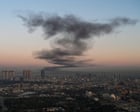
The recent kinetic impact of an Unmanned Aerial System (UAS) on a high-rise structure in Manama, Bahrain, represents more than a localized security breach; it is a proof-of-concept for high-altitude urban targeting in the Persian Gulf. While initial reporting focused on the immediate physical damage, a structural analysis of the incident reveals a sophisticated intersection of geopolitical signaling, electronic warfare gaps, and the evolution of "one-way" attack munitions. This event identifies a critical vulnerability in modern metropolitan air defense: the "Clutter-to-Signal" deficit inherent in protecting dense, vertical urban centers against low-radar-cross-section (RCS) threats.
The Triad of Urban Vulnerability
The success of a drone strike against a fortified capital like Manama is predicated on three specific systemic failures. These pillars define why traditional surface-to-air (SAM) batteries, such as the Patriot or advanced point-defense systems, frequently struggle with "Tier 1" and "Tier 2" small-scale UAS.
- Radar Shadowing and Multipath Interference: In a high-rise environment, the geometry of skyscrapers creates "canyons" that shield low-flying objects from ground-based radar. Even if a radar array is positioned on the outskirts of the city, the signal bounces off glass and steel facades, creating false positives or "ghosting." A drone flying at an altitude below the skyline remains virtually invisible until it exits the clutter, leaving a reaction window measured in seconds.
- The Kinetic Cost-Curve Disparity: There is a profound economic asymmetry in using a million-dollar interceptor missile to neutralize a drone assembled from commercial off-the-shelf (COTS) components and fiberglass. This creates a strategic hesitation in defense protocols—a "decision-making lag" where the cost of the defense might exceed the damage of the impact.
- Low-Velocity Detection Thresholds: Most traditional air defense radars are calibrated to filter out slow-moving objects like birds or weather balloons to prevent alarm fatigue. An Iranian-designed delta-wing drone, flying at speeds under 150 knots, often falls within these filter parameters, allowing it to "ghost" through automated detection grids.
Technical Specifications and Attribution Logic
Analysis of the debris and the flight profile suggests a loitering munition belonging to the Shahed family or a direct derivative. These systems do not rely on constant remote pilot intervention, which would be susceptible to frequency jamming. Instead, they utilize a combination of Inertial Navigation Systems (INS) and multi-constellation GNSS (Global Navigation Satellite Systems) for mid-course guidance.
The Guidance Mechanism
The drone likely utilized "Waypoints of Least Resistance." By programming the flight path to follow maritime corridors before banking sharply into the Manama skyline, the operators minimized the time spent over land-based acoustic or visual sensors. The use of a 4-stroke gasoline engine provides a specific acoustic signature that is easily masked by the ambient noise of a metropolitan port city.
Payload Efficiency
In the Manama strike, the objective was clearly psychological rather than total structural demolition. The high-rise target serves as a "vertical billboard." A 20kg to 50kg high-explosive fragmentation warhead is insufficient to bring down a modern steel-and-concrete skyscraper, but it is optimized to shatter glass facades and create high-visibility thermal blooms. This maximizes the "optical impact" for social media and international news cycles, which is the primary currency of asymmetric warfare.
Geopolitical Signaling: The Bahraini Context
The selection of Bahrain as a target is a calculated move within the broader "Grey Zone" conflict. Bahrain hosts the U.S. Navy’s 5th Fleet and is a signatory to the Abraham Accords. Striking a high-rise in the heart of its financial or residential district serves multiple strategic functions:
- Testing Integrated Air and Missile Defense (IAMD): The strike serves as a live-fire probe to see how regional partners and U.S. assets coordinate. The failure to intercept the drone provides the regional adversary with a data map of sensor gaps.
- Economic Deterrence: Bahrain’s economy relies on its status as a stable financial hub. Kinetic events in the capital risk inflating insurance premiums for shipping and real estate, effectively imposing a "security tax" on the nation’s growth.
- The Abraham Accords Friction: By demonstrating that alliance with external powers does not guarantee immunity from low-cost drone strikes, the perpetrator aims to sow domestic doubt regarding the benefits of these diplomatic alignments.
The Physics of the Impact: Why Skyscrapers?
Targeting the upper floors of a skyscraper is a deliberate tactical choice based on the physics of urban airflow and sensor placement.
Thermal Contrast: At night, a building's thermal mass stands out against the cooling atmosphere. For drones equipped with basic infrared (IR) sensors for terminal guidance, a high-rise is the easiest target to lock onto because it lacks the "heat noise" of ground-level traffic and industrial machinery.
Acoustic Masking: Sound travels differently in vertical environments. The drone’s approach from the seaward side prevents the sound of the engine from reaching ground-level sensors until the craft is nearly overhead. By the time the "thrum" of the engine is identified, the drone is already in its terminal dive.
Structural Vulnerability: While the core of a high-rise is incredibly resilient, the "curtain wall" (the glass exterior) is brittle. A drone strike triggers a "glass rain" effect, where falling debris creates a secondary hazard zone at the street level, effectively paralyzing multiple city blocks with a single, small-yield explosion.
Limitations of Current Defense Paradigms
The Manama incident highlights the obsolescence of the "Fortress" mentality. You cannot surround a city with enough missiles to catch every sub-$20,000 drone. Current limitations include:
- Direct-Fire Constraints: Using anti-aircraft guns (like the Phalanx CIWS) in a city is nearly impossible. The "over-travel" of the rounds—bullets that miss the target—would cause catastrophic collateral damage as they fall back into populated areas.
- Jamming Side Effects: High-powered electronic jamming to "drop" drones would also disable civilian GPS, cell service, and critical hospital equipment. This makes "always-on" electronic shielding a non-viable option for modern cities.
- Visual Identification Lag: Security teams atop buildings often rely on thermal cameras, but these struggle to distinguish a small drone from a large bird or a legal commercial delivery drone without advanced AI-driven object recognition, which is not yet ubiquitous.
The Shift to Directed Energy and Distributed Sensing
To counter the threat demonstrated in Bahrain, the defensive strategy must shift from "Point Defense" to "Layered Resilience." This involves moving beyond kinetic interceptors toward a more nuanced technical stack.
- Directed Energy Weapons (DEW): High-energy lasers provide a "zero-drop" solution. They travel at the speed of light and have no "spent rounds" that fall back to earth, making them ideal for urban high-rises. However, atmospheric conditions like heavy humidity or dust (common in the Gulf) can diffuse the beam.
- Passive Acoustic Arrays: Instead of radar, cities require a mesh network of microphones that can recognize the specific "fingerprint" of a Shahed-style engine. By triangulating the sound, security forces can plot a flight path in real-time without emitting a radar signal that the drone could potentially home in on.
- Hardened "Mesh" GNSS: Improving the resilience of local GPS signals to prevent "spoofing" or "denial of service" by the attacker ensures that the city's own defensive drones can operate accurately to intercept the intruder.
Strategic Forecast: The Vertical Battleground
The Manama strike is the precursor to a new era of urban siege. We are moving away from the era of "Deep Strikes" by expensive fighter jets and into the era of "Pervasive Harassment" by disposable swarms.
The immediate requirement for Gulf states is the installation of rooftop-mounted, low-power microwave emitters capable of "frying" the internal circuits of a drone within a 500-meter radius. This creates a localized "no-fly bubble" around critical infrastructure. Furthermore, building codes in strategic hubs may soon require "anti-drone glazing"—laminated glass designed to absorb the kinetic energy of a small impact without shattering into lethal shards.
The failure in Manama was not a failure of courage, but a failure of "Scale." The defense was looking for a spear when the enemy sent a mosquito. Future security audits must prioritize the "Sub-Radar" layer of the city, treating the sky between the 20th and 80th floors as a new frontier of sovereign airspace that is currently undefended.
The next evolution of this threat will likely involve "Swarm Synchronicity," where multiple drones strike different floors of the same building simultaneously to overwhelm fire suppression systems. Countering this requires an automated, AI-governed response grid that can prioritize targets in milliseconds—a level of autonomy that most current command-and-control structures are not yet legally or technically prepared to deploy.
Establish a decentralized network of high-frequency "Electronic Fences" around the Manama financial district immediately. These must be integrated with thermal-optical sensors that bypass the clutter of radar, providing a dedicated "Urban Air Shield" that operates independently of traditional military hardware.