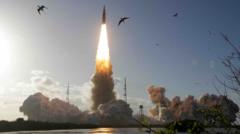
We haven’t sent humans to the Moon in over fifty years. That’s about to change. Right now, four astronauts are training to ride a massive pillar of fire called the Space Launch System (SLS) and slingshot around the lunar far side. This isn't a repeat of Apollo. It’s a completely different beast with higher stakes and much more advanced tech that hasn't been tested with people on board yet.
The crew includes Reid Wiseman, Victor Glover, Christina Koch, and Jeremy Hansen. They aren't just passengers. They're test pilots. They'll be the first humans to see the Moon up close since 1972, but the goal isn't just to look at craters. It’s to prove that the Orion spacecraft can keep people alive in deep space for ten days. If something breaks 200,000 miles away, there’s no quick way home.
The first big hurdle is the High Earth Orbit
Most people think the rocket just points at the Moon and goes. It doesn’t. After launch, the crew will spend about 24 hours in a "High Earth Orbit" (HEO). This is a safety check. They’ll orbit the planet in a long oval that takes them thousands of miles out.
During this phase, the astronauts will manually fly the Orion capsule. They need to make sure the life support systems work perfectly before they commit to the "Trans-Lunar Injection" burn. Once they ignite that engine to head for the Moon, they’re committed. There’s no turning back. If the carbon dioxide scrubbers fail or the heat shield has a glitch, they’re in serious trouble. NASA is basically using the first day as a dress rehearsal in our backyard before heading into the deep woods.
Radiation is the silent killer nobody likes to talk about
When astronauts stay on the International Space Station (ISS), they’re still protected by Earth’s magnetic field. It blocks a lot of the nasty solar radiation. On Artemis II, the crew will leave that protection behind. They’ll pass through the Van Allen radiation belts, which are zones of highly energetic charged particles.
NASA has packed Orion with sensors to measure this, but the crew will also be wearing specialized vests to protect their vital organs. A solar flare during the mission could be devastating. Unlike the Moon landings of the 60s, we’re now heading into a period of high solar activity. The sun is "awake," and it’s throwing tantrums. The timing has to be perfect, or the crew needs enough shielding to survive a massive blast of radiation. It’s a game of cosmic roulette.
Why we can't just use Apollo technology
I hear people ask this all the time. "We did it in 1969, why is it so hard now?"
The truth is, we can't build Apollo anymore. The supply chains are gone. The blueprints are basically museum pieces. More importantly, the Apollo capsules were deathtraps by modern safety standards. Orion is built to be "human-rated" for the long haul. It has better computers, better solar panels, and a heat shield that can withstand temperatures of 5,000 degrees Fahrenheit when it hits the atmosphere at 25,000 miles per hour.
The SLS rocket is also way more powerful than the Saturn V in many ways. It uses solid rocket boosters alongside liquid engines. It’s a hybrid of Shuttle-era tech and new engineering. But because it’s so complex, every delay feels like a setback for the whole program. We’re not just trying to get to the Moon; we’re trying to build a permanent highway there.
The slingshot around the lunar far side
Artemis II won't land. Instead, it will perform a "free-return trajectory." The spacecraft will fly around the back side of the Moon, using lunar gravity to whip it back toward Earth.
During those hours behind the Moon, the crew will be completely cut off from Earth. No radio. No GPS. Just four humans in a small metal can, looking out at the stars and the grey lunar soil. This is the ultimate test of psychological grit. Christina Koch already holds the record for the longest single spaceflight by a woman, so she knows about isolation. But being 250,000 miles away is a different kind of lonely.
What happens if the heat shield fails
The re-entry is the most terrifying part of the mission. When Orion returns, it won't just drop straight down. It will perform a "skip entry." Think of it like skipping a stone across a pond. It will hit the upper atmosphere, bounce back up slightly, and then come back down for a final descent. This helps spread out the heat and the G-forces, making it easier on the crew.
But this maneuver has never been done with humans inside. If the angle is too steep, the capsule burns up. If it’s too shallow, they skip off into space forever. The margin for error is razor-thin. NASA engineers have been obsessing over the data from the uncrewed Artemis I mission, where the heat shield showed some unexpected charring. They say it’s fine. Let's hope they're right.
Why this mission matters for 2026 and beyond
This isn't just about flags and footprints. Artemis II is the gatekeeper for Artemis III, which actually intends to put boots on the lunar south pole. If Artemis II fails, the whole dream of a Moon base or a mission to Mars dies with it.
We’re looking for water ice in the shadows of lunar craters. That ice can be turned into oxygen and rocket fuel. Basically, the Moon is our gas station for the rest of the solar system. You can't get to Mars without learning how to survive on the Moon first. Artemis II is the graduation exam for deep space travel.
How to track the mission progress
You don't have to be a rocket scientist to follow along. NASA's "Artemis Real-time Orbit Retrogression" (AROW) website lets you see exactly where the spacecraft is in relation to the Earth and Moon.
- Bookmark the NASA Artemis blog for technical updates that don't make the evening news.
- Follow the crew on social media. They’re posting behind-the-scenes footage of the simulators and the "vomit comet" training flights.
- Check the launch windows. They change constantly based on the alignment of the planets and the moon.
The next few months will be filled with engine tests and "wet dress rehearsals." Watch those closely. If the ground tests go smoothly, we’re on track for a historic launch. If they start swapping out valves or delaying for "anomalies," you’ll know the team is sweating the small stuff. In spaceflight, the small stuff is what kills you. Stay skeptical of the PR hype and look at the flight data instead. That's where the real story lives.