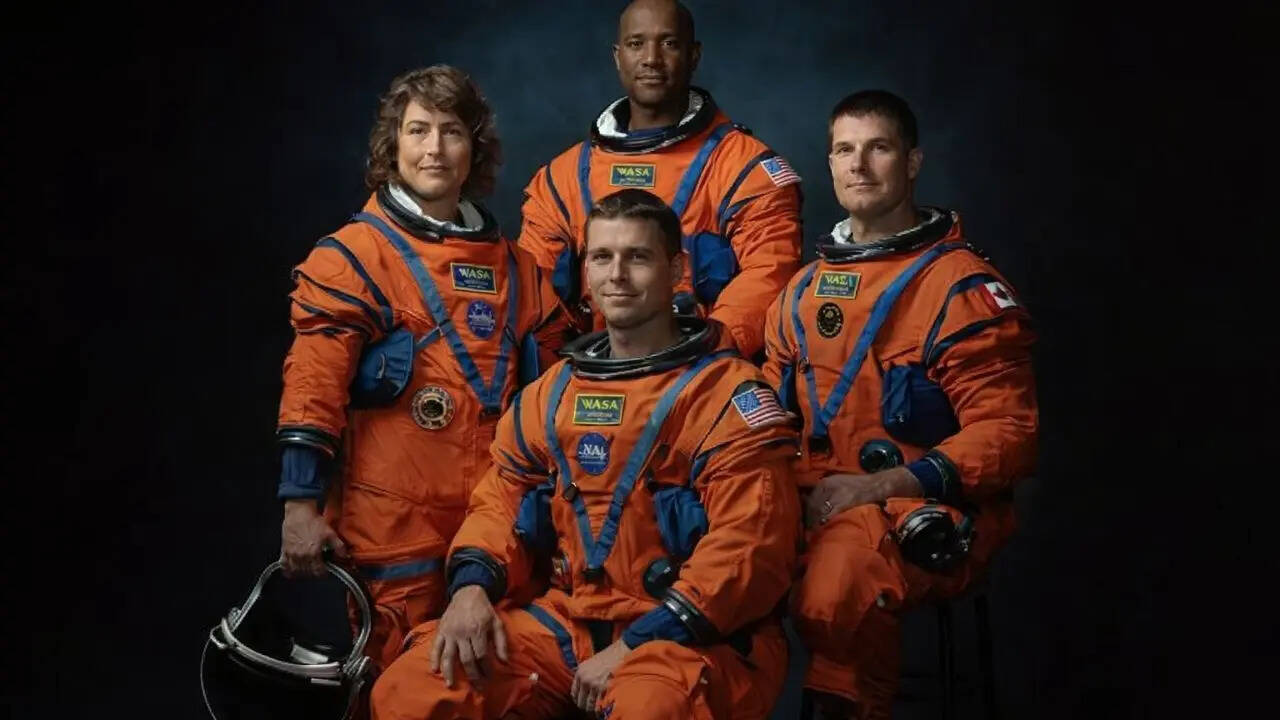
Four human beings are currently sealed inside a high-tech metal canister at Kennedy Space Center, waiting for 700,000 gallons of cryogenic propellant to explode beneath them. If the countdown holds for the 6:24 PM EDT liftoff on April 1, 2026, Reid Wiseman, Victor Glover, Christina Koch, and Jeremy Hansen will become the first people to leave low Earth orbit in 53 years. They are the vanguard of a mission that is less about reaching the Moon and more about proving that NASA’s aging infrastructure and ballooning budgets can still produce a masterpiece of engineering.
This is not a vacation. Artemis II is a high-stakes stress test of a spacecraft that has never carried humans and a heat shield that significantly underperformed during its last outing. While the public watches for the spectacle of the Space Launch System (SLS) clearing the tower, the real story lies in the hardware that must keep four people alive in the radiation-soaked vacuum of deep space for ten days—and the bureaucratic pressure to succeed at any cost.
The Heat Shield Ghost
The primary shadow hanging over this launch is the Orion spacecraft’s thermal protection system. During the uncrewed Artemis I mission, the heat shield experienced "char liberation"—an engineering euphemism for the shield wearing away in unexpected, uneven chunks during its 25,000 mph atmospheric reentry.
NASA engineers spent the better part of two years analyzing why the Avcoat material didn't behave according to their computer models. They eventually determined that the behavior was a result of the specific trajectory and atmospheric chemistry of a lunar return, which differs fundamentally from the low-Earth orbit returns we’ve seen for decades. The agency has opted to fly Artemis II with the existing heat shield design, banking on the "flight rationale" that the erosion, while ugly, maintains a sufficient safety margin. It is a calculated risk that reminds veteran observers of the pre-Challenger era: trusting that what didn't fail last time won't fail this time.
A Trajectory Born of Necessity
The mission profile is a hybrid free-return trajectory. Unlike the Apollo missions, which often entered lunar orbit, Artemis II will use the Moon's gravity as a cosmic slingshot.
The spacecraft will first perform two high Earth orbits to verify that the life support systems—which were absent on the Artemis I flight—are actually functioning. Only after the crew confirms they can breathe and maintain pressure will they commit to the Trans-Lunar Injection (TLI). Once that engine fires, they are on a one-way trip around the far side of the Moon.
This specific path, reaching 4,700 miles beyond the lunar surface, is designed so that if the Orion’s main engine fails, physics will naturally pull the capsule back to Earth. It is the ultimate safety net for a vehicle that is still effectively a prototype.
The Life Support Gamble
For the first time since 1972, a crew will be relying on a closed-loop Environmental Control and Life Support System (ECLSS) outside the protective magnetic field of Earth. On the International Space Station (ISS), help is only a few hours away. On Artemis II, if the CO2 scrubbers fail or the nitrogen-oxygen mix falters while they are 230,000 miles away, the crew must rely entirely on their own troubleshooting skills and the backup systems packed into the cramped Orion cabin.
The crew has spent the last year training for these contingencies, including practicing manual navigation using the stars in case their GPS and communication links with Houston are severed. They aren't just pilots; they are experimental test subjects for a suite of technologies intended to eventually reach Mars.
The High Cost of the Moon
Critics of the Artemis program point to the staggering price tag. The SLS rocket alone costs roughly $2 billion per launch, a figure that many industry analysts find unsustainable in an era of reusable commercial rockets.
However, NASA argues that the SLS provides a unique heavy-lift capability that no private entity has yet matched in a crew-rated capacity. The mission is a massive injection of capital into a sprawling supply chain that spans all 50 states, making it as much a political project as a scientific one. The "why" of Artemis II is simple: to maintain American hegemony in space at a time when China is rapidly advancing its own lunar plans.
The Journey Home
If everything goes to plan, the mission will end with a splashdown in the Pacific Ocean on April 10, 2026. A U.S. Navy recovery team is already positioned to retrieve the capsule and its inhabitants. The successful return of the Artemis II crew would vindicate a decade of development and set the stage for Artemis III—the actual landing—currently slated for 2028.
But before they can worry about the landing, they have to survive the launch. The four astronauts are currently finishing their final medical checks, eating controlled meals, and waiting for the sun to set over Pad 39B. The countdown isn't just for a rocket; it's for the resurrection of deep-space human exploration. Physics doesn't care about budgets or political timelines. It only cares about the integrity of the seals and the precision of the burns.