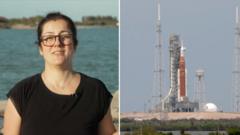
For over half a century, Harrison "Jack" Schmitt has carried a burden that no person should have to hold for a lifetime. He is the last living human to have stood on the lunar surface. When his Apollo 17 crewmate Gene Cernan passed away in 2017, the title of "Last Man on the Moon" fell to Schmitt by default. It is a haunting distinction. It represents not just a personal achievement, but a multi-generational failure of ambition. While the world looks toward Artemis II as the dawn of a new era, the technical and political reality on the ground suggests that the bridge between the Apollo ghost stories and a permanent lunar presence is far more fragile than the public realizes.
The Artemis II mission plans to send four astronauts around the Moon, marking the first time humans have left Earth's orbit since 1972. It is a flyby, a proof of concept designed to test the Space Launch System (SLS) and the Orion capsule with a human crew. But beneath the polished PR campaigns lies a brutal truth. We are essentially relearning how to do what we already mastered during the Nixon administration, only this time we are doing it with a supply chain that is fractured, a budget that is constantly under fire, and a technological stack that is a precarious mix of heritage hardware and unproven deep-space systems. For a more detailed analysis into this area, we suggest: this related article.
The High Cost of Forgotten Muscle Memory
Decades of inactivity in deep-space exploration have resulted in a phenomenon known as "institutional amnesia." It isn't just about the blueprints; it’s about the people who understood the nuances of the machines. During the Apollo era, NASA’s workforce was remarkably young, with an average age in the mid-twenties. Those engineers are now in their eighties or gone.
The Artemis program isn't just fighting gravity; it’s fighting the loss of specialized knowledge. When technicians today look at the heat shield requirements for a lunar return trajectory, they aren't just following a manual. They are trying to replicate the physics of an era that relied on slide rules and hand-woven computer memory. The Orion capsule must endure temperatures of 5,000 degrees Fahrenheit upon reentry. During the uncrewed Artemis I flight, the heat shield wore away differently than predicted. This isn't a minor glitch. It is a fundamental reminder that the vacuum of space is unforgiving to those who have been away for too long. To get more details on the matter, extensive analysis is available on Wired.
The SLS Debt Trap
The Space Launch System is often criticized as a "jobs program" designed to keep legacy aerospace contractors profitable. To an extent, that’s true. By using modified Space Shuttle Main Engines (RS-25) and solid rocket boosters, NASA attempted to save money by utilizing existing technology. The irony is that this approach has proven staggeringly expensive.
Each SLS launch is estimated to cost roughly $2 billion. In a world where private entities like SpaceX are driving the cost per kilogram of payload into the dirt with reusable boosters, the SLS stands as a monolith of the old way of doing business. However, the private sector isn't ready to carry the entire load. The Starship HLS (Human Landing System), which is slated to actually put boots on the ground for Artemis III, is currently a series of experimental prototypes. NASA is stuck in a middle ground. They need the raw, expendable power of the SLS to get Orion into orbit, but they need the innovation of the private sector to actually land. If either side of this partnership falters, the entire program collapses.
Radiation and the Human Limit
Going to the Moon is not like going to the International Space Station (ISS). The ISS sits within the protective cocoon of Earth’s magnetic field. Once you pass the Van Allen belts, you are exposed to galactic cosmic rays and solar flares that can shred DNA.
The Artemis II crew will be the first humans in fifty years to enter this high-radiation environment. The Orion capsule features a "storm shelter" area in the center of the cabin where the crew can huddle during a solar event, using the surrounding mass of water and equipment as shielding. But shielding is heavy. In rocket science, weight is the enemy. The trade-off between keeping astronauts safe from cancer-inducing radiation and keeping the spacecraft light enough to leave Earth is a constant, high-stakes calculation.
The Geopolitical Pressure Cooker
The drive to return to the Moon isn't purely about science. If it were, we would send robots. They are cheaper, they don't breathe, and they don't need to come home. We send humans because of the "strategic high ground."
China’s lunar ambitions have turned the South Pole of the Moon into the most valuable real estate in the solar system. The presence of water ice in permanently shadowed craters offers the possibility of creating rocket fuel on-site. This would transform the Moon from a destination into a gas station for the rest of the solar system. If the United States and its partners don't establish the "Artemis Accords" as the de facto law of the lunar land, we risk a future where access to these resources is restricted by a rival power. Jack Schmitt understands this better than most. His mission was about the Cold War; the new missions are about a cold reality where resource scarcity extends beyond our atmosphere.
Beyond the Flag and Footprints
The most significant difference between the 1970s and today is the goal. Apollo was a sprint. Artemis is an attempt at a marathon. To succeed, we have to move past the "flag and footprints" model.
The Lunar Gateway—a planned small space station in orbit around the Moon—is intended to serve as a hub for future missions. Critics argue it’s an unnecessary complication that adds risk and cost. Supporters claim it’s the only way to sustain a long-term presence. This disagreement highlights the central tension of modern spaceflight. Do we go fast and take risks, or do we build slow, expensive infrastructure that might survive a change in presidential administrations?
History shows that NASA’s greatest enemy isn't physics; it’s the four-year election cycle. Programs that take a decade to develop are often gutted before they reach the launchpad. Artemis has survived three different administrations so far, which is a minor miracle in itself.
The Psychological Toll of the Void
We often focus on the hardware, but the software—the human mind—is just as vulnerable. The Artemis II crew will see the Earth shrink to a marble. Unlike the ISS crew, they cannot look down and see their hometowns passing by every 90 minutes. They will be truly isolated.
Schmitt and his contemporaries spoke of the "Overview Effect," a cognitive shift that happens when seeing the planet from a distance. But there is also a sense of profound isolation. When the Apollo 11 lunar module was on the surface, Michael Collins was the loneliest man in history, orbiting alone on the far side of the Moon with no radio contact. The Artemis crews will face this same silence, amplified by the knowledge that there is no rescue mission if things go wrong.
The Manufacturing Crisis
One of the overlooked factors in our delay is the degradation of the domestic manufacturing base. In 1969, we could manufacture specialized alloys and components with a speed that seems impossible today. Now, we deal with "long-lead items" that take years to procure. A single valve or a specific grade of carbon fiber can delay a launch by months.
We have outsourced so much of our industrial capacity that rebuilding a moon-capable supply chain has been like trying to assemble a puzzle with pieces scattered across different continents. This is why the timeline for Artemis keeps slipping. It’s not just the software bugs; it’s the physical reality of putting together a machine with millions of parts when the companies that made those parts no longer exist.
The Lunar Dust Problem
If we manage to land, we face an old enemy that Jack Schmitt knows all too well: regolith. Lunar dust is not like dust on Earth. It is jagged, abrasive, and electrostatic. It doesn't get blown away by wind because there is no wind. Instead, it clings to everything.
During Apollo, the dust ate through the outer layers of space suits and jammed camera seals. It smells like spent gunpowder and caused "lunar hay fever" when the astronauts tracked it back into the LEM. For a long-term stay, this dust is a potential killer. It can degrade seals on airlocks and destroy the lungs of anyone who breathes it in over a period of weeks. Solving the dust problem is arguably more important than solving the rocket problem if we intend to stay.
Reclaiming the Legacy
The Artemis II mission is more than a flight; it is a test of national character. It is an admission that we allowed a vital part of our human identity to atrophy for half a century. Jack Schmitt’s presence at launch events is a bridge to a time when we did the impossible because we decided it was worth the cost.
As we prepare to send the next crew into the black, we have to acknowledge that the risks are higher now. Not because the Moon has changed, but because our margin for error has shrunk. We are a more risk-averse society than we were in the sixties. A single tragedy could ground the program for another fifty years.
The real victory of Artemis II won't be the photos of the lunar far side. It will be the moment the crew splashes down in the Pacific, proving that we have finally recovered the capability we should never have let slip away. We are no longer content with stories from the last man on the moon; we are finally ready to listen to the next ones.
Don't look for a grand conclusion here. The mission is ongoing, the hardware is on the stand, and the clock is ticking. The only thing that matters now is the countdown.