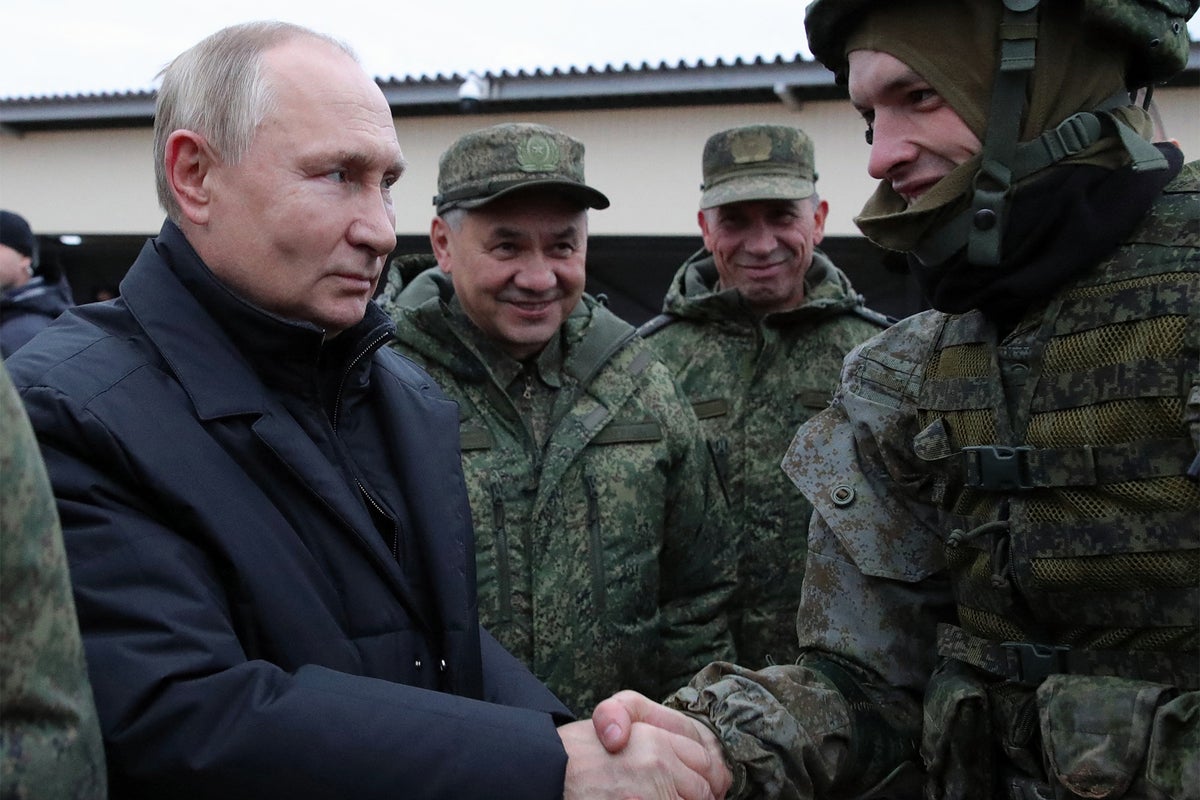
In a small village three hours outside of Ulan-Ude, a man named Yuri sits at a kitchen table. The wood is scarred from years of work. Yuri is not a strategist. He does not look at satellite imagery or thermal maps of the Donbas. He looks at his electricity bill. He looks at the price of flour. Then, he looks at a glossy recruitment brochure that promises him more money in a single month than he has earned in the last three years combined.
This is the silent engine of a conflict that defies the West’s traditional logic of exhaustion.
We often talk about war in terms of "running out." Running out of missiles. Running out of bread. Running out of men. There is a persistent belief in European capitals that a breaking point is hovering just over the horizon—a moment where the sheer scale of loss forces a collapse. But that belief ignores the cold, rhythmic machinery of the Russian interior. To understand why the front lines remain populated, you have to stop looking at the trenches and start looking at the villages like Yuri's.
The Economic Gravity of the Hinterlands
Russia is not a monolith; it is a collection of concentric circles. In Moscow and St. Petersburg, the war is a distant hum, a series of inconveniences managed by a polished middle class. But move further out, into the "Deep Russia" of the autonomous republics and the decaying industrial towns, and the war becomes something else entirely: an escape hatch.
Consider the math of a life in the provinces. In many of these regions, the average monthly salary might hover around 30,000 to 45,000 rubles. A contract with the Ministry of Defense, however, can offer a signing bonus and a monthly salary that dwarfs that figure fivefold. For a man with debts, no prospects, and a family to feed, the choice isn't necessarily about ideology. It’s about the brutal reality of the ledger.
This isn't just a "poverty draft." It is a massive, state-sponsored redistribution of wealth. The Kremlin has turned the act of soldiering into the most lucrative career path available to the bottom third of the population. When a soldier dies, the "coffin money" paid to his family can be enough to buy an apartment in a regional capital—a level of financial security that three generations of his ancestors never achieved.
The Ghost of 1945
There is a weight to the soil in this part of the world. In the West, we view the staggering casualty counts through the lens of modern individualism. We see ten thousand names and think of ten thousand tragedies that should spark a revolution.
In Russia, the state has spent two decades revitalizing a different narrative. It is the cult of the "Great Patriotic War." This isn't just history; it is a civic religion. From a young age, citizens are taught that Russia’s greatest strength is its ability to endure more pain than its enemies. They are told that the nation is a fortress, and a fortress requires a constant supply of stone.
When the mobilization of 2022 happened, there was a flash of panic. People fled to Georgia and Kazakhstan. But the panic didn't lead to a palace coup. Instead, the system adapted. The state learned that it didn't need to force everyone; it just needed to keep the pipeline open through a mix of social pressure and financial incentive.
The machinery of the Russian state is designed for attrition. It views its population not as a collection of voters to be coddled, but as a resource to be managed, much like oil or natural gas. As long as the price of bread stays manageable in Moscow and the checks keep clearing in the provinces, the pressure remains below the boiling point.
The Hidden Reservoirs
If you look at the raw data, the numbers are sobering. Russia has a population of roughly 144 million. Even with a declining birth rate and the exodus of the tech-savvy youth, the pool of "mobilizable" men remains in the millions.
But it’s not just about the numbers. It’s about the legal scaffolding.
The Kremlin has spent the last year quietly tightening the net. Digital summonses now mean you can’t claim you never received the paperwork. If you don't show up, your driver’s license is suspended, you can’t sell property, and you can't take out loans. The state has made it so that living outside the system is more difficult than joining it.
Then there is the prison population. The world watched as the Wagner Group emptied penal colonies, offering a clean slate in exchange for six months on the front. While Wagner is gone, the Ministry of Defense has simply taken over the process. To a man facing fifteen years in a high-security facility, the "Storm-Z" units represent a gamble. It is a terrifying, Darwinian choice, but it ensures that the most dangerous work on the battlefield is done by people the state considers disposable.
The Psychology of the Long Game
We often ask: When will they have had enough?
This question assumes that the Russian public has a "limit" similar to that of a Western democracy. But the feedback loops are different. In a country where the media is a closed circuit, the narrative of the war is framed as an existential struggle for survival against a predatory West. If you believe your country is being hunted, you will tolerate a level of sacrifice that seems insane to an outsider.
The casualties are real. The cemeteries on the outskirts of towns like Ryazan and Pskov are expanding at a rate that is difficult to process. But these losses are distributed. They are concentrated in the ethnic republics and the distant North, far from the eyes of the people who make decisions in the Kremlin.
The mothers and wives do not always protest for the war to end. Often, they protest for better equipment, or for their sons to be paid on time. They have accepted the premise of the conflict; they are simply haggling over the terms of the sacrifice.
The Friction of Reality
None of this is to say that the system is perfect. There is friction. There are localized riots. There is a growing shortage of labor in the civilian economy because so many men have been sucked into the military-industrial complex. Factories making tractors are competing with the army for the same pool of mechanics and drivers.
This internal economic tension is the real "second front." The state is cannibalizing its future to pay for its present. By pulling hundreds of thousands of productive men out of the workforce, they are stunting the country's growth for decades.
But for the man at the kitchen table in Ulan-Ude, "decades" is an abstract concept. He lives in the "now." He sees a world where the old certainties have vanished and the only thing that has value is the contract in front of him.
The West waits for a collapse that is based on a spreadsheet of human suffering. Russia, meanwhile, operates on a different ledger. It is a ledger where the cost of a human life is balanced against the preservation of a system that has survived for centuries by being more brutal than its critics could imagine.
The lines on the map may move by inches, but the machinery behind them is built for miles. It is a slow, grinding process that relies on the fact that, in the vastness of the Russian steppe, there is always another village, another kitchen table, and another man looking for a way out of a life that felt like a dead end long before the first shot was fired.
The fire is not going out. It is simply moving to a different part of the forest, fueled by a supply of wood that the world refuses to believe is still there.