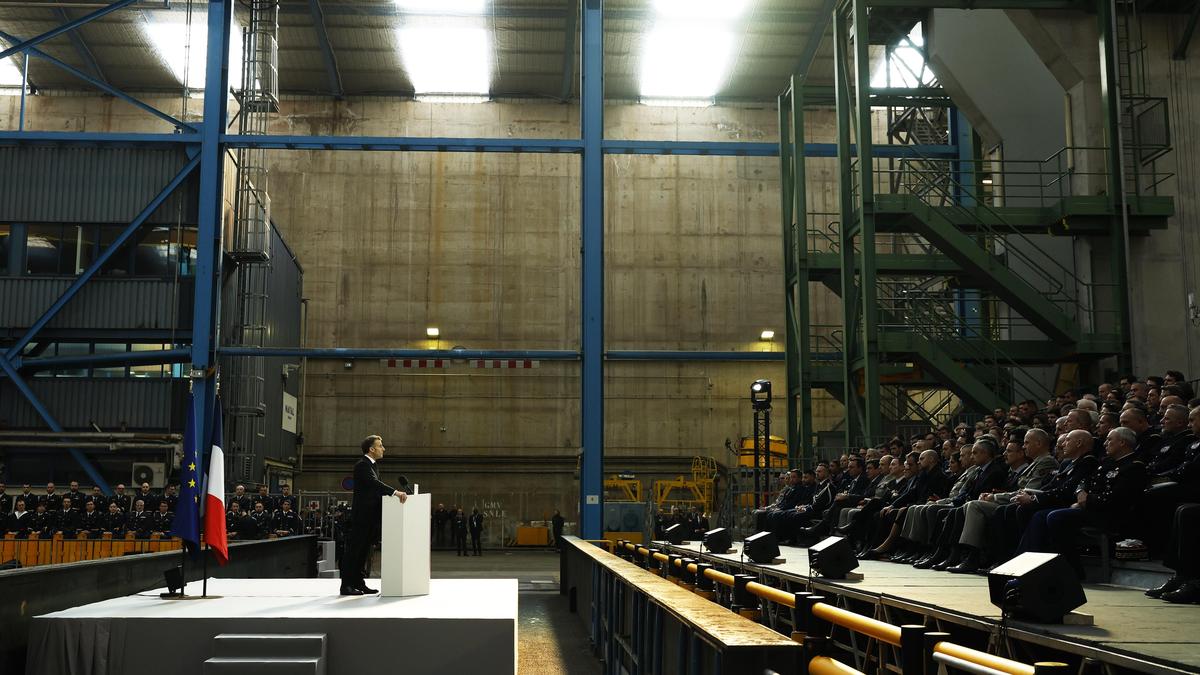
The shift in French nuclear posture from "strict sufficiency" to a potential European "nuclear umbrella" represents the most significant recalibration of continental security since the 1966 withdrawal of French forces from NATO's integrated command. This transition is not merely a diplomatic gesture; it is a structural response to the degradation of the U.S. extended deterrence guarantee and the emergence of a multi-polar missile environment. To evaluate the viability of a French-led European nuclear deterrent, one must analyze the mechanical constraints of the Force de Frappe, the geopolitical friction of shared command, and the technical requirements of modernizing a triad that currently lacks a land-based component.
The Tri-Pillar Framework of French Nuclear Doctrine
French strategic autonomy rests on three specific operational pillars that distinguish it from the American or British models. Understanding these is essential to quantifying how France might "deploy" or "extend" its arsenal to allies.
- Independence of Decision: Unlike the UK’s Trident system, which relies on U.S.-maintained missiles and satellite telemetry, the French system is vertically integrated. From the M51 submarine-launched ballistic missiles (SLBM) to the ASMPA-R cruise missiles, the entire supply chain and command-and-control (C2) architecture are sovereign.
- The "Final Warning" (Ultime Avertissement): French doctrine allows for a single, non-strategic nuclear strike intended to signal to an adversary that the threshold of "vital interests" has been crossed. This is a maneuver designed to restore deterrence rather than initiate a nuclear exchange.
- Strict Sufficiency: France maintains the minimum number of warheads (approximately 290) required to ensure a "second-strike" capability. This number is calculated based on the ability to bypass enemy missile defenses and destroy specific centers of power, rather than achieving total atmospheric saturation.
The Mechanics of Extension: How Arsenal Sharing Functions
Vague reports of "deploying atomic weapons to allies" often conflate distinct military configurations. In a rigorous strategic context, France has three primary methods for extending its nuclear reach to European partners.
The NATO Model: Dual-Capable Aircraft (DCA)
Under the existing U.S. model, nuclear B61 bombs are stationed in countries like Germany or Belgium. In a conflict, these are loaded onto host-nation aircraft but remain under U.S. custodial control via Permissive Action Links (PAL). For France to replicate this, it would need to modify Allied aircraft (such as the F-35 or Eurofighter) to carry the ASMPA-R missile—a technical hurdle involving massive proprietary data sharing—or deploy its own Rafale squadrons to permanent bases in Eastern Europe.
The Consultative Model: The "Euro-Deterrent"
A second mechanism involves deepening the participation of EU allies in nuclear planning without physical weapon transfers. This includes "Nuclear Sharing" in the form of conventional support missions (SNOWCAT), where non-nuclear allies provide electronic warfare, refueling, or air superiority to protect French nuclear-capable bombers.
The Vital Interests Expansion
The most profound shift is the redefinition of "vital interests." If France declares that the integrity of Polish or Baltic borders constitutes a French vital interest, the Force de Frappe automatically extends its shield over those territories without moving a single warhead. This is a psychological shift in the "Calculus of Deterrence," where the cost of an attack on Warsaw is equated to an attack on Paris.
Technical Constraints and the Cost of Escalation
Quantifying the French buildup requires looking at the industrial throughput of the Direction générale de l'armement (DGA). The current modernization cycle involves two primary vectors:
- SNLE 3G (Third Generation Submarines): France is developing four new ballistic missile submarines to replace the Triomphant class. These vessels are the backbone of permanent at-sea deterrence. The "invulnerability" of these platforms is the primary variable in the deterrence equation.
- ASN4G (Hyper-velocity Cruise Missiles): To counter advances in Russian and Chinese A2/AD (Anti-Access/Area Denial) and hypersonic interceptors, France is developing the ASN4G. This missile utilizes scramjet technology to maintain maneuverability at speeds exceeding Mach 5.
The bottleneck in this expansion is not just financial; it is fissile. Unlike the Cold War era, France closed its plutonium production reactors (Marcoule) and its uranium enrichment plant at Pierrelatte. Any significant increase in the total warhead count would require a multi-decade reactivation of the military nuclear fuel cycle, a move that would signal a permanent end to the current non-proliferation era.
The Geometric Logic of European Security
The argument for a French nuclear umbrella is driven by a specific failure in the transatlantic security architecture. The "Credibility Gap" can be expressed as a function of geographic proximity and political alignment.
$$C = \frac{V \cdot P}{D}$$
In this simplified heuristic, C (Credibility) is determined by V (Vital Interests) and P (Political Will), divided by D (Distance/Decoupling). As the U.S. focuses on the Indo-Pacific, the "D" factor for Europe increases, effectively lowering the perceived credibility of the American guarantee. France, being geographically inseparable from the European landmass, offers a "D" value of near-zero, theoretically making its deterrent more credible for continental defense than a trans-oceanic one.
However, this creates a secondary friction: The Command Paradox. European allies are hesitant to trade a U.S. master for a French one. For a French deterrent to be accepted, France would likely have to offer a degree of "co-decision" that it has historically rejected to preserve its sovereign autonomy.
Strategic Divergence: The German Variable
Germany remains the primary obstacle and the primary prize in this realignment. German strategic culture is rooted in "Civilian Power" and a reliance on the U.S. nuclear umbrella. For Berlin to pivot to a French nuclear guarantee, three conditions must be met:
- The Permanent Sunset of the U.S. Guarantee: A definitive withdrawal or a pivot that leaves European borders exposed.
- Financial Burden Sharing: France cannot afford to subsidize the defense of the entire continent alone. A "Europeanized" deterrent would require a mechanism where allies contribute to the R&D and procurement costs of the French nuclear program.
- The Rejection of the "Force de Frappe" as a French Tool: Allies must be convinced the arsenal is a common European utility rather than a tool for French diplomatic hegemony.
The Risk of Proliferation and Adversarial Response
Any expansion of the French nuclear posture will trigger a symmetrical response from the Kremlin. The Russian "Escalate to De-escalate" doctrine relies on the assumption that NATO (or a European subset) will blink first in a sub-strategic nuclear exchange. By positioning French nuclear assets closer to the Russian border or integrating them into Eastern European defense, France increases the risk of "Preemptive Neutralization."
This creates a "Security Dilemma" where the steps taken to increase security actually decrease it by lowering the nuclear threshold. The deployment of the ASMPA-R (a supersonic, nuclear-tipped cruise missile) is particularly sensitive because its flight profile is similar to conventional cruise missiles, leading to a "Discrimination Problem." An adversary seeing a Rafale launch a missile cannot know if it is conventional or nuclear until impact, forcing a "use-it-or-lose-it" decision-making process.
Structural Recommendation for Continental Defense
To move from a sovereign deterrent to a Europeanized framework without collapsing the existing security architecture, the following strategic sequence is required:
- Establish a European Nuclear Planning Group (ENPG): Modeled after NATO's NPG, this body would allow allies to participate in target selection and doctrine development without having physical control over the warheads. This addresses the "Consultative Model" requirements while maintaining French sovereignty.
- Decouple Conventional and Nuclear Integration: Allies should prioritize the integration of "Shield" technologies—specifically the European Sky Shield Initiative (ESSI)—to provide the conventional layer required to protect nuclear infrastructure.
- Formalize the "Vital Interests" Clause: France should issue a White Paper explicitly defining the territorial integrity of EU Member States as a core French vital interest. This provides the legal and doctrinal basis for extension without the logistical complexity of stationing weapons abroad.
The path forward is not a sudden mass production of warheads, but a calculated integration of European conventional forces around a French nuclear core. This creates a "Double-Key" system of a different sort: French fingers on the trigger, but European hands on the shield. This arrangement stabilizes the continent against U.S. volatility while maintaining a credible deterrent against Eastern encroachment. Evaluate the current budgetary allocations of the European Defense Fund (EDF) to identify where dual-use infrastructure—specifically hardened command bunkers and secure communications—can be co-financed to support this new strategic reality.