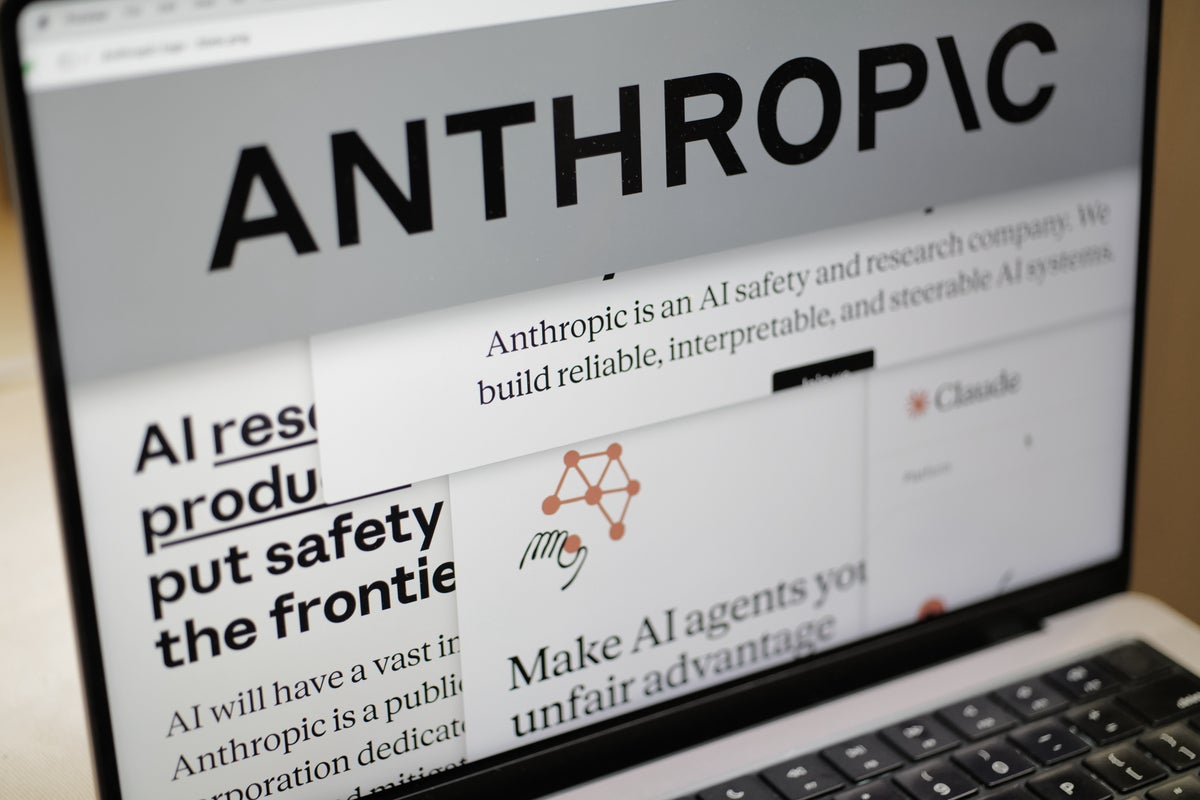
The headlines are screaming about a "victory for innovation" because a judge slapped the Pentagon’s hand for trying to label Anthropic a supply chain risk. The tech press is taking a victory lap. They see it as a triumph of due process over the "deep state" bureaucracy. They are dead wrong.
By blocking the Department of Defense (DoD) from designating AI labs as inherent risks, the courts haven't saved Silicon Valley; they have effectively blinded the only agency tasked with worrying about the next decade of unconventional warfare. This isn't about paperwork or hurt feelings at a VC-backed startup. It is about the fundamental breakdown of how we define a "weapon" in an era where code is more kinetic than a Hellfire missile.
The "lazy consensus" here is that unless a company is literally owned by a hostile foreign power, the government should stay out of its way. That logic is a relic of the Cold War. In 2026, the risk isn't just who owns the shares—it’s who owns the weights, who sees the telemetry, and who can subvert the alignment layer from ten thousand miles away.
The Myth of the Neutral Model
We need to stop pretending that Large Language Models (LLMs) are just fancy calculators. The legal argument winning the day is that Anthropic is an American company with American values, and therefore, it cannot be a "risk." This assumes that "risk" is a static binary.
In reality, supply chain risk in AI is fluid. I’ve watched defense contractors spend three years vetting a single bolt for a fighter jet while simultaneously plugging their entire research department into an API that leaks metadata like a sieve. The court's decision treats Anthropic as a finished product, like a box of wrenches. But AI is a living, breathing vulnerability surface.
When the Pentagon tries to flag a company, they aren't necessarily saying the founders are spies. They are saying the attack surface is too wide to defend. By stripping the DoD of the power to make these preemptive calls, the court is forcing the military to wait for a breach before they can act. In the world of autonomous agents and automated cyber-warfare, waiting for a breach is the same as surrendering.
Why "Due Process" is a Death Sentence for Security
The core of the legal challenge rests on the Administrative Procedure Act (APA). The argument is that the government was "arbitrary and capricious" because it didn't give Anthropic a clear rubric for why they were being targeted.
Here is the brutal truth: National security is arbitrary. It has to be.
If you publish a checklist of exactly how to avoid being labeled a risk, you provide a roadmap for adversaries to spoof compliance. I have seen this play out in the hardware sector for decades. A company checks every box, passes every audit, and still has a backdoor baked into the firmware because the "checklists" can't keep up with the engineering.
By demanding "transparency" in the designation process, the courts are demanding that the Pentagon reveal its hand. You cannot have a transparent intelligence apparatus. The moment the DoD explains exactly why Claude 3 or Claude 4 constitutes a risk, they tip off every bad actor about what the U.S. can and cannot detect.
The Math of Subversion
Let’s look at the technical reality of why the Pentagon is sweating. It isn't just about data exfiltration. It's about Model Poisoning and Evasive Fine-tuning.
If a foreign intelligence service manages to influence the RLHF (Reinforcement Learning from Human Feedback) process of a major model used by the DoD, they don't need to "hack" the Pentagon. They just need the model to subtly hallucinate a specific error in a structural integrity calculation or a piece of tactical code.
$$P(Success) = 1 - (1 - p)^n$$
Where $p$ is the probability of a single poisoned token being accepted and $n$ is the number of interactions. In a high-volume military environment, $n$ is massive. The probability of a catastrophic failure approaches 100% over time.
The court sees an injunction as a way to protect a business's reputation. The Pentagon sees it as a hole in the hull of a sinking ship.
The Silicon Valley Arrogance Trap
There is a pervasive belief in San Francisco that because these companies are "Benefit Corporations" or have "Safety Committees," they are somehow immune to being used as pawns.
I’ve sat in rooms where executives talk about "AI Safety" as if it’s a moral philosophy. It’s not. In a defense context, safety is a technical specification. If your model can be jailbroken by a creative teenager with a "DAN" prompt, it shouldn't be anywhere near a DoD supply chain.
The competitor’s article misses the nuance of dual-use technology. We treat AI like it’s Microsoft Word. It’s not. It’s enriched uranium that can also talk to you about your feelings.
- The Status Quo: "Anthropic is a domestic leader in safety."
- The Reality: Anthropic is a massive, centralized repository of high-value weights that every state-sponsored hacking group on the planet is currently trying to penetrate.
Being a "good guy" doesn't make you a safe supplier. It makes you a target. The Pentagon's attempt to label them a risk was likely a blunt instrument to force a higher tier of security protocols that the private sector simply refuses to pay for.
The PAA Dismantling: Are We Asking the Wrong Questions?
People often ask: "Is Anthropic safe for government use?"
This is the wrong question. The right question is: "Can the government secure an un-securable architecture?"
Current LLM architectures are inherently non-deterministic. You cannot "verify" them in the way you verify a flight control system. When the judge blocks the Pentagon from labeling a provider a risk, they are effectively saying the government must accept non-deterministic software in its most sensitive loops without complaint.
Another common query: "Will this injunction help AI startups get more government contracts?"
Yes, in the short term. But it creates a "Toxic Supply Chain" where no one actually knows what they are buying. We are setting ourselves up for a "SolarWinds" moment, but for intelligence itself. Imagine a scenario where every piece of tactical advice given to a commander is subtly skewed by a model that was compromised two years prior during its training phase.
The Cost of "Winning" This Legal Battle
Anthropic might have won the right to bid on contracts without the "risk" scarlet letter, but they’ve lost something far more valuable: the shroud of government-mandated hardness.
When the DoD labels you a risk, they are often doing you a favor. They are telling you that your current posture is insufficient for the big leagues. By suing their way out of that designation, Anthropic has signaled that they value their marketing image over the grueling, expensive, and often painful process of true military-grade hardening.
If I’m a procurement officer today, I’m even more terrified of Anthropic than I was before the injunction. Now I know that if I find a problem, the company will call their lawyers instead of their engineers.
The Actionable Truth for the C-Suite
Stop looking at this as a legal precedent and start looking at it as a warning. If you are building AI, you are building a weapon system. Whether you like it or not, the "dual-use" nature of your product means you will eventually be treated with the same suspicion as a uranium enrichment facility.
- Assume you are already compromised. If your security model relies on "we are an American company," you have already lost.
- Demand the designation. If I were running a serious AI lab, I would be begging the DoD for a formal risk assessment. Not to fight it, but to use it as a roadmap to become the only "hardened" player in a field of soft targets.
- Stop the APA theater. Using the Administrative Procedure Act to dodge security scrutiny is a short-term stock price play. It guts the long-term viability of the US AI industry as a trusted partner for global democratic defense.
The court thinks it protected the free market. In reality, it just told the Pentagon that it’s no longer allowed to have an opinion on the most dangerous technology ever created.
Don't cheer for the injunction. Start worrying about what fills the vacuum where oversight used to be. The next time a major model "hallucinates" a strategic catastrophe, we won't be able to say we weren't warned. We’ll just have to admit we sued the people who tried to warn us.
Stop treating national security like a nuisance and start treating it like the fundamental engineering constraint it is.