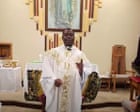
The legal system rarely hands victims a "fair" fight, but in McLennan County, the scales might finally be shifting. A Texas judge is now weighing a critical motion that could see Anthony Odiong, a Catholic priest accused of preying on his congregants, face three separate accusers in a single, consolidated trial. For the prosecution, it's a chance to show a jury a calculated pattern of abuse. For the defense, it's a "prejudicial nightmare" they’re desperate to avoid.
You’ve likely heard the basics of the case by now. Odiong isn't just any defendant; he's a former priest at the Saint Peter Catholic Student Center near Baylor University and other parishes across Texas and Louisiana. The allegations aren't just about "inappropriate behavior." We're talking about felony sexual assault, including charges of second-degree and even first-degree assault—a charge that carries a potential life sentence because of the specific power dynamics at play under Texas law.
The strategic power of the single trial
Most criminal trials are isolated events. You have one victim, one set of facts, and one verdict. But prosecutors in the Odiong case are pushing for joinder. This basically means they want to present the testimony of three different women in one room, before one jury.
Why does this matter? It’s significantly harder for a defense attorney to claim a victim is "misremembering" or "seeking attention" when three different people who don't know each other describe the exact same predatory playbook. In Odiong’s case, the allegations follow a chillingly similar script: spiritual counseling that turns into emotional dependency, followed by sexual coercion.
Texas law is actually quite specific about this. Under the Texas Penal Code, sexual activity between a member of the clergy and an adult who is "emotionally dependent" on their spiritual advice is a crime. It’s one of only a dozen states that criminalizes this specific breach of trust. By combining these cases, the prosecution isn't just trying to prove three crimes; they're trying to prove a predatory lifestyle.
Why the defense is fighting back
Odiong’s legal team isn't taking this sitting down. Their argument is simple: a jury that hears about three separate victims will naturally assume the defendant is guilty of something, even if the evidence in one specific case is weaker than the others. They call this "evidentiary spillover."
It's a valid legal concern. If the judge allows the consolidation, the jury will hear details that might not have been admissible if the trials were separate. For instance, if one woman has digital evidence and another only has her testimony, the digital evidence "colors" the jury's perception of both women. Honestly, from a defense standpoint, it's a disaster. If they lose this motion, Odiong’s path to an acquittal becomes much steeper.
Breaking down the charges and the life sentence threat
Odiong faces a mountain of legal trouble, but the first-degree sexual assault charge is the one that should keep him up at night.
In Texas, sexual assault is typically a second-degree felony. However, it gets bumped up to first-degree—punishable by 5 to 99 years or life in prison—under specific aggravating factors. In this case, the prosecution is leaning on a unique Texas statute regarding "prohibited marriages." Because Odiong, as a Catholic priest, was prohibited from "marrying or purporting to marry" these women under the laws of his office and the state’s recognition of his role, the power imbalance is treated with extreme severity.
Here is what the prosecution is working with:
- Two counts of second-degree sexual assault: Each carrying up to 20 years.
- One count of first-degree sexual assault: Carrying up to life in prison.
- The "Pattern of Behavior" Clause: At least eight women have come forward in total, though not all are part of this specific trial motion.
The fact that so many women have surfaced actually helped the state bypass the statute of limitations. In Texas, if you can prove a serial pattern, those old time limits often go out the window, allowing victims from as far back as 2012 to finally seek justice.
The institutional failure of the Church
We can't talk about Anthony Odiong without talking about the Diocese of Austin and the Archdiocese of New Orleans. Odiong was ordained in Nigeria in 1993 and moved into the Texas system in 2006. For years, women tried to report him. They went to the police. They went to the church hierarchy.
And for years, very little happened.
He was moved from the Saint Peter Catholic Student Center in Waco to Saint Anthony of Padua in Luling, Louisiana. It wasn't until a Guardian investigation and subsequent police work by Waco detective Bradley DeLange that the house of cards fell. This case is a stark reminder that "internal investigations" by religious institutions are often just a way to shuffle the deck while the victims are left to deal with the trauma.
What happens next in the McLennan County Court
The judge's decision on the trial consolidation will likely be the most important ruling before the first juror is even seated. If the trials are joined, expect a fast-paced, high-intensity proceeding where the sheer volume of testimony might be overwhelming. If they're severed, we’re looking at years of individual trials, which risks "victim fatigue" and gives the defense more chances to chip away at the state's momentum.
If you or someone you know has been a victim of clergy abuse, you don't have to wait for a news report to take action.
- Document everything: Keep dates, locations, and any digital correspondence.
- Contact secular authorities: Go to the police, not just the church. The Odiong case proved that law enforcement (like the Waco PD) is often more equipped to handle these crimes than a bishop’s office.
- Seek specialized legal counsel: There are firms that focus specifically on institutional abuse and can help navigate the complexities of the Texas Penal Code regarding clergy misconduct.
The trial of Anthony Odiong isn't just about one man. It's a test of whether the Texas legal system can effectively prosecute those who use spiritual authority as a weapon.