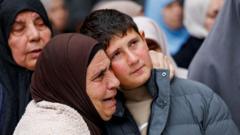
The black Kia Picanto sat crumpled on the side of a Gaza road, its windshield a mosaic of spiderwebbed glass and its chassis ventilated by high-velocity rounds. Inside, the quiet was absolute. It was the kind of silence that only follows the sudden, violent erasure of a family. Twelve-year-old Faisal al-Khalidi survived because he was shielded by the very bodies of the people who raised him. He lay beneath the weight of his father, his pregnant mother, and his siblings, soaking in their blood while Israeli armored vehicles hummed just yards away.
This is not merely a story of collateral damage or the "fog of war." When we examine the ballistics, the positioning of the vehicles, and the documented patterns of engagement in the Gaza Strip, a more clinical and disturbing picture emerges. The killing of the al-Khalidi family represents a breakdown in the basic rules of distinction that are supposed to govern modern warfare. It highlights a systemic failure where civilian vehicles, clearly marked and carrying families fleeing designated combat zones, are treated as mobile threats by default.
The Geometry of the Kill Zone
To understand how a family ends up dead in a compact car, you have to look at the geography of the escape routes. The Israeli military frequently issues evacuation orders, directing thousands of civilians into narrow corridors. These "safe" passages often turn into kill zones due to shifting front lines and the rapid deployment of mechanized units.
In Faisal’s case, the car was not caught in a crossfire. There were no Hamas fighters in the back seat. There was no secondary explosion indicating the presence of munitions. The trajectory of the bullets suggests a direct, sustained engagement from an elevated position, likely an IDF tank or an armored personnel carrier. When a heavy machine gun opens fire on a civilian vehicle at close range, the results are predictable and total. The kinetic energy alone is enough to turn the interior of a car into a whirlwind of metal fragments and glass shards.
Faisal describes hearing his mother’s final cry. It is a detail that haunts the periphery of the military reports, yet it is the most vital piece of evidence we have. It confirms that the passengers were alive, conscious, and terrified in the seconds before the final volley. The military logic often cited in these instances is "suspicious movement." But when the baseline for suspicion is a family car trying to navigate a debris-strewn road, the definition of a combatant becomes so broad that it ceases to exist.
The Failure of Visual Identification
Modern armored vehicles are equipped with sophisticated optics. Thermal imaging, high-definition zoom, and night-vision capabilities allow tank commanders to see the buttons on a man's shirt from a kilometer away. Why, then, do these systems consistently fail to identify children in the back of a hatchback?
The answer lies in the "threat-first" training doctrine. In high-intensity urban environments, Israeli crews are taught that any delay in pulling the trigger could mean a suicide vest or an anti-tank missile hitting their hull. This creates a psychological environment where the burden of proof is shifted onto the civilian. You are a target until you prove you are not, and in a moving car, you rarely get the chance to provide that proof.
Furthermore, the use of automated or remote-controlled weapon systems (RCWS) adds a layer of abstraction. A soldier looking through a screen in the belly of a Merkava tank is disconnected from the reality on the ground. The "gamification" of engagement means that a Kia Picanto looks like a blip on a monitor rather than a vessel for a pregnant woman and her four children.
Accountability and the Paper Trail
When these incidents occur, the official response follows a weary, predictable script. An initial statement mentions that the "details are under review." Months later, if the media pressure remains high, a brief report might conclude that the soldiers acted according to SOP (Standard Operating Procedure) given the "complex operational environment."
True investigative journalism requires us to look past the press releases. We have to look at the lack of independent forensics. In Gaza, there are no police cordons, no ballistics experts from neutral third parties, and no chain of custody for evidence. The IDF investigates itself. This inherent conflict of interest means that "mistakes" are categorized as unavoidable tragedies rather than criminal negligence.
Data from human rights organizations suggests that roadside shootings of fleeing civilians have become a recurring feature of the conflict. This isn't an isolated tragedy; it is a data point in a trend of permissive engagement rules. When soldiers know that the likelihood of facing a court-martial for shooting a civilian car is statistically near zero, the threshold for lethal force naturally drops.
The Psychology of the Survivor
Faisal al-Khalidi is now a data point himself. He is one of thousands of "WCNSF"—Wounded Child No Surviving Family. This acronym, coined during the current conflict, reflects a new demographic of orphanhood. Faisal spent hours pinned under his dead father, listening to the mechanical whir of the tanks that had just orphaned him.
The long-term impact of this specific brand of trauma is poorly understood. We are witnessing the creation of a generation that has seen the "sophisticated" and "moral" machinery of a modern state used to liquidate their entire support system in a matter of seconds. This isn't just a humanitarian crisis; it is a security failure of the highest order. Every time a family is wiped out in their car, the narrative of "surgical strikes" and "minimal civilian harm" loses all credibility, not just in Gaza, but globally.
The Logistics of Displacement
The al-Khalidi family was moving because they were told to move. The irony of the Gazan war is that the most dangerous place to be is often the path the military has told you to take. These "humanitarian corridors" are frequently intersected by active combat operations.
If a family stays in their home, they risk a 2,000-pound JDAM (Joint Direct Attack Munition) collapsing their building. If they leave, they risk the 7.62mm rounds of a roadside checkpoint. It is a lethal lottery with no winning ticket. The coordination between the units issuing evacuation orders and the units on the ground pulling the triggers is clearly non-existent or, worse, ignored.
Tactical Negligence or Intent?
Critics of the Israeli military argue that the frequency of these roadside killings suggests a policy of "area denial." By making the roads sufficiently lethal, the military effectively freezes the population in place or forces them into even smaller, more manageable pockets. While intent is difficult to prove without access to classified internal communications, the outcome remains the same: the civilian car has been transformed from a tool of escape into a coffin.
We must also consider the role of the "active defense" systems. The presence of drones overhead provides a constant stream of intelligence. If a drone is watching the al-Khalidi car for miles, and that drone is linked to the same network as the tanks on the ground, the "we didn't know" defense begins to crumble. The technology exists to prevent these deaths; the will to integrate that technology into a restrictive fire policy does not.
The Silence of the International Community
The international response to the killing of families in cars is usually a series of "deep concerns" and "calls for a thorough investigation." These are empty phrases. Without the threat of actual consequences—sanctions, a halt to munitions transfers, or international criminal proceedings—the operational behavior on the ground will not change.
The al-Khalidi family is gone. Their names—Yasser, Shimaa, and the children—are now etched into a growing list of casualties that the world seems increasingly comfortable with ignoring. But Faisal is still here. He is the living evidence of a military strategy that has prioritized speed and force protection over the most basic tenets of international law.
The blood on his clothes has dried, but the mechanical sound of those tanks will play in his head for the rest of his life. We must stop treating these events as "unfortunate incidents" and start recognizing them as the inevitable result of a warfare model that views the civilian as an obstacle to be cleared rather than a life to be protected.
The next time a military spokesperson speaks of "pinpoint accuracy," remember the Kia Picanto. Remember the twelve-year-old boy trapped under the weight of his own mother’s corpse. The hardware may be high-tech, but the results are as primitive and brutal as any massacre in history.
Demand the dashcam footage. Demand the drone feeds. Demand the names of the commanders who authorized fire on a civilian vehicle. Anything less is a betrayal of the very concept of justice.