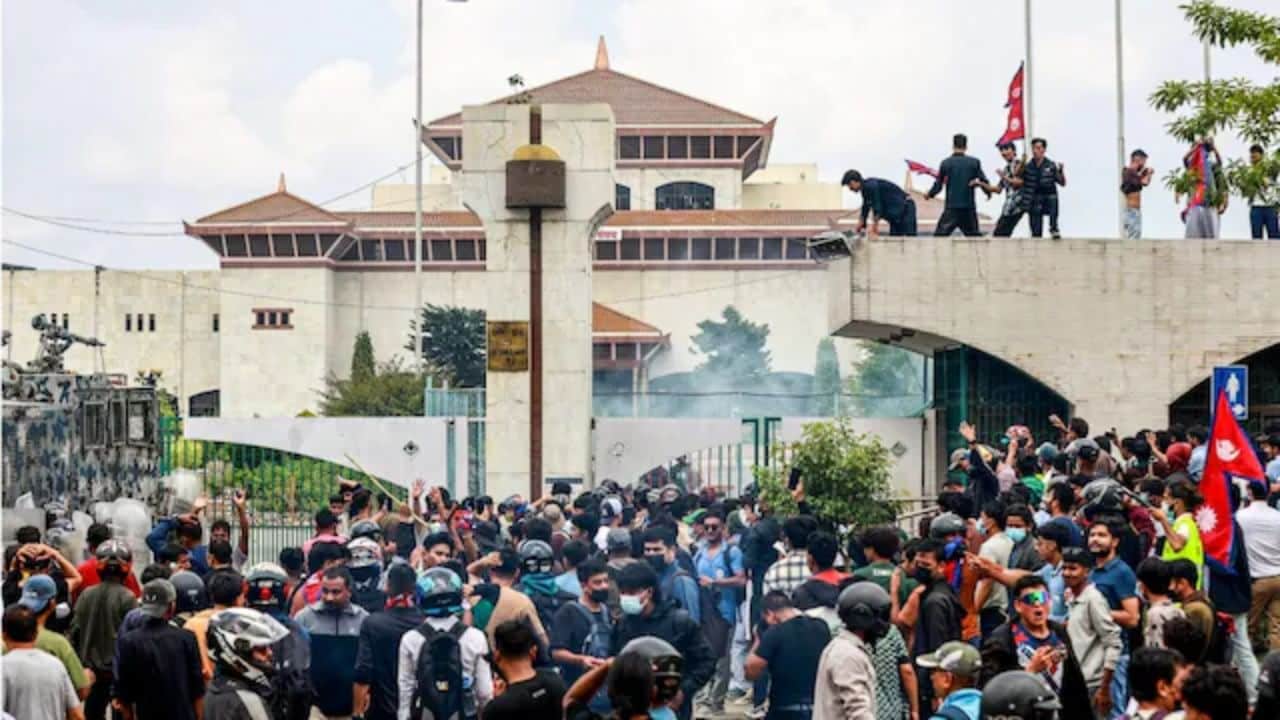
The recommendation by a high-level commission to prosecute former Prime Minister K.P. Sharma Oli and several top-tier security officials marks a structural shift in Nepal’s post-monarchy governance. This is not merely a reactionary legal move; it is the first formal attempt to quantify executive liability for the use of force against a digitally synchronized youth demographic. The crisis of July and August 2024, characterized by widespread "Gen Z" mobilization, exposed a critical failure in the state’s crowd-control doctrine. By analyzing the breakdown of the state’s monopoly on violence and the subsequent legal response, we can identify three specific mechanisms of political destabilization that led to this prosecutorial inflection point.
The Triad of Institutional Failure
The violence that claimed over 100 lives during the anti-government protests was the product of three converging failures: a tactical intelligence gap, a breakdown in the proportional use of force, and an antiquated command-and-control hierarchy.
1. The Tactical Intelligence Gap
The Oli administration utilized traditional human intelligence (HUMINT) and physical surveillance to gauge the threat level of the protests. However, the mobilization was driven by decentralized digital networks—predominantly TikTok and encrypted Telegram channels—which bypassed the state's monitoring infrastructure. This resulted in an "Information Asymmetry" where the government consistently underestimated the scale and speed of assembly. When police arrived at protest sites, they were outnumbered, leading to panic-induced escalations.
2. Proportionality and the Lethality Gradient
International law and Nepal’s own Domestic Security Act require a "graduated response" to civil unrest. Data from hospital admissions during the peak protest weeks (July 15–30) indicates a deviation from this protocol. The high ratio of head and chest wounds among deceased protesters suggests that "less-lethal" options—such as tear gas and water cannons—were either bypassed or used in conjunction with live ammunition at short range. The commission’s report specifically targets the "Order to Fire" (OTF) chain, questioning whether the executive branch bypassed the Chief District Officers (CDOs) to issue direct commands to security forces.
3. Command-and-Control Disconnect
The structural flaw in Nepal’s security apparatus is the overlap between the Nepal Police and the Armed Police Force (APF). During the 2024 protests, the lack of a unified command structure created a "Responsibility Vacuum." In several instances in Kathmandu and Lalitpur, units from different branches operated in the same sector without synchronized rules of engagement (ROE). This led to "competitive escalation," where one unit’s aggression forced the other to match it to maintain a perimeter, regardless of the actual threat level posed by the protesters.
Economic and Social Cost Functions of the Crackdown
The decision to prosecute is not driven solely by human rights concerns but by a cold assessment of the state’s "Cost Function." The Oli government’s strategy of suppression generated three distinct types of long-term debt for the Nepali state.
- Legitimacy Debt: The systematic targeting of Gen Z—the cohort that represents Nepal's future labor force and primary source of remittances—severed the social contract. When a state uses lethal force against its youngest citizens, it destroys the "Compliance Utility" of the law. Citizens no longer obey laws because they are legitimate; they obey only until the cost of rebellion is lower than the cost of submission.
- Economic Opportunity Cost: The 2024 protests resulted in a total shutdown of the Kathmandu Valley for 12 cumulative days. For an economy heavily dependent on the informal sector and tourism, the "Static Loss" (direct revenue) was compounded by "Dynamic Loss" (investor flight). The prosecution of the former PM acts as a "Risk Mitigation" signal to international markets, suggesting that the state is moving toward a more predictable, rule-of-law-based environment.
- Institutional Decay: Using the police as a political blunt instrument erodes the professionalization of the force. The commission noted that several mid-level officers expressed psychological distress and a sense of "Moral Injury," leading to a spike in early retirements and desertions within the security ranks.
The Precedent of Executive Liability
The commission’s recommendation hinges on the concept of "Command Responsibility." This legal framework posits that a leader is responsible not just for the orders they give, but for the crimes they fail to prevent when they have effective control over the perpetrators.
The Evidentiary Threshold
To successfully prosecute an ousted head of state in Nepal’s Supreme Court, the prosecution must bridge the gap between "General Policy" and "Specific Criminal Intent."
- The Paper Trail: Did the Prime Minister’s Office (PMO) issue written directives that superseded standard operating procedures?
- The Omission Variable: Did the PM receive reports of excessive force and fail to issue a "Cease and Desist" order to the Ministry of Home Affairs?
- The Post-Facto Ratification: By publicly defending the security forces' actions while the death toll was still rising, did the executive provide "Legal Cover" that encouraged further violence?
The second limitation of this legal strategy is the fragility of Nepal’s coalition politics. The current government must balance the pursuit of justice with the risk of creating a "Prosecutorial Seesaw," where every outgoing administration is systematically indicted by its successor. This creates a bottleneck in the legislative process, as leaders become more focused on self-preservation than policy.
The Gen Z Variable: A New Political Calculus
The demographic shift in Nepal has rendered traditional "strongman" tactics obsolete. The Gen Z protesters are characterized by three traits that the Oli administration failed to account for:
- Horizontal Leadership: There is no single "head of the snake" to arrest. The movement is organized through clusters.
- Global Visibility: Every interaction between a police baton and a protester was live-streamed. The state no longer controls the "Narrative Monopoly."
- Zero-Sunk-Cost Bias: Unlike older generations who remember the civil war and fear a return to total chaos, the youth see the current status quo as a dead end. They have "nothing to lose," which shifts the "Incentive Structure" toward radical change rather than incremental reform.
Strategic Path Forward for the State
To stabilize the political environment and address the commission's findings, the state must move beyond the courtroom. Prosecution is a necessary but insufficient condition for stability.
The primary objective must be the "Depoliticization of the Security Apparatus." This requires a legislative overhaul of the Police Act to grant the Nepal Police functional autonomy from the Ministry of Home Affairs. This would ensure that an officer's career progression is tied to performance and adherence to human rights, rather than political loyalty.
The second objective is the "Institutionalization of Youth Grievance." The protests were a symptom of a blocked political pipeline. Creating formal "Youth Advisory Councils" with actual budgetary oversight could transition Gen Z energy from the streets into the bureaucracy.
The final strategic play is the "Standardization of Accountability." If the prosecution of K.P. Sharma Oli proceeds, it must be conducted under a transparent, international-standard judicial process. Any perception of a "kangaroo court" will only validate the former PM's narrative of victimhood and further polarize the country. The state must prove it is punishing a crime, not a political rival. This involves inviting international observers from the UN or regional legal bodies to audit the evidentiary phase. Only through this level of rigor can Nepal convert a moment of national trauma into a foundation for durable governance.
Would you like me to analyze the specific legal statutes in the Nepal Penal Code that would be used in such a high-profile prosecution?


