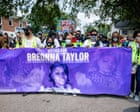
The floorboards in a quiet apartment don’t usually make much noise. They settle. They creak under the weight of a midnight snack or a restless pacing. But on March 13, 2020, the floorboards at 3003 Springfield Drive in Louisville became the stage for a collision between a private life and a falsified piece of paper.
Breonna Taylor was twenty-six. she was an ER technician. She was a daughter. She was sleeping.
When the door burst open, the world changed. Not just for her family, but for the very definition of American justice. We often talk about the law as a solid, unbreakable thing—a mountain of precedent and granite. In reality, the law is only as sturdy as the ink on the page. When that ink is a lie, the mountain crumbles.
The Paper Trail of a Lie
To understand why a federal judge recently dismissed major reconstruction charges against two former Louisville police officers, Joshua Jaynes and Kyle Meany, you have to understand the birth of a warrant.
A search warrant is supposed to be a sacred contract. A police officer tells a judge, "I have proof that a crime is happening here." The judge, acting as the gatekeeper of our constitutional rights, reads that proof and decides if the government has the right to break down a citizen's door. It is the only thing standing between a private home and state force.
In the case of Breonna Taylor, that contract was forged.
Prosecutors argued that Jaynes and Meany lied to secure the "no-knock" warrant. They claimed they had verified with a postal inspector that a suspected drug dealer was receiving packages at Breonna’s home. They hadn't. The "evidence" was a ghost. It was a shortcut taken by men who likely thought the ends justified the means.
But shortcuts in the legal system have a body count.
The Ruling That Cut the Cord
U.S. District Judge Charles Simpson’s recent ruling feels like a cold splash of water to those seeking "justice" in the traditional sense. He didn't say the officers were innocent of lying. He didn't say the warrant was valid. Instead, he performed a surgical separation of cause and effect.
The judge ruled that the officers’ primary sin—the falsified affidavit—was not the "legal" cause of Breonna Taylor’s death.
Consider this: The law often looks for a straight line. The prosecution argued the line went from the lie to the warrant, the warrant to the raid, and the raid to the death. Judge Simpson saw a break in that line. He pointed to the moment Breonna’s boyfriend, Kenneth Walker, fired a single shot at the unidentified intruders entering the dark apartment.
In the eyes of the court, that shot—fired in self-defense by a man who thought his home was being robbed—became the "superseding cause" of the tragedy.
It is a devastating legal distinction. It suggests that while the officers may have started the fire with a lie, the person who tried to put it out is the one responsible for the smoke damage. By dismissing the civil rights charges that carried potential life sentences, the court essentially decided that the lie was a separate crime from the killing.
The officers still face charges for the lie itself. But the weight of the death has been lifted from their legal ledgers.
The Human Cost of "Close Enough"
Imagine you are Kenneth Walker. It is after midnight. You are in bed with the woman you love. Suddenly, the door hinges scream. Shadows flood the hallway. You reach for your legal firearm. You fire once to protect your home.
In response, a hail of thirty-two bullets flies back.
When the smoke clears, your partner is gone. And years later, a court tells you that the paperwork used to get those men into your hallway was fake, but the fact that you defended yourself is why the system cannot hold them accountable for her life.
This is where the law feels less like a shield and more like a maze. To a lawyer, "superseding cause" is a fascinating bit of debris to study. To a family, it is a slap in the face. It tells them that the spark doesn't matter as much as the explosion.
The danger of this ruling isn't just about one night in Louisville. It’s about the precedent it sets for every officer sitting at a desk today, staring at a warrant application. If the "legal cause" of a death can be shifted away from the initial lie, what is the deterrent against lying?
If an officer knows that a falsified warrant might lead to a shootout, but they won't be held responsible for the casualties of that shootout, the Fourth Amendment begins to look more like a suggestion than a command.
The Invisible Stakes
We live in an era where "accountability" is a buzzword, but true accountability is rare. The federal government stepped in because local authorities failed to bring significant charges. The Department of Justice wanted to prove that when you weaponize the court system to bypass a citizen's rights, you own the consequences.
Judge Simpson’s ruling pushes back against that logic. It reinforces a world where the bureaucracy of the lie is treated as a white-collar crime, while the blood on the floor is treated as a tragic, disconnected accident.
But you cannot separate the two.
A no-knock raid is a high-pressure environment by design. It is meant to overwhelm, confuse, and dominate. When you trigger that environment based on a falsehood, you are setting a trap. To then argue that the victim’s reaction to the trap is what caused the injury is a leap of logic that many find impossible to stomach.
Beyond the Gavel
The case isn't over. The Department of Justice is "evaluating its next steps." There are still charges on the table regarding the conspiracy to cover up the lie after the fact. Jaynes and Meany aren't walking free today, but the shadow of a life sentence has vanished.
This story isn't just about police reform or racial justice, though it is deeply rooted in both. It is about the integrity of the truth.
When we allow the truth to be "good enough" or "close enough," we invite chaos into our bedrooms at 1:00 AM. We tell the people who hold the power of life and death that they can skip the boring parts of the Constitution if they're in a hurry.
Justice shouldn't be a game of "technically." It shouldn't rely on finding a loophole that allows a lie to exist in a vacuum, insulated from the tragedy it birthed.
Somewhere in Louisville, there is an empty space in a family photo. There is a mother who still waits for a version of the truth that carries weight. And there is a legal system that, for all its complexity and grandiosity, just told the world that a forged signature is just a signature, even when it leads to a grave.
The floorboards are quiet now. But the silence is deafening.