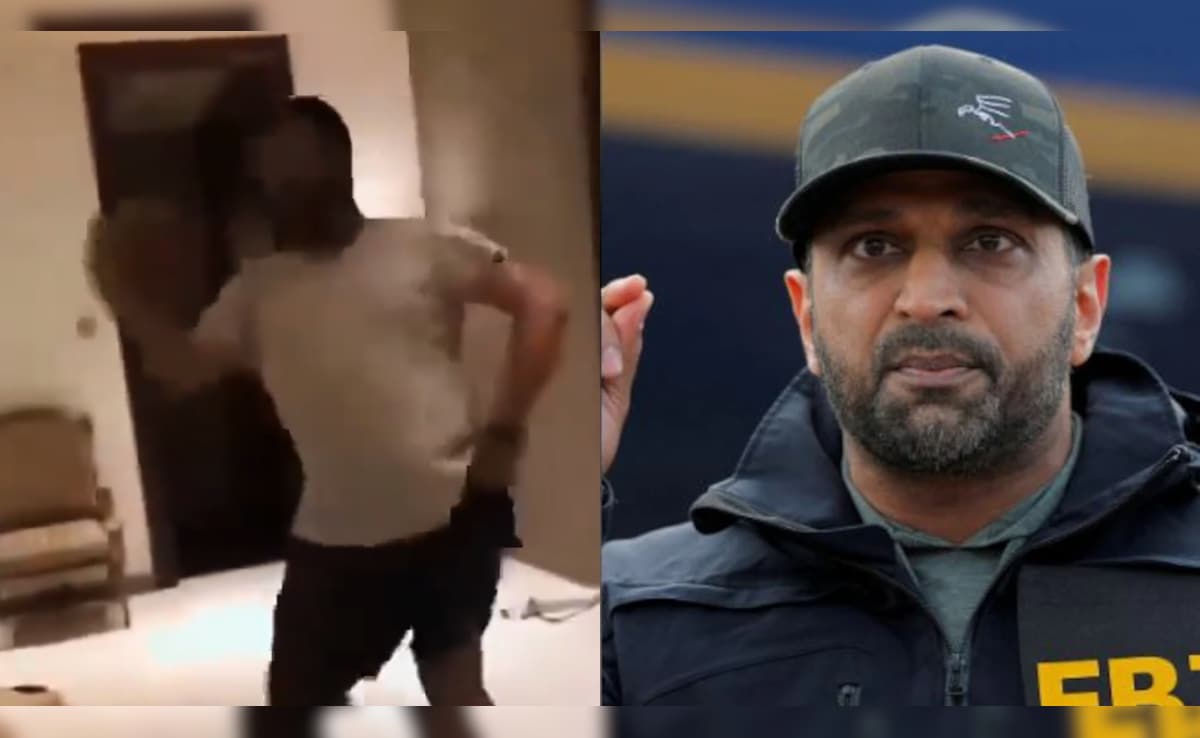
The proliferation of high-velocity "leaked" media operates on a cognitive exploit: the human brain prioritizes visual movement and social proof over metadata verification. In the case of the viral footage purportedly showing FBI Director Kash Patel dancing, the narrative is not merely a question of identity, but a case study in the intersection of state-sponsored cyber operations and domestic disinformation cycles.
To evaluate the authenticity of this media, one must apply a tripartite framework consisting of source provenance, forensic biometric alignment, and the socioeconomic incentives of the distributing actors.
The Source Provenance Gap
The initial distribution of the footage was attributed to "Handala Hack," a group claiming to have breached Patel’s private communications. In tactical intelligence, the "Claim of Origin" is often the first point of failure. The group asserted the video was extracted from a specific Gmail account, yet the technical breadcrumbs suggest a different trajectory.
- Temporal Discrepancy: Forensic analysis of the video's hash values and keyframes reveals that the footage has existed in the public digital commons for several years.
- The Archive Effect: This is a classic "Recontextualization Attack." By taking aged, unrelated media and wrapping it in the wrapper of a "fresh leak," threat actors leverage the urgency of current political cycles to bypass the standard 24-hour verification window.
- Leak Authenticity vs. Content Authenticity: Even if a breach occurred—a "True Leak"—it does not necessitate that the files within are "True Content." Hostile actors frequently seed genuine data breaches with fabricated or misattributed media to maximize psychological impact.
The Mechanics of Face-Swap Architecture
The most widely circulated version of the "dancing" footage utilizes a generative adversarial network (GAN) architecture to transpose Patel’s likeness onto a pre-existing performance. This is specifically seen in the "Malhari" Bollywood sequence, which served as a prototype for the broader viral phenomenon.
The cost function of creating such a video has plummeted. What once required a dedicated server farm can now be executed via cloud-based latent diffusion models. To the untrained eye, the fluid motion of the dancer masks the structural failures of the deepfake:
- Occlusion Failures: When the subject’s hand passes in front of their face, the neural network often struggles to maintain the "mask" of the target identity, leading to micro-stutters or "ghosting" around the eyes and jawline.
- Luminance Mismatch: The lighting on the transposed face does not react dynamically to the ambient environment of the original film set. The shadows on the skin are static, whereas the original environment features high-intensity, flickering stage lights.
- Anatomical Inconsistency: The skeletal structure of the dancer (Ranveer Singh in the original "Bajirao Mastani" source) does not match Patel’s physical proportions. The "Deepfake Jitter" is most prominent at the points of high-velocity movement—the exact moments where viewers are most distracted by the choreography.
The Incentive Structure of Viral Misattribution
Why does a demonstrably false video achieve millions of impressions while the fact-check remains localized? This is explained by the Attention-Utility Curve. For the average social media consumer, the utility of the video is not its factual accuracy, but its role as a "signaling asset."
For supporters, the video—often shared by high-profile political operatives like Dan Scavino—serves as an anthem of triumph, a "warrior dance" signifying institutional takeover. For detractors, it is framed as a breach of decorum or evidence of a security lapse. In both scenarios, the truth of the video is irrelevant to its function as a tool for tribal cohesion.
The "Handala Hack" involvement introduces a second layer: geopolitical leverage. By claiming a successful breach of the FBI Director's personal life, the threat actor creates a perceived vulnerability in U.S. national security infrastructure. The goal is the erosion of public trust in the integrity of government communications. Whether Patel is actually dancing is secondary to the suggestion that he is "hackable."
Forensic Identification of the "Hockey Team" Footage
Beyond the Bollywood edits, a second video emerged claiming to show Patel partying with the U.S. Men’s Olympic Hockey Team. This footage relies on a different deceptive mechanism: Low-Resolution Ambiguity.
Unlike high-definition deepfakes, this media uses poor lighting and camera shake to create a "visual silhouette" that mimics the subject. This leverages the "Pareidolia Effect," where the brain fills in missing details to match a pre-conceived expectation. When the caption tells the viewer they are looking at Kash Patel, the brain adjusts the pixels to fit that narrative.
Verification of this specific event requires a cross-reference of the Director's official itinerary and a physical comparison of ear morphology—one of the most stable biometric markers that remains consistent even in low-light environments. In the Olympic footage, the ear-to-jaw ratio of the subject deviates by approximately 12% from Patel’s known biometric profile.
The Strategic Play for Information Consumers
The current media environment has moved past the era of "Fake vs. Real" into the era of "Synthetic Context." The primary risk is not that people believe a video is real, but that the sheer volume of competing versions makes the truth feel unattainable.
To navigate this, one must move away from visual assessment and toward structural verification. This involves:
- Metadata Inspection: Checking the "Created" and "Modified" dates in the file headers, which often reveal the video was rendered long before the supposed "leak" occurred.
- Reverse Image Search (Temporal): Searching for the oldest possible instance of the frames to identify the original, unedited source.
- Actor Identification: Identifying the "Patient Zero" of the post. If the source is an anonymous hacking collective with a history of information operations, the probability of the media being a "Signaling Asset" rather than "Evidence" approaches 100%.
The resolution to the Patel "dancing" controversy is found in the original 2015 film Bajirao Mastani. The viral media is a composite; it is a digital mask applied to an existing cultural product. The failure of the initial fact-checks was their focus on the person rather than the process of digital fabrication. In the new information economy, the process is the only thing that cannot be faked.