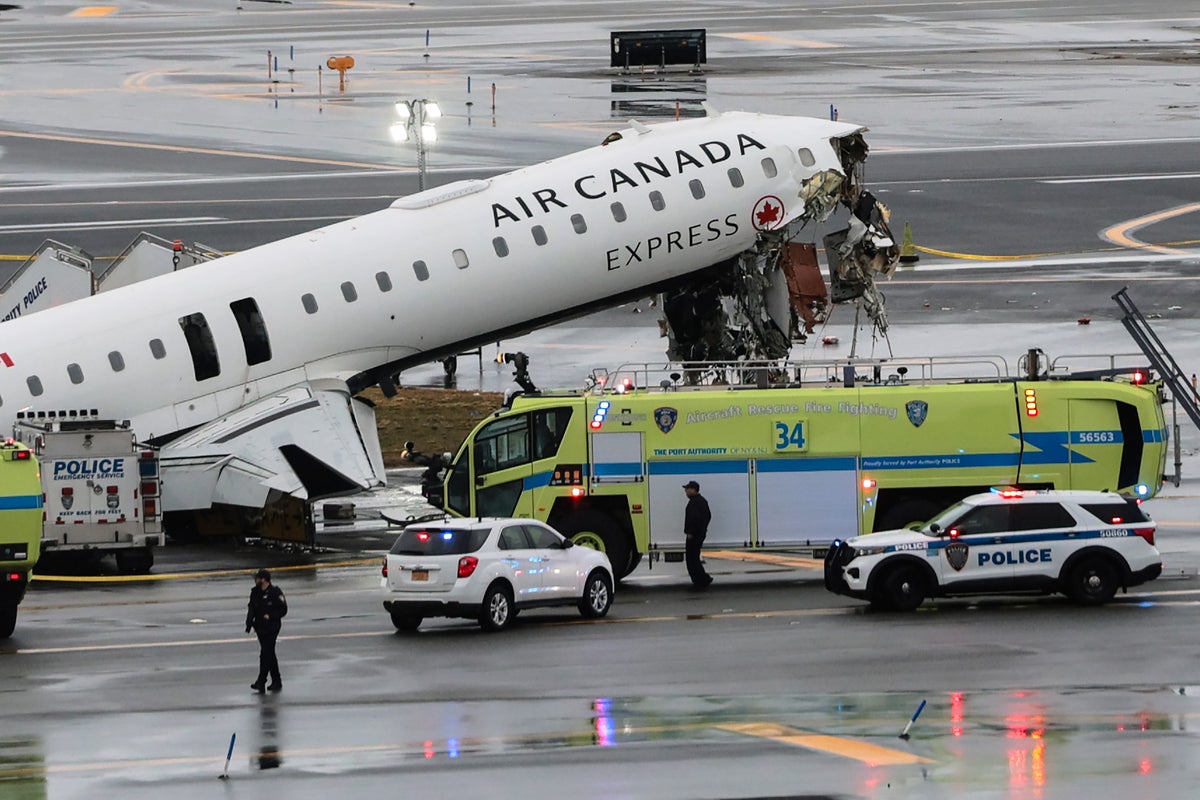
Air Canada’s recent operational and reputational volatility following the LaGuardia incident provides a clinical study in the breakdown of corporate crisis governance. When a Chief Executive Officer is forced to retract a statement regarding a physical asset failure—specifically one involving passenger safety—the failure is rarely a matter of poor "wording." Instead, it represents a systemic rupture between the legal department’s liability shielding and the operational reality of aviation safety protocols. The subsequent calls for resignation are not merely emotional public reactions; they are market-driven responses to a perceived deficit in "Command Integrity," a metric that institutional investors use to gauge a firm’s ability to navigate high-stakes tail risks.
The Triad of Crisis Communication Failure
To understand why the initial statement regarding the LaGuardia crash catalyzed such a severe backlash, we must deconstruct the communication into three distinct failure vectors:
- The Information Asymmetry Gap: Leadership communicated a definitive stance on the cause or nature of the incident before the National Transportation Safety Board (NTSB) or the Transportation Safety Board of Canada (TSB) issued preliminary findings. In aviation, the gap between an event and its official causal analysis is a "period of high volatility" where any corporate assertion acts as a speculative bet against federal investigators.
- Liability-First Logic: The initial statement likely prioritized the mitigation of "Legal Exposure" over "Stakeholder Trust." By attempting to frame the incident in a manner that minimized carrier culpability, the organization inadvertently signaled a lack of transparency. This creates a "Defensiveness Paradox" where the more a company tries to protect its legal flank, the more it exposes its reputational throat.
- The Empathy-Data Mismatch: Aviation is a high-reliability industry where technical precision is required. However, when physical harm or the threat of death is present, the audience—comprising passengers, staff, and regulators—demands a synthesis of technical accuracy and moral accountability. Air Canada’s initial delivery utilized clinical, distancing language that failed to acknowledge the human element of the kinetic event.
The Cost Function of Executive Contradiction
The CEO's apology is more than a social gesture; it is a forced correction of a strategic error that carries quantifiable costs. In the aviation sector, the cost of a mishandled crisis can be modeled as:
$$C_{total} = C_{operational} + C_{regulatory} + C_{reputational_equity}$$
- Operational Costs: These include the immediate grounding of similar airframes, inspection mandates, and the diversion of management's "Cognitive Bandwidth" away from revenue-generating activities to damage control.
- Regulatory Friction: Misleading or premature statements invite heightened scrutiny from the Federal Aviation Administration (FAA). This often results in a "Compliance Tax," where future certifications or route expansions face longer lead times and more rigorous audits.
- Reputational Equity: This is the most difficult to recover. For a legacy carrier like Air Canada, the brand operates on a "Safety Premium." When leadership appears to obfuscate the details of a crash, that premium evaporates, leading to a measurable shift in customer preference toward competitors perceived as more transparent.
Structural Misalignment in Corporate Governance
The demand for resignation following the LaGuardia statement suggests a deeper issue within Air Canada’s board-level oversight. A CEO does not release a high-stakes statement in a vacuum. The failure points toward a breakdown in the "Internal Review Loop."
Usually, a statement of this magnitude passes through:
- General Counsel: To vet for litigation risk.
- Corporate Communications: To vet for brand alignment.
- Safety/Technical Operations: To vet for factual accuracy.
If the resulting output was egregious enough to merit a public apology and resignation calls, we can hypothesize that the General Counsel’s influence overrode the Technical and Communications inputs. This "Legal Capture" of the executive office is a common pathology in distressed corporations. It prioritizes the avoidance of a $50 million settlement over the preservation of a $5 billion brand.
The Mechanism of Modern Public Accountability
The speed of the backlash highlights the "Digital Velocity" of modern aviation news. In the era of real-time flight tracking and social media, the public often has access to raw data (ADS-B broadcasts, cockpit voice recordings, passenger footage) at the same time as the executive suite.
The traditional "Information Gatekeeper" model is dead. When the CEO’s statement contradicted the widely available data from the LaGuardia site, the "Verification Gap" became visible. This gap is where public anger resides. The calls for resignation are a mechanism of the market attempting to "Self-Correct" by removing an individual who is no longer seen as a reliable narrator of the company's reality.
The Limits of the Public Apology
An apology is a "Low-Friction Recovery" tactic. While it may temporarily de-escalate social media sentiment, it does nothing to address the structural issues that led to the initial statement. To regain "Institutional Credibility," Air Canada must move beyond rhetoric and implement a "Transparency Protocol" that includes:
- Deferred Commentary: Adopting a policy of zero speculation until the NTSB issues a "Preliminary Report."
- Direct Technical Briefings: Moving away from filtered PR statements toward briefings led by the Chief Safety Officer (CSO), rather than the CEO or legal team.
- Stakeholder Integration: Engaging with pilot and flight attendant unions to ensure the "Frontline Narrative" matches the "Executive Narrative."
The error at LaGuardia was kinetic; the error in the boardroom was elective. The former is a risk inherent to flight; the latter is a failure of leadership. The survival of the current executive mandate depends on whether the board views this as an isolated "Communications Gaffe" or a fundamental "Competency Deficit."
Institutional investors will now be looking for a shift in "Incentive Structures." If the CEO remains, their performance metrics must be decoupled from short-term stock price and tied explicitly to "Safety Culture Health" and "Regulatory Compliance Scores." Anything less is merely a cosmetic adjustment to a structural crack.
The strategic priority for Air Canada is no longer the LaGuardia incident itself, but the "Audit of Internal Truth." The organization must identify the specific point in the approval chain where the decision to prioritize liability over accuracy was made. Removing that bottleneck is the only way to ensure that the next crisis does not result in a total collapse of executive authority. Air Canada must now operate under a "Hyper-Transparency" mandate, treating every data point regarding the crash as a public record to preempt the inevitable skepticism that follows a retracted executive statement.